
Stöbern
genialokal zum Startbildschirm hinzufügen
Installieren Sie die genialokal App auf Ihrem Startbildschirm für einen schnellen Zugriff und eine komfortable Nutzung.
Installieren Sie die genialokal App auf Ihrem Startbildschirm für einen schnellen Zugriff und eine komfortable Nutzung.
Tippen Sie einfach auf Teilen:
 Und dann auf "Zum Home-Bildschirm [+]".
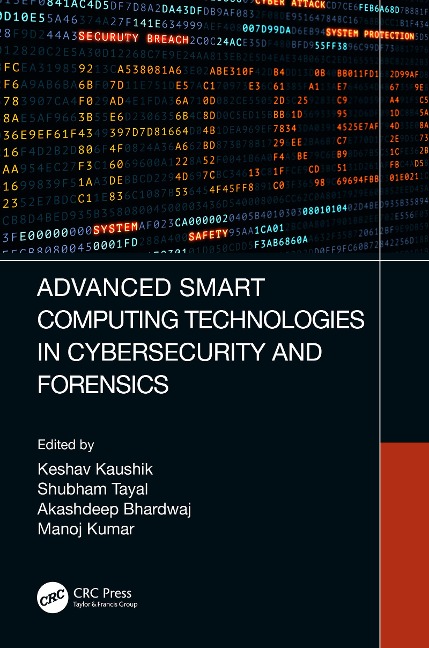
This book addresses the topics related to artificial intelligence, the Internet of Things, blockchain technology, and machine learning. It brings together researchers, developers, practitioners, and users interested in cybersecurity and forensics. The first objective is to learn and understand the need for and impact of advanced cybersecurity and forensics and its implementation with multiple smart computational technologies. This objective answers why and how cybersecurity and forensics have evolved as one of the most promising and widely-accepted technologies globally and has widely-accepted applications. The second objective is to learn how to use advanced cybersecurity and forensics practices to answer computational problems where confidentiality, integrity, and availability are essential aspects to handle and answer. This book is structured in such a way so that the field of study is relevant to each reader's major or interests. It aims to help each reader see the relevance of cybersecurity and forensics to their career or interests. This book intends to encourage researchers to develop novel theories to enrich their scholarly knowledge to achieve sustainable development and foster sustainability. Readers will gain valuable knowledge and insights about smart computing technologies using this exciting book. This book: . Includes detailed applications of cybersecurity and forensics for real-life problems . Addresses the challenges and solutions related to implementing cybersecurity in multiple domains of smart computational technologies . Includes the latest trends and areas of research in cybersecurity and forensics . Offers both quantitative and qualitative assessments of the topics Includes case studies that will be helpful for the researchers Prof. Keshav Kaushik is Assistant Professor in the Department of Systemics, School of Computer Science at the University of Petroleum and Energy Studies, Dehradun, India. Dr. Shubham Tayal is Assistant Professor at SR University, Warangal, India. Dr. Akashdeep Bhardwaj is Professor (Cyber Security & Digital Forensics) at the University of Petroleum & Energy Studies (UPES), Dehradun, India. Dr. Manoj Kumar is Assistant Professor (SG) (SoCS) at the University of Petroleum and Energy Studies, Dehradun, India.
Prof. Keshav Kaushik is Assistant Professor in the Department of Systemics, School of Computer Science at the University of Petroleum and Energy Studies, Dehradun, India. Dr. Shubham Tayal is Assistant Professor at SR University, Warangal. Dr. Akashdeep Bhardwaj is Professor (Cyber Security & Digital Forensics) at the University of Petroleum & Energy Studies (UPES), Dehradun, India. Dr. Manoj Kumar is Assistant Professor (SG) (SoCS) at the University of Petroleum and Energy Studies, Dehradun.
1. Detection of Cross-Site Scripting and Phishing Website Vulnerabilities Using Machine Learning. 2. A Review: Security and Privacy Defensive Techniques for Cyber Security Using Deep Neural Networks (DNNs). 3. DNA-Based Cryptosystem for Connected Objects and IoT Security. 4. A Role of Digital Evidence: Mobile Forensics Data. 5. Analysis of Kernel Vulnerabilities Using Machine Learning. 6. Cyber Threat Exploitation and Growth during COVID-19 Times. 7. An Overview of the Cybersecurity in Smart Cities in the Modern Digital Age. 8. The Fundamentals and Potential for Cyber Security of Machine Learning in the Modern World. 9. Qualitative and Quantitative Evaluation of Encryption Algorithms. 10. Analysis and Investigation of Advanced Malware Forensics. 11. Network Intrusion Detection System Using Naïve Bayes Classification Technique for Anomaly Detection. 12. Data Security Analysis in Mobile Cloud Computing for Cyber Security. 13. A Comprehensive Review of Investigations of Suspects of Cyber Crimes. 14. Fault Analysis Techniques in Lightweight Ciphers for IoT Devices.
Dieses eBook wird im PDF-Format geliefert und ist mit einem Adobe Kopierschutz (DRM) versehen. Sie können dieses eBook mit allen Geräten lesen, die das PDF-Format und den Adobe Kopierschutz (DRM) unterstützen.
Zum Beispiel mit den folgenden Geräten:
• tolino Reader
Laden Sie das eBook direkt über den Reader-Shop auf dem tolino herunter oder übertragen Sie das eBook auf Ihren tolino mit einer kostenlosen Software wie beispielsweise Adobe Digital Editions.
• Sony Reader & andere eBook Reader
Laden Sie das eBook direkt über den Reader-Shop herunter oder übertragen Sie das eBook mit der kostenlosen Software Sony READER FOR PC/Mac oder Adobe Digital Editions auf ein Standard-Lesegeräte mit epub- und Adobe DRM-Unterstützung.
• Tablets & Smartphones
Möchten Sie dieses eBook auf Ihrem Smartphone oder Tablet lesen, finden Sie hier unsere kostenlose Lese-App für iPhone/iPad und Android Smartphone/Tablets.
• PC & Mac
Lesen Sie das eBook direkt nach dem Herunterladen mit einer kostenlosen Lesesoftware, beispielsweise Adobe Digital Editions, Sony READER FOR PC/Mac oder direkt über Ihre eBook-Bibliothek in Ihrem Konto unter „Meine eBooks“ - „online lesen“.
Schalten Sie das eBook mit Ihrer persönlichen Adobe ID auf bis zu sechs Geräten gleichzeitig frei.
Bitte beachten Sie, dass die Kindle-Geräte das Format nicht unterstützen und dieses eBook somit nicht auf Kindle-Geräten lesbar ist.