Und dann auf "Zum Home-Bildschirm [+]".

Stöbern
genialokal zum Startbildschirm hinzufügen
Installieren Sie die genialokal App auf Ihrem Startbildschirm für einen schnellen Zugriff und eine komfortable Nutzung.
Installieren Sie die genialokal App auf Ihrem Startbildschirm für einen schnellen Zugriff und eine komfortable Nutzung.
Ihr gewünschter Artikel ist in 0 Buchhandlungen vorrätig - wählen Sie hier eine Buchhandlung in Ihrer Nähe aus:

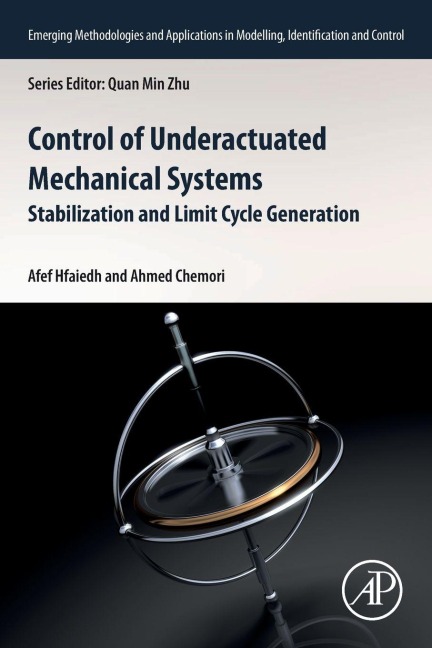
Control of Underactuated Mechanical Systems: Stabilization and Limit Cycle Generation clearly explains stabilization and limit cycle generation in underactuated mechanical systems (UMS),addressing control design challenges and demonstrating concepts through real-time experiments. The book begins with advancements in UMS, introducing key concepts such as stabilization and limit cycle generation, supported by literature examples. It then focuses on the inertia wheel inverted pendulum, presenting a detailed discussion. The second part tackles stabilization, offering various control solutions validated through numerical simulations and real-time experiments. The final part addresses stable limit cycle generation, detailing three proposed control solutions and their validation through different case studies. This book is a valuable resource for PhD and Master students, engineers, researchers, and educators. It provides guidance in robotics and automatic control, utilizing a simplified methodology for controlling underactuated mechanical systems.
Afef Hfaiedh received her Master's degree in Automatic Control, Robotics, and Signal Processing in 2015 and her Ph.D. in Automatic Control in 2021. She is a postdoctoral researcher at RISC-LAB and a part-time professor at the University of Tunis El Manar, specializing in nonlinear control applications in robotics and underactuated mechanical systems.
Part I: General context and case study 1. Introduction 2. The inertia wheel inverted pendulum case study Part II: Control solutions for the stabilisation problem 3. A revisited adaptive sliding mode control scheme 4. Nonlinear RISE feedback control scheme 5. Model reference adaptive IDA-PBC approach Part III: Control solutions for stable limit cycle generation problem 6. Partial feedback linearization and optimization 7. Nonlinear Model Predictive control 8. Dual Model Free control