Und dann auf "Zum Home-Bildschirm [+]".

Stöbern
genialokal zum Startbildschirm hinzufügen
Installieren Sie die genialokal App auf Ihrem Startbildschirm für einen schnellen Zugriff und eine komfortable Nutzung.
Installieren Sie die genialokal App auf Ihrem Startbildschirm für einen schnellen Zugriff und eine komfortable Nutzung.

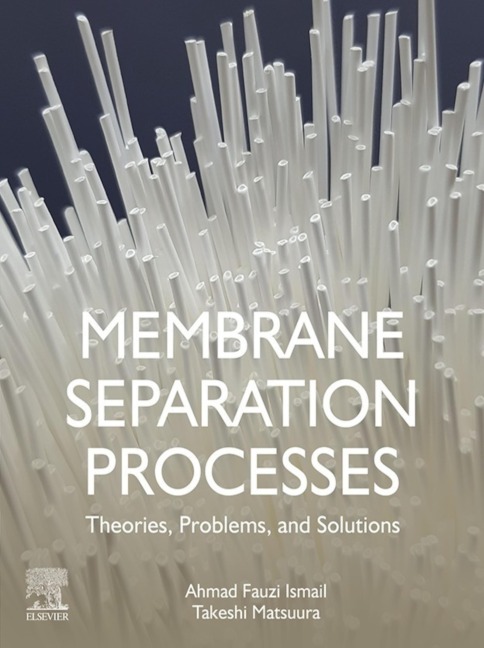
Membrane Separation Processes: Theories, Problems, and Solutions provides graduate and senior undergraduate students and membrane researchers in academia and industry with the fundamental knowledge on the topic by explaining the underlying theory that is indispensable for solving problems that occur in membrane separation processes. All major membrane processes are discussed, and an economic analysis is provided. Separation processes such as RO, UF, MF, RO, PRO and MD are thoroughly discussed. During the last two decades, the scope of the R&D of membrane separation processes has been significantly broadened. Other sections in the book cover membrane contactor and membrane adsorption. In addition, hybrid systems in which two or more membrane systems are combined are now being investigated for large-scale applications.
- Written by renowned experts with extensive experience with industry, education and R&D who have complementary expertise
- In-depth coverage of the most important conventional and emerging membrane processes
- Provides fundamental membrane theories for solving problems in separation processes without using complicated software
Professor Ahmad Fauzi bin Ismail is the Founding Director of the Advanced Membrane Technology Research Centre (AMTEC), UTM. He earned his Ph.D. in Chemical and Process Engineering from the University of Strathclyde, Glasgow, United Kingdom, under the Commonwealth Academic Staff Scholarship. Prof. Fauzi is the recipient of more than 200 prestigious national and international awards. Among his most notable accolades are the Mustafa Prize Award / (OIC/Muslim Nobel Prize) 2023 (the first Malaysian to receive the Award), The World Academy of Sciences (TWAS) Prize in Engineering Sciences 2019, Merdeka Award 2014, Malaysian Toray Science & Technology Foundation Award 2013, and three consecutive Malaysia's Rising Star Awards (2016-2018), Malaysian Young Scientist Award, 2001. He also received the ASEAN Young Scientist and Technologist Award 2000 and the Elsevier Groundbreaking Research Award, 2025.Professor Takeshi Matsuura is a senior academic with a career spanning more than 50 years and has held several distinguished posts in many countries including the USA, Canada, Japan, Germany and Singapore. Most recently he joined the University of Ottawa (1992) as the British Gas/NSERC Industrial Research Chair. He served as professor of the Department of Chemical Engineering and the director of the Industrial Membrane Research Institute (IMRI) until he retired in 2002 and was appointed as professor emeritus in 2003. He received the Research Award of International Desalination and Environmental Association in 1983. He is a fellow of the Chemical Institute of Canada and a member of the North American Membrane Society. He has delivered plethora of invited lectures and presentations to many of the world's foremost scientific events and conferences. He has published over 400 papers in refereed journals, authored and co-authored 6 books and edited 8 books. A special symposium was held at the Eighth Annual Meeting of the North American Membrane Society to honour Prof. Matsuura (together with Dr. S. Sourirajan) for life-long contributions to membrane research and a similarly the International Conference on Membrane Science and Technology 2013 was held in his honour. In addition, he has received the George S. Glinski Award for Excellence in Research and the occasion of his 75th birthday was marked with a special edition of the journal Desalination.
1. Membrane preparation by phase inversion2. Reverse osmosis3. Nanofiltration4. Ultrafiltration5. Microfiltration6. Gas separation7. Mixed matrix membrane8. Vapor separation9. Pervaporation10. Membrane distillation11. Membrane contactor12. Membrane extraction13. Membrane adsorption14. Forward osmosis15. Pressure retarded osmosis16. Module calculation17. System calculation18. Economic analysis