
Stöbern
genialokal zum Startbildschirm hinzufügen
Installieren Sie die genialokal App auf Ihrem Startbildschirm für einen schnellen Zugriff und eine komfortable Nutzung.
Installieren Sie die genialokal App auf Ihrem Startbildschirm für einen schnellen Zugriff und eine komfortable Nutzung.
Tippen Sie einfach auf Teilen:
 Und dann auf "Zum Home-Bildschirm [+]".
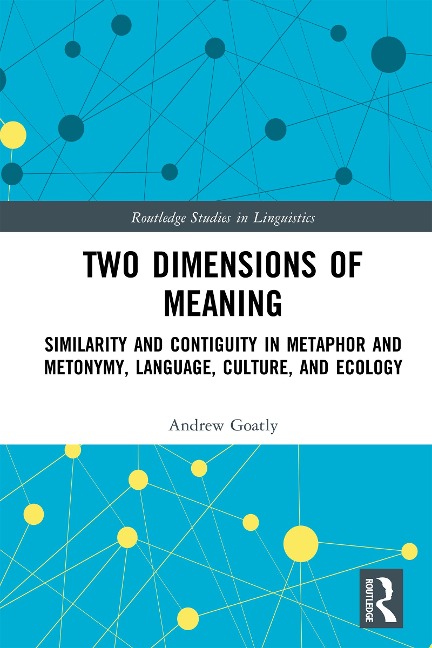
The book takes as its point of departure the notion that similarity and contiguity are fundamental to meaning. It shows how they manifest in oral, literate, print, and internet cultures, in language acquisition, pragmatics, dialogism, classification, the semantics of grammar, literature, and, most centrally, metaphor and metonymy. The book situates these reflections on similarity and contiguity in the interplay of language, cognition, culture, and ideology, and within broader debates around such issues as capitalism, biodiversity, and human control over nature. Positing that while similarity-focused systems can be reductive, and have therefore been contested in social science, philosophy, and poetry, and contiguity-based ones might disregard useful statistical and scientific evidence, Andrew Goatly argues for the need for humans to entertain diverse metaphors, models, and languages as ways of understanding and acting on our world. The volume also considers the cognitive connections between the similarity-contiguity duality and the noun-verb distinction. This innovative volume will appeal to scholars involved in wider debates on meaning, within the fields of cognitive semantics, pragmatics, metaphor and metonymy theory, critical discourse analysis, and the philosophy of language. Equally, the motivated and intelligent general reader, interested in language, philosophy, culture, and ecology, should find the later chapters of the book fascinating, and the earlier technical chapters accessible.
Andrew Goatly has had a long academic career in the UK, Rwanda, Thailand, Singapore, and Hong Kong, where he remains an Honorary Professor at Lingnan University. His books include The Language of Metaphors (Routledge 1997, 2011), Critical Reading and Writing in the Digital Age (Routledge 2000, 2016), Washing the Brain (2007), Explorations in Stylistics (2008), and Meaning and Humour (2012). He is now semi-retired in Canterbury, Kent, UK, an active member of the Green Party, and a keen amateur singer.
0. Introduction: the similarity/contiguity distinction and an outline of the book. 1. The two dimensions: similarity and contiguity in metaphor and metonymy 2. The prevalence of metaphor and metonymy and their interplay 3. The Development of Language in two Dimensions of Meaning. 4. Corpus linguistics, collocation and lexical priming 5. The syntagmatic contiguity of metonymy in grammar and narrative. 6. Nouns and noun phrases: the similarity dimension, classification, quantification and commodification. 7. Nouns and the similarity mode: classification, taxonomies, paradigms and measurement in science and mathematics. 8. Resisting noun-based classification and scientific universals in sociology, linguistics, philosophy and poetry 9. Process and interrelatedness in quantum physics and Blackfoot, a language without nouns. 10. Feyerabend and Conquest of abundance: abstraction versus the richness of being 11. Conclusion (1): Evaluating the two dimensions 12. Conclusion (2): interplay, synthesis, and the need for diverse metaphors Appendix1. Metaphor themes associated with the canonical event schema: CHANGE IS MOVEMENT, ACTIVITY IS MOVEMENT FORWARDS etc. Appendix 2. Lexical details of the EMOTION IS SENSE IMPRESSION nexus.
Dieses eBook wird im PDF-Format geliefert und ist mit einem Adobe Kopierschutz (DRM) versehen. Sie können dieses eBook mit allen Geräten lesen, die das PDF-Format und den Adobe Kopierschutz (DRM) unterstützen.
Zum Beispiel mit den folgenden Geräten:
• tolino Reader
Laden Sie das eBook direkt über den Reader-Shop auf dem tolino herunter oder übertragen Sie das eBook auf Ihren tolino mit einer kostenlosen Software wie beispielsweise Adobe Digital Editions.
• Sony Reader & andere eBook Reader
Laden Sie das eBook direkt über den Reader-Shop herunter oder übertragen Sie das eBook mit der kostenlosen Software Sony READER FOR PC/Mac oder Adobe Digital Editions auf ein Standard-Lesegeräte mit epub- und Adobe DRM-Unterstützung.
• Tablets & Smartphones
Möchten Sie dieses eBook auf Ihrem Smartphone oder Tablet lesen, finden Sie hier unsere kostenlose Lese-App für iPhone/iPad und Android Smartphone/Tablets.
• PC & Mac
Lesen Sie das eBook direkt nach dem Herunterladen mit einer kostenlosen Lesesoftware, beispielsweise Adobe Digital Editions, Sony READER FOR PC/Mac oder direkt über Ihre eBook-Bibliothek in Ihrem Konto unter „Meine eBooks“ - „online lesen“.
Schalten Sie das eBook mit Ihrer persönlichen Adobe ID auf bis zu sechs Geräten gleichzeitig frei.
Bitte beachten Sie, dass die Kindle-Geräte das Format nicht unterstützen und dieses eBook somit nicht auf Kindle-Geräten lesbar ist.