Und dann auf "Zum Home-Bildschirm [+]".

Stöbern
genialokal zum Startbildschirm hinzufügen
Installieren Sie die genialokal App auf Ihrem Startbildschirm für einen schnellen Zugriff und eine komfortable Nutzung.
Installieren Sie die genialokal App auf Ihrem Startbildschirm für einen schnellen Zugriff und eine komfortable Nutzung.
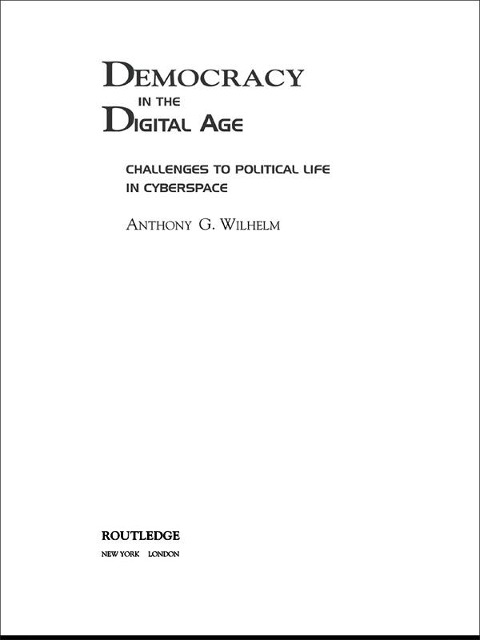
Democracy in the Digital Age is a fascinating philosophical exploration of how the emerging information and communication technologies are impacting political participation in the United States. Rather than being the antidote to democratic ills, the political conversations occurring online are neither inclusive nor deliberative, suggesting that new technologies, as currently designed and used, are as much threats to progress as they are vehicles of progress. Wilhelm finds that there is often an appearance of progress, but negligible advancement of the human condition. He discusses the four features of digitally-mediated political life (resources, inclusiveness, deliberation, and design) and demonstrates the need for a strong public policy.
Anthony G. Wilhelm is Director of Information and Communication Technology Research at the Tomás Rivera Policy Insitute, a national think tank that examines issues of concern to the Hispanic community. He also served as the Teledemocracy Project Coordinator at Claremont Graduate University's School for Politics and Economics.
Introduction 1. Cyberdemocracy's Troubled and Frothy Surface Neofuturists, Dystopians, and Technorealists Research on the Democratic Potential of New Communications Technologies Beyond the Mere Smoke of Opinion 2. Shaping Virtual Civic Spaces Antecedent Resources and the Threshold of Political Functioning Inclusiveness in Online Public Life Deliberation and Light-Speed Telecommunications Technologies Designing a Democratic Future 3. Resource Requirements of Digitally Mediated Political Life Toward a Resource Model of Telecommunications Access Data Methods Thic Description of Teletechnology Access and Use Noneconomic Barriers The Causal Priority of Family and Education 4. Immune to Progress: Reconceptualizing America's Information and Telecommunications Underclass A Tale of Two Cities Expanding the Definition of Information Poverty: A Periphery-Center Model Data and Methods A New Classification of Information and Technology Poverty 5. Virtual Sounding Boards: How Deliberative is Online Political Discussion? Exploratory Questions Why Content Analysis? Content Categories The Vast Cyberwasteland? Irrigating the Wasteland 6. Designer Democracy Becoming Digital: The Prospects for Home-Based Cyberdemocracy Bypassing Poor Neighborhoods, Communities of Color, and Rural America Public-Access Workstations and Community Building Opening the Space of Flows 7. Catching the Red Queen: Public-Policy Rennovations The Difference Principle Toward Ubiquitous Deployment of Advanced Services Enhancing Deliberation in Online Political Forums Political Multicasting: An Enduring Public Trusteeship 8. Conclusion: Media Campaigns and the New International Appendix A1: Logistic Regression Analysis of Home Computer Ownership Appendix A2: Logistic Regression Analysis of Home Modem Ownership Appendix A3: Logistic Regression Analysis of Digitally Mediated Political Engagement Appendix B: List of (Self-Identified) Political Usenet and AOL Forums References Index
Dieses eBook wird im PDF-Format geliefert und ist mit einem Adobe Kopierschutz (DRM) versehen. Sie können dieses eBook mit allen Geräten lesen, die das PDF-Format und den Adobe Kopierschutz (DRM) unterstützen.
Zum Beispiel mit den folgenden Geräten:
• tolino Reader
Laden Sie das eBook direkt über den Reader-Shop auf dem tolino herunter oder übertragen Sie das eBook auf Ihren tolino mit einer kostenlosen Software wie beispielsweise Adobe Digital Editions.
• Sony Reader & andere eBook Reader
Laden Sie das eBook direkt über den Reader-Shop herunter oder übertragen Sie das eBook mit der kostenlosen Software Sony READER FOR PC/Mac oder Adobe Digital Editions auf ein Standard-Lesegeräte mit epub- und Adobe DRM-Unterstützung.
• Tablets & Smartphones
Möchten Sie dieses eBook auf Ihrem Smartphone oder Tablet lesen, finden Sie hier unsere kostenlose Lese-App für iPhone/iPad und Android Smartphone/Tablets.
• PC & Mac
Lesen Sie das eBook direkt nach dem Herunterladen mit einer kostenlosen Lesesoftware, beispielsweise Adobe Digital Editions, Sony READER FOR PC/Mac oder direkt über Ihre eBook-Bibliothek in Ihrem Konto unter „Meine eBooks“ - „online lesen“.
Schalten Sie das eBook mit Ihrer persönlichen Adobe ID auf bis zu sechs Geräten gleichzeitig frei.
Bitte beachten Sie, dass die Kindle-Geräte das Format nicht unterstützen und dieses eBook somit nicht auf Kindle-Geräten lesbar ist.