
Stöbern
genialokal zum Startbildschirm hinzufügen
Installieren Sie die genialokal App auf Ihrem Startbildschirm für einen schnellen Zugriff und eine komfortable Nutzung.
Installieren Sie die genialokal App auf Ihrem Startbildschirm für einen schnellen Zugriff und eine komfortable Nutzung.
Tippen Sie einfach auf Teilen:
 Und dann auf "Zum Home-Bildschirm [+]".
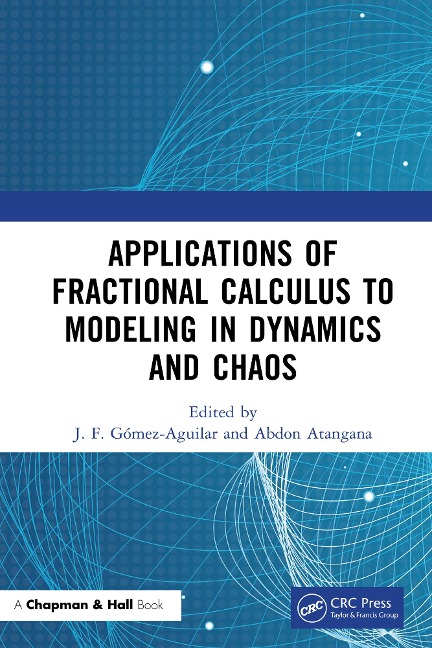
Applications of Fractional Calculus to Modeling in Dynamics and Chaos aims to present novel developments, trends, and applications of fractional-order derivatives with power law and Mittag-Leffler kernel in the areas of chemistry, mechanics, chaos, epidemiology, fluid mechanics, modeling, and engineering. Non-singular and non-local fractional-order derivatives have been applied in different chapters to describe complex problems. The book offers theory and practical applications for the solutions of real-life problems and will be of interest to graduate-level students, educators, researchers, and scientists interested in mathematical modeling and its diverse applications. Features - Discusses real-world problems, theory, and applications - Covers new developments and advances in the various areas of nonlinear dynamics, signal processing, and chaos - Suitable to teach master's and/or PhD-level graduate students, and can be used by researchers, from any field of the social, health, and physical sciences
J. F. Gómez-Aguilar received the B.S. degree and M. Eng., in electrical engineering from Guanajuato University in 2005 and 2007, respectively, and Ph.D. degree in Physical from DCI, Guanajuato University in 2012. He is member of the Science and Technology National Council Engineering and Industry Recognized Referees Record (CONACYT-RCEA MEXICO). He is currently a full research professor at the Electronics Engineering Department of the National Research and Technological Development Center (CENIDET), Cuernavaca, Mor., Mexico. His scientific interests are fractional calculus, image and signal processing, control, electrochemistry, bioelectromagnetism and biomedical applications. He is serving as guest editor of some special issues, and also reviewer of more than 40 international accredited journals. He has presented and participated in more than 10 international conferences, also is author of more than 100 papers published in international journals with strict revision. His research interests are nonlinear dynamics, control theory, computational complexity, fractional dynamics, iterative methods, integral transforms and applications, signal processing, biomathematics, mathematical physics and variable order fractional calculus and applications. Abdon Atangana is a leading applied Mathematics professor at the UFS. He obtained his honours and master's degrees from the Department of Applied Mathematics at the UFS with distinction. He obtained his PhD degree in applied mathematics from the Institute for Groundwater Studies. He serves as an editor for 18 international journals and is also a reviewer of more than 200 international accredited journals and has been awarded the world champion of peer review twice, in 2016 and 2017. He also serves on more than 20 editorial boards of applied mathematics and mathematics. He has presented and participated in more than 20 international conferences and has been invited as plenary speaker in more than 10 international conferences of applied mathematics and mathematics. His research interests are methods and applications of partial and ordinary differential equations, fractional differential equations, perturbation methods, asymptotic methods, iterative methods, and groundwater modelling. Prof Atangana is the founder of the fractional calculus with non-local and non-singular kernels popular in applied mathematics today. Since 2013 he has published in 165 international accredited journals of applied mathematics, applied physics, geo-hydrology and bio-mathematics. He is also the single author of two books in Academic Press Elsevier.
1. Chaos and Multiple Attractors in Fractional Financial Model. 2. Time-Fractional Optimal Control for Constrained Systems Involving Mittag-Leffler Non-Singular Kernel. 3. Signal Reconstruction by using State Observers for Fractional-Order Chaotic Systems with Application to Secure Communications. 4. On Fractal Structure and co-existing Hidden Attractors in Models with Mittag-Leffler Kernel. 5. Compound Structure with a Fractal Type Representation for Fractional Models. 6. A Behavior of Shallow Water Wave under Mittag-Leffler Law. 7. On Solutions of Fractional Klein-Gordon Equations. 8. Reproducing Kernel Method for Solutions of Fractal Fractional Differential Equations. 9. Stability of Fractional Nonlinear Systems with Mittag-Leffler Kernel and Design of State Observers. 10. Coexistence of Chaotic Attractors in a Four-Dimensional Memristor-based Chaotic Non-Local System. Analysis and FPGA Implementation. 11. New Chaotic Attractor Captured with Fractal-Fractional Differential and Integral Operators. 12. New Results in Modeling Herd Behavior in Ecological Interaction. 13. Double Integration for the Fractional Advection-Dispersion Equation with Non-Singular Derivative. 14. Numerical Methods for Solving Systems of Atangana-Baleanu Fractional Differential Equations. 15. Use of Real Data Application for Analysis of the Measles Disease under Caputo-Fabrizio-Caputo Operator. 16. Crank-Nicolson Quasi Wavelet Method for the Numerical Solution of Variable Order Time Space RIESZ Fractional Reaction-Diffusion Equation. 17. Fractional Optimal Control Model for Nutrient-Phytoplankton-Zooplankton. 18. Comparative Numerical Results Considering Fractional Derivative and Memory Dependent Derivative in Modeling RL and RC Electrical Circuits. 19. Solution of Fractional Langevin Equation with Exponential Kernel and its Anomalous Relaxation Function. 20. A Mathematical Model on Prostitution and Drug (Alcohol) Misuse. The Menacing Combination with Exponential Law Optimal Control. 21. Another Aspect of Fractional Langevin Motion Driven by Fractional Gaussian Noise involving Caputo-Fabrizio derivative
Dieses eBook wird im PDF-Format geliefert und ist mit einem Adobe Kopierschutz (DRM) versehen. Sie können dieses eBook mit allen Geräten lesen, die das PDF-Format und den Adobe Kopierschutz (DRM) unterstützen.
Zum Beispiel mit den folgenden Geräten:
• tolino Reader
Laden Sie das eBook direkt über den Reader-Shop auf dem tolino herunter oder übertragen Sie das eBook auf Ihren tolino mit einer kostenlosen Software wie beispielsweise Adobe Digital Editions.
• Sony Reader & andere eBook Reader
Laden Sie das eBook direkt über den Reader-Shop herunter oder übertragen Sie das eBook mit der kostenlosen Software Sony READER FOR PC/Mac oder Adobe Digital Editions auf ein Standard-Lesegeräte mit epub- und Adobe DRM-Unterstützung.
• Tablets & Smartphones
Möchten Sie dieses eBook auf Ihrem Smartphone oder Tablet lesen, finden Sie hier unsere kostenlose Lese-App für iPhone/iPad und Android Smartphone/Tablets.
• PC & Mac
Lesen Sie das eBook direkt nach dem Herunterladen mit einer kostenlosen Lesesoftware, beispielsweise Adobe Digital Editions, Sony READER FOR PC/Mac oder direkt über Ihre eBook-Bibliothek in Ihrem Konto unter „Meine eBooks“ - „online lesen“.
Schalten Sie das eBook mit Ihrer persönlichen Adobe ID auf bis zu sechs Geräten gleichzeitig frei.
Bitte beachten Sie, dass die Kindle-Geräte das Format nicht unterstützen und dieses eBook somit nicht auf Kindle-Geräten lesbar ist.