Und dann auf "Zum Home-Bildschirm [+]".

Stöbern
genialokal zum Startbildschirm hinzufügen
Installieren Sie die genialokal App auf Ihrem Startbildschirm für einen schnellen Zugriff und eine komfortable Nutzung.
Installieren Sie die genialokal App auf Ihrem Startbildschirm für einen schnellen Zugriff und eine komfortable Nutzung.
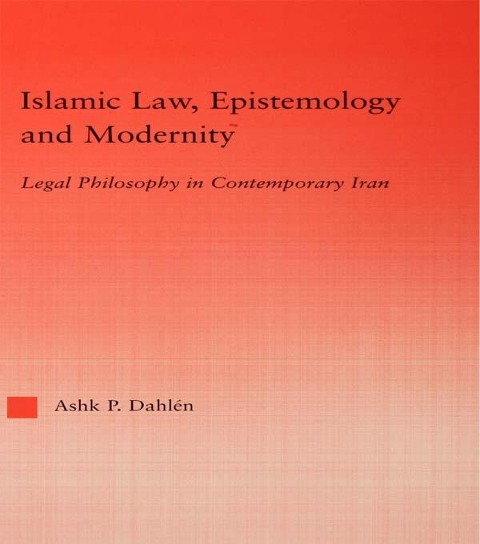
This study analyses the major intellectual positions in the philosophical debate on Islamic law that is occurring in contemporary Iran. As the characteristic features of traditional epistemic considerations have a direct bearing on the modern development of Islamic legal thought, the contemporary positions are initially set against the established normative repertory of Islamic tradition. It is within this broad examination of a living legacy of interpretation that the context for the concretizations of traditional as well as modern Islamic learning, are enclosed.
Ashk Dahlen
Preface List of transliteration 1. Introduction A. Purpose and nature of the study B. Theory and methodology C. Previous research D. Introductionary remarks on analytical concepts E. Modernity , postmodernism and secularism 2. The Nature of Islamic law A. An Islamic legal system? Law, jurisprudence and ethics B. Law and spirituality: Shi'i esoterism 3. Categories of traditional Islamic epistemology A. Knowledge and science B. The 'historical-empirical' epistemic scheme C. The 'theological', 'philosophical' and 'mystical' epistemic schemes D. The 'juristic-rational' epistemic scheme 4. Shi'i legal dogmatics A.Usul al-fiqh (legal theory) B. The constant sources of law: The Qur'an, sunnat and imja (consensus) C. The non-constant source of law: aql (reason) D. Ijtihad (independent reasoning) and taqlid (emulation) E. Hauzah-yi ilmiyah ('precint of knowledge') F. Hermeneutical principles G. Interpretative pluralism and ikhtilaf (divergence) 5. Islamic traditionalism and Islamice modernism A. An Introduction to Islamic traditionalism B. The Islamic traditionalist position of Abdullah Jawadi-Amuli C. An Introduction to Islamic modernism D. The Islamic modernist position of Muhammad Mujtahid-Shabistari 6. Surush on the nature of Islamic law A. The Biography of Abd al-Karim Surush B. Style of communication C. Philosophical foundation: Critical realism D. Modernity and the West E. Religion F. Jurisprudence G. Ijtihad H. Hauzah 7. Surush's theory of contraction and expansion of religious knowledge A. Its principal objectives B. History: The Stage of natural man C. Critical rationality: Self-determining and liberated D. Science: Falsification and corroboration E. Religous epistemology: Divine absolute or provisional conjecture? F. Epistemological ambiguities: A priori and a posteriori G. Epistemic relativism or epistemological relativism H. Hermeneutics: There is nothing beyond the text I. Divergent interpretations: The Problem of truth and probability Conclusions Bibliography Tables: I. Contemporary positions on Islamic law II. The textual corpus of Abd al-Karim Surush
Dieses eBook wird im PDF-Format geliefert und ist mit einem Adobe Kopierschutz (DRM) versehen. Sie können dieses eBook mit allen Geräten lesen, die das PDF-Format und den Adobe Kopierschutz (DRM) unterstützen.
Zum Beispiel mit den folgenden Geräten:
• tolino Reader
Laden Sie das eBook direkt über den Reader-Shop auf dem tolino herunter oder übertragen Sie das eBook auf Ihren tolino mit einer kostenlosen Software wie beispielsweise Adobe Digital Editions.
• Sony Reader & andere eBook Reader
Laden Sie das eBook direkt über den Reader-Shop herunter oder übertragen Sie das eBook mit der kostenlosen Software Sony READER FOR PC/Mac oder Adobe Digital Editions auf ein Standard-Lesegeräte mit epub- und Adobe DRM-Unterstützung.
• Tablets & Smartphones
Möchten Sie dieses eBook auf Ihrem Smartphone oder Tablet lesen, finden Sie hier unsere kostenlose Lese-App für iPhone/iPad und Android Smartphone/Tablets.
• PC & Mac
Lesen Sie das eBook direkt nach dem Herunterladen mit einer kostenlosen Lesesoftware, beispielsweise Adobe Digital Editions, Sony READER FOR PC/Mac oder direkt über Ihre eBook-Bibliothek in Ihrem Konto unter „Meine eBooks“ - „online lesen“.
Schalten Sie das eBook mit Ihrer persönlichen Adobe ID auf bis zu sechs Geräten gleichzeitig frei.
Bitte beachten Sie, dass die Kindle-Geräte das Format nicht unterstützen und dieses eBook somit nicht auf Kindle-Geräten lesbar ist.