
Stöbern
genialokal zum Startbildschirm hinzufügen
Installieren Sie die genialokal App auf Ihrem Startbildschirm für einen schnellen Zugriff und eine komfortable Nutzung.
Installieren Sie die genialokal App auf Ihrem Startbildschirm für einen schnellen Zugriff und eine komfortable Nutzung.
Tippen Sie einfach auf Teilen:
 Und dann auf "Zum Home-Bildschirm [+]".
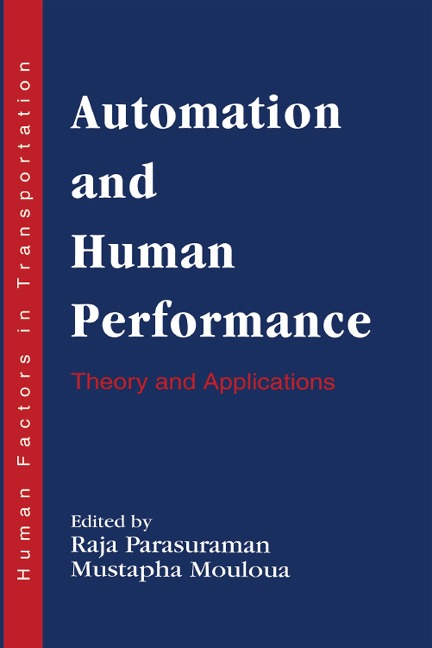
There is perhaps no facet of modern society where the influence of computer automation has not been felt. Flight management systems for pilots, diagnostic and surgical aids for physicians, navigational displays for drivers, and decision-aiding systems for air-traffic controllers, represent only a few of the numerous domains in which powerful new automation technologies have been introduced. The benefits that have been reaped from this technological revolution have been many. At the same time, automation has not always worked as planned by designers, and many problems have arisen--from minor inefficiencies of operation to large-scale, catastrophic accidents. Understanding how humans interact with automation is vital for the successful design of new automated systems that are both safe and efficient. The influence of automation technology on human performance has often been investigated in a fragmentary, isolated manner, with investigators conducting disconnected studies in different domains. There has been little contact between these endeavors, although principles gleaned from one domain may have implications for another. Also, with a few exceptions, the research has tended to be empirical and only theory-driven. In recent years, however, various groups of investigators have begun to examine human performance in automated systems in general and to develop theories of human interaction with automation technology. This book presents the current theories and assesses the impact of automation on different aspects of human performance. Both basic and applied research is presented to highlight the general principles of human-computer interaction in several domains where automation technologies are widely implemented. The major premise is that a broad-based, theory-driven approach will have significant implications for the effective design of both current and future automation technologies. This volume will be of considerable value to researchers in human
Parasuraman, Raja; Mouloua, Mustapha
Contents: B.H. Kantowitz, Series Foreword. Foreword. Preface. Part I:Theories and Major Concepts.D.D. Woods, Decomposing Automation: Apparent Simplicity, Real Complexity. V. Riley, Operator Reliance on Automation: Theory and Data. M.W. Scerbo, Theoretical Perspectives on Adaptive Automation. J.M. Flach, K.B. Bennett, A Theoretical Framework for Representational Design. Part II:Assessment of Human Performance in Automated Systems.R. Parasuraman, M. Mouloua, R. Molloy, B. Hilburn, Monitoring of Automated Systems. B.H. Kantowitz, J.L. Campbell, Pilot Workload and Flightdeck Automation. A.F. Kramer, L.J. Trejo, D.G. Humphrey, Psychophysiological Measures of Workload: Potential Applications to Adaptively Automated Systems. M.R. Endsley, Automation and Situation Awareness. J.S. Warm, W.N. Dember, P.A. Hancock, Vigilance and Workload in Automated Systems. K.L. Mosier, L.J. Skitka, Human Decision Makers and Automated Decision Aids: Made for Each Other? B.G. Coury, R.D. Semmel, Supervisory Control and the Design of Intelligent User Interfaces. C.A. Bowers, R.L. Oser, E. Salas, J.A. Cannon-Bowers, Team Performance in Automated Systems. Part III:Applications.N.B. Sarter, Cockpit Automation: From Quantity and Quality, From Individual Pilot to Multiple Agents. W.H. Rogers, P.C. Schutte, K.A. Latorella, Fault Management in Aviation Systems. V.D. Hopkin, J.A. Wise, Human Factors in Air Traffic System Automation. P.A. Hancock, R. Parasuraman, E.A. Byrne, Driver-Centered Issues in Advanced Automation for Motor Vehicles. J.D. Lee, T.F. Sanquist, Maritime Automation. S. Guerlain, P.J. Smith, J.W. Smith, S. Rudmann, J. Heintz Obradovich, P. Strohm, Decision Support in Medical Systems. C.G. Drury, Automation in Quality Control and Maintenance. N. Meshkati, Organizational and Safety Factors in Autom
Dieses eBook wird im PDF-Format geliefert und ist mit einem Adobe Kopierschutz (DRM) versehen. Sie können dieses eBook mit allen Geräten lesen, die das PDF-Format und den Adobe Kopierschutz (DRM) unterstützen.
Zum Beispiel mit den folgenden Geräten:
• tolino Reader
Laden Sie das eBook direkt über den Reader-Shop auf dem tolino herunter oder übertragen Sie das eBook auf Ihren tolino mit einer kostenlosen Software wie beispielsweise Adobe Digital Editions.
• Sony Reader & andere eBook Reader
Laden Sie das eBook direkt über den Reader-Shop herunter oder übertragen Sie das eBook mit der kostenlosen Software Sony READER FOR PC/Mac oder Adobe Digital Editions auf ein Standard-Lesegeräte mit epub- und Adobe DRM-Unterstützung.
• Tablets & Smartphones
Möchten Sie dieses eBook auf Ihrem Smartphone oder Tablet lesen, finden Sie hier unsere kostenlose Lese-App für iPhone/iPad und Android Smartphone/Tablets.
• PC & Mac
Lesen Sie das eBook direkt nach dem Herunterladen mit einer kostenlosen Lesesoftware, beispielsweise Adobe Digital Editions, Sony READER FOR PC/Mac oder direkt über Ihre eBook-Bibliothek in Ihrem Konto unter „Meine eBooks“ - „online lesen“.
Schalten Sie das eBook mit Ihrer persönlichen Adobe ID auf bis zu sechs Geräten gleichzeitig frei.
Bitte beachten Sie, dass die Kindle-Geräte das Format nicht unterstützen und dieses eBook somit nicht auf Kindle-Geräten lesbar ist.