
Stöbern
genialokal zum Startbildschirm hinzufügen
Installieren Sie die genialokal App auf Ihrem Startbildschirm für einen schnellen Zugriff und eine komfortable Nutzung.
Installieren Sie die genialokal App auf Ihrem Startbildschirm für einen schnellen Zugriff und eine komfortable Nutzung.
Tippen Sie einfach auf Teilen:
 Und dann auf "Zum Home-Bildschirm [+]".

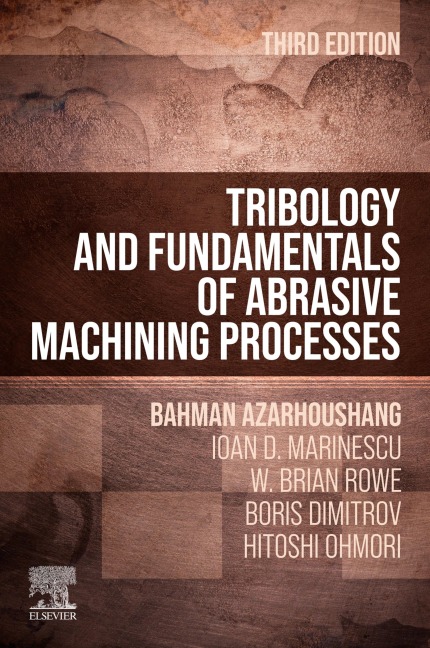
This new edition draws upon the fundamentals of abrasive machining processes and the science of tribology to understand, predict, and improve abrasive machining processes. Each of the main elements of the abrasive machining system is looked at alongside the tribological factors that control the efficiency and quality of the processes described. The new edition has been updated to include a variety of industrial applications. Grinding and conditioning of grinding tools are dealt with in particular detail, and solutions are proposed for many of the most commonly experienced industrial problems, such as poor accuracy, poor surface quality, rapid tool wear, vibrations, workpiece burn, and high process costs. The entire book has been rewritten and restructured, with ten completely new chapters. Other new features include:
- Extensive explanations of the main abrasive machining processes such as grinding (including reciprocating and creep-feed grinding, high-speed high-efficiency deep grinding, external and internal cylindrical grinding, and centerless grinding), honing, superfinishing, lapping, polishing, and finishing
- Discussions of the new classes of abrasives, abrasive tools, and bonding materials
- New case studies and troubleshooting on the most common grinding practices
- New coverage on grinding tool conditioning, mechanical dressing, and nonmechanical dressing processes
- Detailed explanations of the effects of process input parameters (such as cutting parameters, workpiece material and geometry, and abrasive tools) on process characteristics, workpiece quality, tool wear, and process parameters (such as cutting forces and temperature as well as achievable material removal rate)
- Updated topics regarding process fluids for abrasive machining and fluid delivery
Prof. Bahman Azarhoushang earned his Ph.D. in Mechanical Engineering from the University of Stuttgart in 2011. Since 2013, he has been a professor at Furtwangen University and Director of the KSF-Institute for Advanced Manufacturing. Alongside his academic career, he has extensive industrial experience as an advisor to manufacturing companies, optimizing grinding and precision manufacturing processes for more than 1,200 companies worldwide. His work combines industrial solutions with advanced manufacturing research. Professor Azarhoushang has published over 350 scientific papers, delivered numerous international keynote lectures, and serves as a member of the German Council of Science and Humanities and as an editor for several international journals.Ioan D. Marinescu is Professor and Director of the Precision Micromachining Center at The University of Toledo, Ohio, USA, and CEO of Advanced Manufacturing Solutions, LLC. His research interests include manufacturing processes, grinding, tribology, advanced materials, and machining of brittle materials.W. Brian Rowe is Consulting Director and Emeritus Professor of Mechanical Engineering at Liverpool John Moores University, Liverpool, UK. He is also former Director of the Advanced Manufacturing Technology and Tribology Research Laboratory. Professor Rowe is a widely respected researcher in the fields of tribology and grinding. He has authored many books on grinding and grinding machine technology, also on bearing analysis and design.Boris Dimitrov is a Consulting Engineer in mechanics and chemistry, former Chief Scientist of the Romanian Research Institute of Applied Mechanics, and a former member of the Romanian Institute for Precision Mechanics in Bucharest.Hitoshi Ohmori is Chief Scientist at the Materials Fabrication Laboratory, RIKEN, Wak-, Saitama, Japan.
Part One: Science of abrasive machining and tribology (introduction)1. AbrasivesBahman Azarhoushang2. Abrasive toolsBahman Azarhoushang3. Abrasive machining processesBahman Azarhoushang4. Tribosystems of abrasive machining processesAmir Daneshi and Bahman Azarhoushang Part Two: Principles of abrasive machining processes5. Kinematics of bonded abrasive machining processesAli Zahedi and Bahman Azarhoushang6. Material removal mechanisms of bonded abrasive machining (forces, friction, and energy)Bahman Azarhoushang and Mohammadali Kadivar7. Contact mechanicsBahman Azarhoushang and Ali Zahedi8. Grinding wheel macrodesign and microtopographyBahman Azarhoushang9. Grinding tool conditioningBahman Azarhoushang and Heike Kitzig-Frank10. Principles of grinding processesBahman Azarhoushang and Heike Kitzig-Frank11. Cutting temperature and energy partition in grindingMohammadali Kadivar and Bahman Azarhoushang12. Kinematics and material removal mechanisms of loose abrasive machiningMohammadali Kadivar and Bahman Azarhoushang Part Three: Tool wear, induced surface integrity of workpiece material, and machineability of materials13. Mechanisms of tool wearBahman Azarhoushang and Amir Daneshi 14. Thermal aspects of abrasive machining processesBahman Azarhoushang and Mohammadali Kadivar15. Workpiece surface roughnessBahman Azarhoushang and Amir Daneshi16. Machineability of materialsAmir Daneshi and Bahman Azarhoushang Part Four: Process fluids and tribochemistry of abrasive machining17. Process fluids for abrasive machiningBahman Azarhoushang18. Fluid deliveryBahman Azarhoushang19. Tribochemistry of abrasive machiningAli Zahedi and Bahman Azarhoushang