
Stöbern
genialokal zum Startbildschirm hinzufügen
Installieren Sie die genialokal App auf Ihrem Startbildschirm für einen schnellen Zugriff und eine komfortable Nutzung.
Installieren Sie die genialokal App auf Ihrem Startbildschirm für einen schnellen Zugriff und eine komfortable Nutzung.
Tippen Sie einfach auf Teilen:
 Und dann auf "Zum Home-Bildschirm [+]".
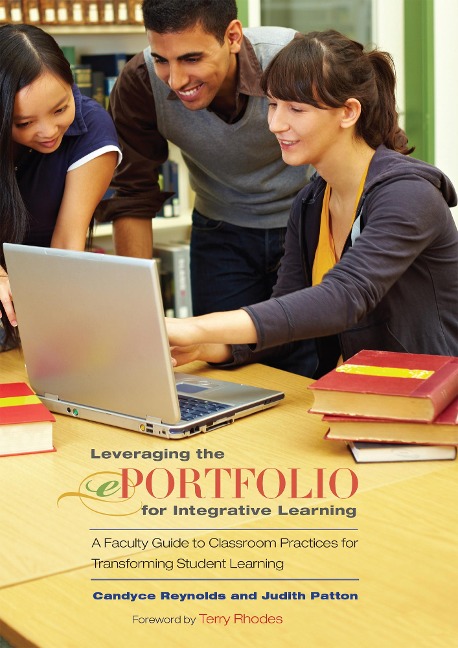
The fruit of the authors' more than 15 years of using and writing about ePortfolios in general education and disciplinary programs and courses, this book is a comprehensive and practical guide to the use of the ePortfolio as a pedagogy that facilitates the integrative learning that is a central goal of higher education.Faculty and administrators of programs using ePortfolios can use this guide to help their students work individually on an ePortfolio or as part of a class or program requirement. Readers will discover through examples of student portfolios and targeted exercises how to assist students in making their learning visible to themselves, their peers, their instructors and their future employersWhile interest in ePortfolios has exploded-because they provide an easier and more comprehensive ways to assess student learning than traditional portfolios, and because they have the potential to transformatively develop students' ability to connect and apply their knowledge-faculty and administrators all too often are disappointed by the lackluster ePortfolios that students submit. Reynolds and Patton demonstrate how systematically embedding practices in the classroom that engage students in integrative learning practices dramatically improves outcomes. The authors describe easy to use and practical strategies for faculty to incorporate integrative ePortfolios in their courses and curricula, and create the scaffolding to develop students' skills and metacognition.The book opens by outlining the underlying learning theory and the key concepts of integrative learning and by describing the purpose, structure and implementation of ePortfolios. Subsequent sections cover classroom practices and assignments to help students understand themselves as learners; make connections between course content, their personal lives, and to the curriculum; bridge theory to practice; and consider issues of audience and communication and presentation in developing their portfolios. The book goes on to cover technological issues and assessment, with a particular emphasis on the use of rubrics; and concludes with explicated examples of ePortfolios created in a first-year program, ePortfolios created by graduating students, career-oriented ePortfolios, and lifelong ePortfolios.For both experienced faculty and administrators, and readers just beginning to use ePortfolios, this book provides a framework and guidance to implement them to their fullest potential.
Candyce Reynolds is Associate Professor, Educational Leadership and Policy, at Portland State University. Judith Patton is Professor, Professor of Dance, Department of Theater and Film, at Portland State University. Terrel L. Rhodes, Vice President, Office of Quality, Curriculum and Assessment; and Executive Director of VALUE- Association of American Colleges and Universities
Foreword-Terry Rhodes Preface Acknowledgments Introduction Part One. Key Concepts 1. ePortfolios as a Tool for Integrative Learning 2. Integrating Knowledge. The Crux of an Education 3. Retooling Your Syllabus and Teaching. Integrating Integrative Learning and ePortfolios Into Your Course Part Two. Teaching for Integrative Learning 4. Fostering Reflective Practice 5. Making Connections or Integrating Knowledge 6. Making Connections for Lifelong Learning 7. Communicating Effectively in ePortfolios. A Picture Is Worth a Thousand Words Part Three. Creating the ePortfolio 8. Designing an ePortfolio System 9. Making an ePortfolio Using Free Web-Based Software Part Four. At the End 10. Assessment of ePortfolios. Using Rubrics to Assess 11. Parting Thoughts References Index
Dieses eBook wird im PDF-Format geliefert und ist mit einem Adobe Kopierschutz (DRM) versehen. Sie können dieses eBook mit allen Geräten lesen, die das PDF-Format und den Adobe Kopierschutz (DRM) unterstützen.
Zum Beispiel mit den folgenden Geräten:
• tolino Reader
Laden Sie das eBook direkt über den Reader-Shop auf dem tolino herunter oder übertragen Sie das eBook auf Ihren tolino mit einer kostenlosen Software wie beispielsweise Adobe Digital Editions.
• Sony Reader & andere eBook Reader
Laden Sie das eBook direkt über den Reader-Shop herunter oder übertragen Sie das eBook mit der kostenlosen Software Sony READER FOR PC/Mac oder Adobe Digital Editions auf ein Standard-Lesegeräte mit epub- und Adobe DRM-Unterstützung.
• Tablets & Smartphones
Möchten Sie dieses eBook auf Ihrem Smartphone oder Tablet lesen, finden Sie hier unsere kostenlose Lese-App für iPhone/iPad und Android Smartphone/Tablets.
• PC & Mac
Lesen Sie das eBook direkt nach dem Herunterladen mit einer kostenlosen Lesesoftware, beispielsweise Adobe Digital Editions, Sony READER FOR PC/Mac oder direkt über Ihre eBook-Bibliothek in Ihrem Konto unter „Meine eBooks“ - „online lesen“.
Schalten Sie das eBook mit Ihrer persönlichen Adobe ID auf bis zu sechs Geräten gleichzeitig frei.
Bitte beachten Sie, dass die Kindle-Geräte das Format nicht unterstützen und dieses eBook somit nicht auf Kindle-Geräten lesbar ist.