Und dann auf "Zum Home-Bildschirm [+]".

Stöbern
genialokal zum Startbildschirm hinzufügen
Installieren Sie die genialokal App auf Ihrem Startbildschirm für einen schnellen Zugriff und eine komfortable Nutzung.
Installieren Sie die genialokal App auf Ihrem Startbildschirm für einen schnellen Zugriff und eine komfortable Nutzung.
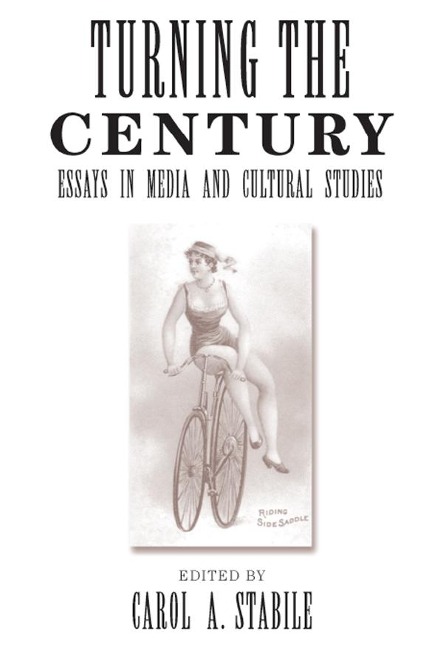
The essays in Turning the Century make a significant contribution to our understanding of America's love affairs with novelty and the mass media. The essays also show that neither the current communications revolution nor the response to it is unprecedented. Through this book, Carol Stabile provides a historical context within which scholars and students of American culture can interpret and understand end-of-the-millennium-fever --particularly, the claims of politicians, pundits, and even cultural studies scholars who maintain that recent information technology innovations make the present moment unique. Contemporary studies of mass media and popular culture reflect a similar emphasis on what is new, distinct, and therefore specific to contemporary culture. Claims of millennial transformation, however, are only possible insofar as the history of mass media can be forgotten or ignored. In Turning the Century, Carol Stabile analyzes those hidden, and now all but forgotten, conditions and relations of production that continue to shape and inform contemporary culture.
Carol Stabile
* List of Figures * Acknowledgments * Introduction, Carol A. Stabile * Sound out of Time: Modernitys Echo, Jonathan Sterne * Maintaining the Order of Things: Class, the Gospel of Scientific Efficiency, and the Invention of Policy Expertise in America, 18651921, Amos Tevelow * Sensationalism, Objectivity, and Reform in Turn-of-the-Century America, Mark Harrison * All Love Making Scenes Must Be Normal: Pennsylvania Movie Censorship in the Progressive Era, Michael G. Aronson * Only Flossy, High-Society Dudes Would Smoke Em: Gender and Cigarette Advertising in the Nineteenth Century, Dawn Schmitz * Trotting Horses and Moving Pictures: A Sporting View of Early Cinema, Andrew C. Miller * Girls Who Come to Pieces: Women, Cosmetics, and Advertising in the Ladies Home Journal, 191920, Lisa Belicka Kernen * Race Betterment and Class Consciousness at the Turn of the Century, or Why Its Okay to Marry Your Cousin, Kelly Happe * Conspicuous Whiteness: The New Woman, the Old Negro, and the Vanishing Past of Early Brand Advertising, Carla Willard * Constructions of Violence: Labor, Capital, and Hegemonic Struggle in the Pullman Strike of 1894, Kevin Ayotte * Afterword, Richard Ohmann * About the Editor and Contributors * Index
Dieses eBook wird im PDF-Format geliefert und ist mit einem Adobe Kopierschutz (DRM) versehen. Sie können dieses eBook mit allen Geräten lesen, die das PDF-Format und den Adobe Kopierschutz (DRM) unterstützen.
Zum Beispiel mit den folgenden Geräten:
• tolino Reader
Laden Sie das eBook direkt über den Reader-Shop auf dem tolino herunter oder übertragen Sie das eBook auf Ihren tolino mit einer kostenlosen Software wie beispielsweise Adobe Digital Editions.
• Sony Reader & andere eBook Reader
Laden Sie das eBook direkt über den Reader-Shop herunter oder übertragen Sie das eBook mit der kostenlosen Software Sony READER FOR PC/Mac oder Adobe Digital Editions auf ein Standard-Lesegeräte mit epub- und Adobe DRM-Unterstützung.
• Tablets & Smartphones
Möchten Sie dieses eBook auf Ihrem Smartphone oder Tablet lesen, finden Sie hier unsere kostenlose Lese-App für iPhone/iPad und Android Smartphone/Tablets.
• PC & Mac
Lesen Sie das eBook direkt nach dem Herunterladen mit einer kostenlosen Lesesoftware, beispielsweise Adobe Digital Editions, Sony READER FOR PC/Mac oder direkt über Ihre eBook-Bibliothek in Ihrem Konto unter „Meine eBooks“ - „online lesen“.
Schalten Sie das eBook mit Ihrer persönlichen Adobe ID auf bis zu sechs Geräten gleichzeitig frei.
Bitte beachten Sie, dass die Kindle-Geräte das Format nicht unterstützen und dieses eBook somit nicht auf Kindle-Geräten lesbar ist.