
Stöbern
genialokal zum Startbildschirm hinzufügen
Installieren Sie die genialokal App auf Ihrem Startbildschirm für einen schnellen Zugriff und eine komfortable Nutzung.
Installieren Sie die genialokal App auf Ihrem Startbildschirm für einen schnellen Zugriff und eine komfortable Nutzung.
Tippen Sie einfach auf Teilen:
 Und dann auf "Zum Home-Bildschirm [+]".
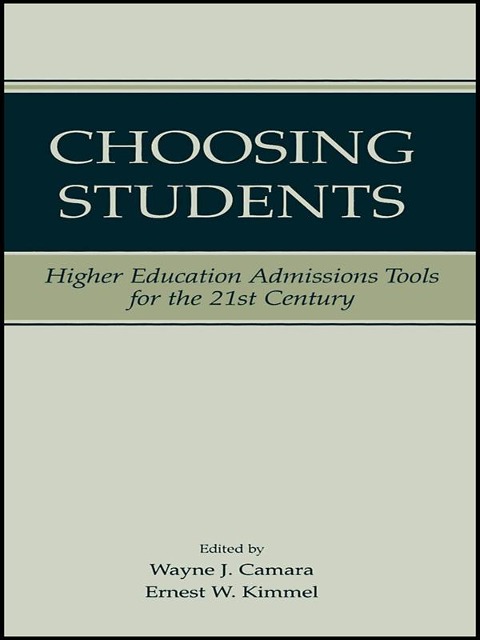
This volume brings a variety of perspectives to bear on the issue of how higher education institutions can - or should - choose students during the early part of the 21st century. Many of the contributors report on research to develop and validate potential tools to assist those responsible for admission decisions. Other contributors, however, pose broader questions about the nature of selective admissions, about institutional responses to the changing demography of those seeking to enter higher education, or about the appropriate criteria of 'success' in higher education. The volume is particularly timely because the question of how changes in admission tools and processes will affect campus diversity following the recent Supreme Court decision concerning the University of Michigan. Diversity is an important concern of all of the contributors and the chapter by Lee Bollinger--President at Michigan at the time the court cases were filed--is particularly relevant.
This book brings together the research that underlies a variety of proposed approaches to improving the selection of students. Providing support for the integrity of the admissions process and the validity of new tools to help a higher education institution to select a diverse student body, this book explores the implications of the assessment component of K-12 school reform for higher education admissions practices. The diverse contributions to this volume reflect the current ferment in educational research and educational practice as institutions of higher education seek to develop a new admissions paradigm for coming decades following the University of Michigan decisions.
This book is intended for those leaders and professionals who set admission policies and practices in American colleges, and graduate and professional schools, as well as for those scholars and scientists who research, develop, and validate tools for use in the process of choosing students in ways that are congruent with an institution's mission, values, and goals.
Contents: Preface. Part I: Diversity in Higher Education.L.C. Bollinger, Competition in Higher Education and Admissions Testing. R. Laird, What Is It We Think We Are Trying to Fix and How Should We Fix It? A View From the Admissions Office. E.W. Kimmel, Who Is at the Door? The Demography of Higher Education in the 21st Century. W.J. Camara, Broadening Criteria of College Success and the Impact of Cognitive Predictors. W.J. Camara, Broadening Predictors of College Success. Part II: Improving Current Practice.P.R. Sackett, The Performance-Diversity Tradeoff in Admission Testing. W.W. Willingham, Prospects for Improving Grades for Use in Admissions. R.L. Linn, Evaluating College Applicants: Some Alternatives. Part III: New Constructs and New Measures.R.J. Sternberg, The Rainbow Project Collaborators, Augmenting the SAT Through Assessments of Analytical, Practical, and Creative Skills. W.E. Sedlacek, The Case for Noncognitive Measures. N. Schmitt, F.L. Oswald, M. Gillespie, Broadening the Performance Domain in the Prediction of Academic Success. P.M. Etienne, E.R. Julian, Assessing the Personal Characteristics of Premedical Students. P.J. Pashley, A.E. Thornton, J.R. Duffy, Access and Diversity in Law School Admissions. I.I. Bejar, Toward a Science of Assessment. Part IV: Admission in the Context of K-16 Reform Efforts.S. Rabinowitz, The Integration of Secondary and Postsecondary Assessment Systems: Cautionary Concerns. M.W. Kirst, Rethinking Admission and Placement in an Era of New K-12 Standards. D.T. Conley, Proficiency-Based Admissions.
Dieses eBook wird im PDF-Format geliefert und ist mit einem Adobe Kopierschutz (DRM) versehen. Sie können dieses eBook mit allen Geräten lesen, die das PDF-Format und den Adobe Kopierschutz (DRM) unterstützen.
Zum Beispiel mit den folgenden Geräten:
• tolino Reader
Laden Sie das eBook direkt über den Reader-Shop auf dem tolino herunter oder übertragen Sie das eBook auf Ihren tolino mit einer kostenlosen Software wie beispielsweise Adobe Digital Editions.
• Sony Reader & andere eBook Reader
Laden Sie das eBook direkt über den Reader-Shop herunter oder übertragen Sie das eBook mit der kostenlosen Software Sony READER FOR PC/Mac oder Adobe Digital Editions auf ein Standard-Lesegeräte mit epub- und Adobe DRM-Unterstützung.
• Tablets & Smartphones
Möchten Sie dieses eBook auf Ihrem Smartphone oder Tablet lesen, finden Sie hier unsere kostenlose Lese-App für iPhone/iPad und Android Smartphone/Tablets.
• PC & Mac
Lesen Sie das eBook direkt nach dem Herunterladen mit einer kostenlosen Lesesoftware, beispielsweise Adobe Digital Editions, Sony READER FOR PC/Mac oder direkt über Ihre eBook-Bibliothek in Ihrem Konto unter „Meine eBooks“ - „online lesen“.
Schalten Sie das eBook mit Ihrer persönlichen Adobe ID auf bis zu sechs Geräten gleichzeitig frei.
Bitte beachten Sie, dass die Kindle-Geräte das Format nicht unterstützen und dieses eBook somit nicht auf Kindle-Geräten lesbar ist.