Und dann auf "Zum Home-Bildschirm [+]".

Stöbern
genialokal zum Startbildschirm hinzufügen
Installieren Sie die genialokal App auf Ihrem Startbildschirm für einen schnellen Zugriff und eine komfortable Nutzung.
Installieren Sie die genialokal App auf Ihrem Startbildschirm für einen schnellen Zugriff und eine komfortable Nutzung.
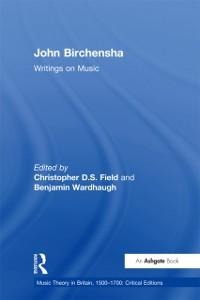
John Birchensha (c.1605-?1681) is chiefly remembered for the impression that his theories about music made on the mathematicians, natural philosophers and virtuosi of the Royal Society in the 1660s and 1670s, and for inventing a system that he claimed would enable even those without practical experience of music to learn to compose in a short time by means of 'a few easy, certain, and perfect Rules'-his most famous composition pupil being Samuel Pepys in 1662. His great aim was to publish a treatise on music in its philosophical, mathematical and practical aspects (which would have included a definitive summary of his rules of composition), entitled Syntagma music Subscriptions for this book were invited in 1672-3, and it was due to be published by March 1675; but it never appeared, and no final manuscript of it survives. Consequently knowledge about his work has hitherto remained extremely sketchy. Recent research, however, has brought to light a number of manuscripts which allow us at last to form a more complete view of Birchensha's ideas. Almost none of this material has been previously published. The new items include an autograph treatise of c.1664 ('A Compendious Discourse of the Principles of the Practicall & Mathematicall Partes of Musick') which Birchensha presented to the natural philosopher Robert Boyle, and which covers concisely much of the ground that he intended to cover in Syntagma music a detailed synopsis for Syntagma music hich he prepared for a meeting of the Royal Society in February 1676; and an autograph notebook (now in Brussels) containing his six rules of composition with music examples, presumably written for a pupil. Bringing all this material together in a single volume will allow scholars to see how Birchensha's rules and theories developed over a period of fifteen years, and to gain at least a flavour of the lost Syntagma music
Dr Christopher D.S. Field, is Honorary Fellow in Music at University of Edinburgh, UK and Dr Benjamin Wardhaugh, is a Ph.D student in History, University of Oxford, UK
Contents: Introduction; Birchensha's reputation as a music theorist; Birchensha's life; The practical part of music; The mathematical and philosophical parts of music; 'To reduce all the parts of musick to a regularity and just order'; The sources; Transcription policy; Dates. John Birchensha's Writings on Music: Dedicatory epistle and preface to Templum Musicum (1664); Letter to the Royal Society (26 April 1664); ' A compendious discourse'; Birchensha's description of his 'grand scale' (9 June 1665); 'Animadversion' for Syntagma musicÃ- (1672); Synopsis of Syntagma musicÃ- for the Royal Society (February 1675/6); Birchensha demonstrates his 'compleat scale of musick' to the Royal Society (10 February 1675/6); Rules of composition, I: Silas Taylor's manuscript; Rules of composition, II: William Corbett's manuscript; Rules of composition, III: Francis Withey's manuscript; Bibliography; Index.
Dieses eBook wird im PDF-Format geliefert und ist mit einem Adobe Kopierschutz (DRM) versehen. Sie können dieses eBook mit allen Geräten lesen, die das PDF-Format und den Adobe Kopierschutz (DRM) unterstützen.
Zum Beispiel mit den folgenden Geräten:
• tolino Reader
Laden Sie das eBook direkt über den Reader-Shop auf dem tolino herunter oder übertragen Sie das eBook auf Ihren tolino mit einer kostenlosen Software wie beispielsweise Adobe Digital Editions.
• Sony Reader & andere eBook Reader
Laden Sie das eBook direkt über den Reader-Shop herunter oder übertragen Sie das eBook mit der kostenlosen Software Sony READER FOR PC/Mac oder Adobe Digital Editions auf ein Standard-Lesegeräte mit epub- und Adobe DRM-Unterstützung.
• Tablets & Smartphones
Möchten Sie dieses eBook auf Ihrem Smartphone oder Tablet lesen, finden Sie hier unsere kostenlose Lese-App für iPhone/iPad und Android Smartphone/Tablets.
• PC & Mac
Lesen Sie das eBook direkt nach dem Herunterladen mit einer kostenlosen Lesesoftware, beispielsweise Adobe Digital Editions, Sony READER FOR PC/Mac oder direkt über Ihre eBook-Bibliothek in Ihrem Konto unter „Meine eBooks“ - „online lesen“.
Schalten Sie das eBook mit Ihrer persönlichen Adobe ID auf bis zu sechs Geräten gleichzeitig frei.
Bitte beachten Sie, dass die Kindle-Geräte das Format nicht unterstützen und dieses eBook somit nicht auf Kindle-Geräten lesbar ist.