
Stöbern
genialokal zum Startbildschirm hinzufügen
Installieren Sie die genialokal App auf Ihrem Startbildschirm für einen schnellen Zugriff und eine komfortable Nutzung.
Installieren Sie die genialokal App auf Ihrem Startbildschirm für einen schnellen Zugriff und eine komfortable Nutzung.
Tippen Sie einfach auf Teilen:
 Und dann auf "Zum Home-Bildschirm [+]".
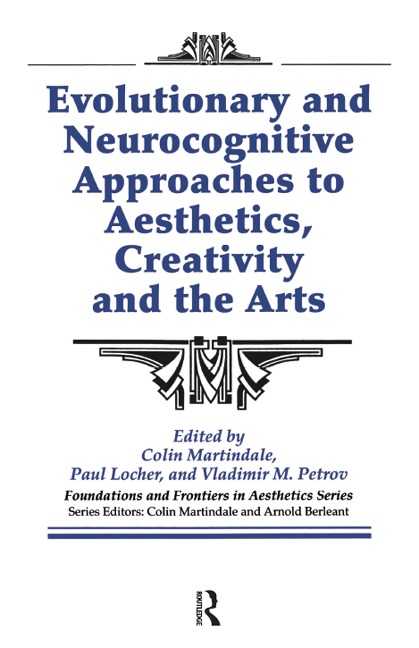
In this book, well-known scholars describe new and exciting approaches to aesthetics, creativity and psychology of the arts, approaching these topics from a point of view that is biological or related to biology and answering new questions with new methods and theories. All known societies produce and enjoy arts such as literature, music and visual decoration or depiction. Judging from prehistoric archaeological evidence, this arose very early in human development. Furthermore, Darwin was explicit in attributing aesthetic sensitivity to lower animals. These considerations lead us to wonder whether the arts might not be evolutionarily based. Although such an evolutionary basis is not obvious on the face of it, the idea has recently elicited considerable attention. The book begins with a consideration of ten theories on the evolutionary function of specific arts such as music and literature. The theory of evolution was first drawn up in biology, but evolution is not confined to biology: genuinely evolutionary theories of sociocultural change can be formulated. That they need to be formulated is shown in several chapters that discuss regular trends in literature and scientific writings. Psychologists have recently rediscovered the obvious fact that thought and perception occur in the brain, so cognitive science moves ever closer to neuroscience. Several chapters give overviews of neurocognitive and neural network approaches to creativity and aesthetic appreciation. The book concludes with two exciting describing brain-scan research on what happens in the brain during creativity and presenting a close examination of the relationship between genetically transmitted mental disorder and creativity.
Colin Martindale, Paul Locher, Vladimir Petrov, Arnold Berleant
Preface Colin Martindale Chapter 1 What Art is and What Art Does: An Overview of Contemporary Evolutionary Hypotheses Ellen Dissanayake Chapter 2 An Evolutionary Model of Artistic and Musical Creativity Gregory J. Feist Chapter 3 The Adaptive Function of Literature Joseph Carroll Chapter 4 Does Reading Literature Make People Happy? Willie van Peer, Alexandra Menties and Jan Auracher Chapter 5 Cognitive Poetics and Poetry Recital Reuven Tsur Chapter 6 The Alphabet and Creativity: Implications for East Asia William C. Hannas Chapter 7 Creativity, Gender, History, and Authors of Fantasy for Children Ravenna Helson Chapter 8 Trends in the Creative Content of Scientific Journals: Good, but Not as Good! Robert Hogenraad Chapter 9 The Information Approach to Human Sciences, Especially Aesthetics Vladimir M. Petrov Chapter 10 Art and Cognition: Cognitive Processes in Art Appreciation Helmut Leder and Benno Belke Chapter 11 Literary Creativity: A Neuro-Psychoanalytic View Norman N. Holland Chapter 12 A Neural-Network Theory of Beauty Colin Martindale Chapter 13 Neural Correlates of Creative Cognition Oshin Vartanian and Vinod Goel Chapter 14 Creativity, DNA, and Cerebral Blood Flow Rosa Aurora Chávez-Eakle Chapter 15 Artistic Creativity and Affective Disorders: Are They Connected? Dennis K. Kinney and Ruth L. Richards
Dieses eBook wird im PDF-Format geliefert und ist mit einem Adobe Kopierschutz (DRM) versehen. Sie können dieses eBook mit allen Geräten lesen, die das PDF-Format und den Adobe Kopierschutz (DRM) unterstützen.
Zum Beispiel mit den folgenden Geräten:
• tolino Reader
Laden Sie das eBook direkt über den Reader-Shop auf dem tolino herunter oder übertragen Sie das eBook auf Ihren tolino mit einer kostenlosen Software wie beispielsweise Adobe Digital Editions.
• Sony Reader & andere eBook Reader
Laden Sie das eBook direkt über den Reader-Shop herunter oder übertragen Sie das eBook mit der kostenlosen Software Sony READER FOR PC/Mac oder Adobe Digital Editions auf ein Standard-Lesegeräte mit epub- und Adobe DRM-Unterstützung.
• Tablets & Smartphones
Möchten Sie dieses eBook auf Ihrem Smartphone oder Tablet lesen, finden Sie hier unsere kostenlose Lese-App für iPhone/iPad und Android Smartphone/Tablets.
• PC & Mac
Lesen Sie das eBook direkt nach dem Herunterladen mit einer kostenlosen Lesesoftware, beispielsweise Adobe Digital Editions, Sony READER FOR PC/Mac oder direkt über Ihre eBook-Bibliothek in Ihrem Konto unter „Meine eBooks“ - „online lesen“.
Schalten Sie das eBook mit Ihrer persönlichen Adobe ID auf bis zu sechs Geräten gleichzeitig frei.
Bitte beachten Sie, dass die Kindle-Geräte das Format nicht unterstützen und dieses eBook somit nicht auf Kindle-Geräten lesbar ist.