
Stöbern
genialokal zum Startbildschirm hinzufügen
Installieren Sie die genialokal App auf Ihrem Startbildschirm für einen schnellen Zugriff und eine komfortable Nutzung.
Installieren Sie die genialokal App auf Ihrem Startbildschirm für einen schnellen Zugriff und eine komfortable Nutzung.
Tippen Sie einfach auf Teilen:
 Und dann auf "Zum Home-Bildschirm [+]".

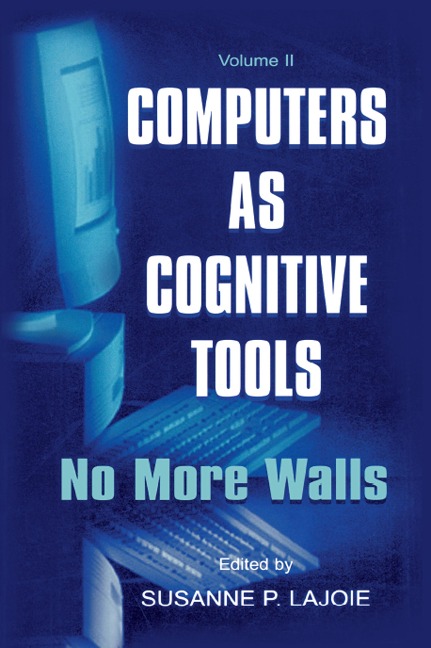
Since the publication of the first edition of Computers as Cognitive Tools in 1993, rapid changes have taken place in the uses of technology for educational purposes and in the theories underlying such uses. Changes in perspectives on thinking and learning are guiding the instructional design of computer-based learning environments. Computers as Cognitive Tools, Volume II: No More Walls provides examples of state-of-the-art technology-based research in the field of education and training. These examples are theory-driven and reflect the learning paradigms that are currently in use in cognitive science. The learning theories, which consider the nature of individual learning, as well as how knowledge is constructed in social situations, include information processing, constructivism, and situativity. Contributors to this volume demonstrate some variability in their choice of guiding learning paradigms. This allows readers the opportunity to examine how such paradigms are operationalized and validated. An array of instructional and assessment approaches are described, along with new techniques for automating the design and assessment process. New considerations are offered as possibilities for examining learning in distributed situations. A multitude of subject matter areas are covered, including scientific reasoning and inquiry in biology, physics, medicine, electricity, teacher education, programming, and hypermedia composition in the social sciences and ecology. This volume reconsiders the initial "camp" analogy posited in 1993 edition of Computers as Cognitive Tools, and presents a mechanism for breaking camp to find new summits.
Susanne P. Lajoie,
Contents: Preface. S.P. Lajoie, Introduction: Breaking Camp to Find New Summits. Part I: Technologies for Supporting Knowledge Building in Distributed Learning Contexts.F.N. Akhras, J.A. Self, Modeling the Process, Not the Product, of Learning. S.J. Derry, S. Gance, L.L. Gance, M. Schlager, Toward Assessment of Knowledge-Building Practices in Technology-Mediated Work Group Interactions. J. Greer, G. McCalla, J. Cooke, J. Collins, V. Kumar, A. Bishop, J. Vassileva, Integrating Cognitive Tools for Peer Help: The Intelligent Intranet Peer Help-Desk Project. B.Y. White, T.A. Shimoda, J.R. Frederiksen, Facilitating Students' Inquiry Learning and Metacognitive Development Through Modifiable Software Advisers. B. Sugrue, Cognitive Approaches to Web-Based Instruction. Part II: Cognitive Tools That Foster New Forms of Representation.D.H. Jonassen, C.S. Carr, Mindtools: Affording Multiple Knowledge Representations for Learning. J. Erickson, R. Lehrer, What's in a Link? Student Conceptions of the Rhetoric of Association in Hypermedia Composition. B. Harper, J. Hedberg, B. Corderoy, R. Wright, Employing Cognitive Tools Within Interactive Multimedia Applications. S.P. Lajoie, R. Azevedo, Cognitive Tools for Medical Informatics. D.L. Schwartz, G. Biswas, J.D. Bransford, B. Bhuva, T. Balac, S. Brophy, Computer Tools That Link Assessment and Instruction: Investigating What Makes Electricity Hard to Learn. V.J. Shute, L.A. Torreano, R.E. Willis, DNA: Toward an Automated Knowledge Elicitation and Organization Tool. Part III: Epilogue.B. du Boulay, Fallible, Distractible, Forgetful, Willful, and Irrational Learners. E.B. Mandinach, H.F. Cline, It Won't Happen Soon: Practical, Curricular, and Methodological Problems in Implementing Technology-Based Constructivist Approaches in Classrooms. Part IV: Discussion.A. Lesgold, What Are the Tools For? Revolutionary Change Does Not Follow the Usual Norms.