
Stöbern
genialokal zum Startbildschirm hinzufügen
Installieren Sie die genialokal App auf Ihrem Startbildschirm für einen schnellen Zugriff und eine komfortable Nutzung.
Installieren Sie die genialokal App auf Ihrem Startbildschirm für einen schnellen Zugriff und eine komfortable Nutzung.
Tippen Sie einfach auf Teilen:
 Und dann auf "Zum Home-Bildschirm [+]".
Ihr gewünschter Artikel ist in 0 Buchhandlungen vorrätig - wählen Sie hier eine Buchhandlung in Ihrer Nähe aus:

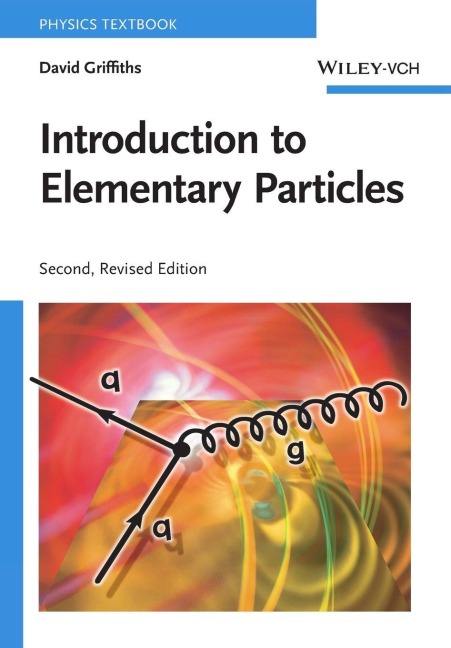

In the second, revised edition of a well-established textbook, the author strikes a balance between quantitative rigor and intuitive understanding, using a lively, informal style. The first chapter provides a detailed historical introduction to the subject, while subsequent chapters offer a quantitative presentation of the Standard Model. A simplified introduction to the Feynman rules, based on a "toy" model, helps readers learn the calculational techniques without the complications of spin. It is followed by accessible treatments of quantum electrodynamics, the strong and weak interactions, and gauge theories. New chapters address neutrino oscillations and prospects for physics beyond the Standard Model. The book contains a number of worked examples and many end-of-chapter problems. A complete solution manual is available for instructors. - Revised edition of a well-established text on elementary particle physics - With a number of worked examples and many end-of-chapter problems - Helps the student to master the Feynman rules - Solution manual available for instructors
David Griffiths is Professor of Physics at the Reed College in Portland, Oregon. After obtaining his PhD in elementary particle theory at Harvard, he taught at several colleges and universities before joining the faculty at Reed in 1978. He specializes in classical electrodynamics and quantum mechanics as well as elementary particles, and has written textbooks on all three subjects.
1 Historical Introduction to the Elementary Particles 2 Elementary Particle Dynamics 3 Relativistic Kinematics 4 Symmetries 5 Bound States 6 The Feynman Calculus 7 Quantum Electrodynamics 8 Electrodynamics and Chromodynamics of Quarks 9 Weak Interactions 10 Gauge Theories 11 Neutrino Oscillations 12 Afterword: What-s Next? A The Dirac Delta Function B Decay Rates and Cross Sections C Pauli and Dirac Matrices D Feynman Rules (Tree Level)