
Stöbern
genialokal zum Startbildschirm hinzufügen
Installieren Sie die genialokal App auf Ihrem Startbildschirm für einen schnellen Zugriff und eine komfortable Nutzung.
Installieren Sie die genialokal App auf Ihrem Startbildschirm für einen schnellen Zugriff und eine komfortable Nutzung.
Tippen Sie einfach auf Teilen:
 Und dann auf "Zum Home-Bildschirm [+]".
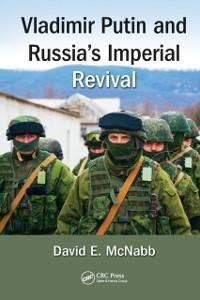
Discerning the early stages of the rebirth of a new Russian empire from the ashes of the Soviet Union, Vladimir Putin and Russia's Imperial Revival argues that Russia's recent overtly aggressive actions and foreign policy doctrines have signaled a renewal of the Cold War. At the least, Russia's actions represent the potential for renewal. This book explains these developments in a historical context.The book begins by describing Russia's initial policy of rapprochement after the collapse of the Soviet Union and its development into a foreign policy of threatened or actual armed aggression. It identifies today's Russia as a nation determined to re-establish itself as a political and military force. As a prominent figure in the development and continuation of its current foreign policy, Vladimir Putin plays a central role in the topics covered.Previous literature often treats Putin as an individual phenomenon examining his connections to corruption or the secret police, but here David E. McNabb examines him as the latest in a long history of Russian despots who followed similar expansionist policies. He details some of the tactics Putin uses to instill fear and dominate political policies of republics newly independent from Russia. These tactics include the use of energy as a weapon, cyber terrorism, and military support for ethnic Russian separatists in other sovereign nations, most recently exemplified by Russia's annexation of Crimea from Ukraine via armed invasion.In an attempt to demystify Russia's re-emergence as an international political force, Vladimir Putin and Russia's Imperial Revival grounds its analyses in history. It explores as far back as the establishment of the first Russian empire, and regards Putin as a leader determined to establish a fifth imperial incarnation. It provides a nuanced understanding of how Russia arrived at its current position through recent and distant internal and international events.
David E. McNabb, PhD, is a professor emeritus at Pacific Lutheran University, Tacoma, Washington; an adjunct professor at Olympic College, Bremerton, Washington; and a recent consultant for an agency of the federal government. He earned his PhD at Oregon State University. He has authored 12 books with another forthcoming, is a joint author of two books, and author or joint author of nearly 100 articles and conference papers. His research interests are in the transformation of government institutions in the United States and in the Baltic states. He is or has been a member of several organizations related to political science, public administration, and European studies.
A MILLENNIUM OF EMPIRE BUILDING The Collapse and Rebirth of an Empire Introduction Rebuilding a Nation Shaping Putin's Foreign Policy Rise of the Phoenix Regaining Status Lost Ending Ties with the West A Renewal of the Cold War? Resurrecting Relations with "Special-Interest" Neighbors Conclusion Stages in the Building of a Russian Empire Introduction The Kievan Rus Empire The Muscovite Empire The Romanov Empire The Soviet Empire Conclusion FROM UNCERTAINTY TO SUPREME CONFIDENCE Russia's Foreign Policy in Transition Introduction Factors Shaping Post-Soviet Foreign Policy A New Role for Russia? Rebuilding the State Russia, the EU, and NATO Conclusion The Putin-Era Foreign Policy of Consolidation Introduction Evolution of the Consolidation Policy Putin-Era Foreign Relations Foreign Policy Goals Russia's Use of Soft Power Conclusion Building Defensive Barriers Introduction Building Barriers in the West Building Barriers in the East Colonization and Deportation in the Conquered Territories Conclusion RUSSIA S FOREIGN POLICY WEAPONS Reforming and Rearming Russia's Military Introduction The Need for Reforms 2000-2008 Military Reforms 2008-2015 Military Reforms and Reorganizations All-Forces Personnel Reductions Rearming the Russian Military Conclusion Russia's Undeclared Cyber Wars Introduction Cyber Tactics 2007: Cyber War with Estonia 2008: Cyber War with Lithuania 2009: Kyrgyzstan under Cyber Attack 2009: Cyber and Shooting War with Georgia Cyber Wars with Ukraine Conclusion The Energy Weapon in Russia's Foreign Policy Introduction State Control of Energy Resources Control of Transit Routes and Modes Means for Implementing the Energy Weapon Acquiescence of Target Countries
Dieses eBook wird im PDF-Format geliefert und ist mit einem Adobe Kopierschutz (DRM) versehen. Sie können dieses eBook mit allen Geräten lesen, die das PDF-Format und den Adobe Kopierschutz (DRM) unterstützen.
Zum Beispiel mit den folgenden Geräten:
• tolino Reader
Laden Sie das eBook direkt über den Reader-Shop auf dem tolino herunter oder übertragen Sie das eBook auf Ihren tolino mit einer kostenlosen Software wie beispielsweise Adobe Digital Editions.
• Sony Reader & andere eBook Reader
Laden Sie das eBook direkt über den Reader-Shop herunter oder übertragen Sie das eBook mit der kostenlosen Software Sony READER FOR PC/Mac oder Adobe Digital Editions auf ein Standard-Lesegeräte mit epub- und Adobe DRM-Unterstützung.
• Tablets & Smartphones
Möchten Sie dieses eBook auf Ihrem Smartphone oder Tablet lesen, finden Sie hier unsere kostenlose Lese-App für iPhone/iPad und Android Smartphone/Tablets.
• PC & Mac
Lesen Sie das eBook direkt nach dem Herunterladen mit einer kostenlosen Lesesoftware, beispielsweise Adobe Digital Editions, Sony READER FOR PC/Mac oder direkt über Ihre eBook-Bibliothek in Ihrem Konto unter „Meine eBooks“ - „online lesen“.
Schalten Sie das eBook mit Ihrer persönlichen Adobe ID auf bis zu sechs Geräten gleichzeitig frei.
Bitte beachten Sie, dass die Kindle-Geräte das Format nicht unterstützen und dieses eBook somit nicht auf Kindle-Geräten lesbar ist.