
Stöbern
genialokal zum Startbildschirm hinzufügen
Installieren Sie die genialokal App auf Ihrem Startbildschirm für einen schnellen Zugriff und eine komfortable Nutzung.
Installieren Sie die genialokal App auf Ihrem Startbildschirm für einen schnellen Zugriff und eine komfortable Nutzung.
Tippen Sie einfach auf Teilen:
 Und dann auf "Zum Home-Bildschirm [+]".
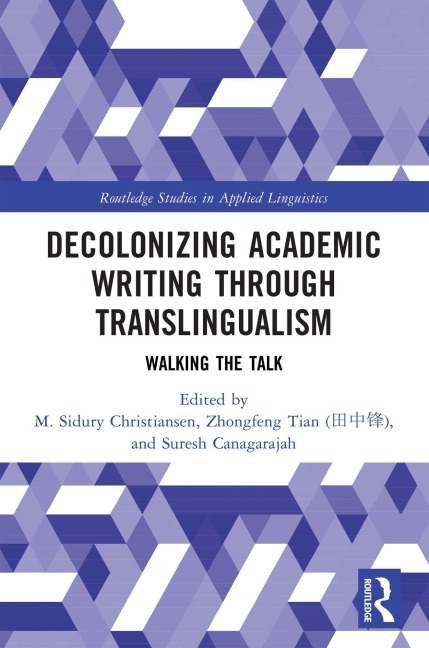
This collection explores innovative ways to embody translingual practices in academic writing, showcasing how multilingual authors can effectively leverage their linguistic resources in research and publication. Recognizing that traditional academic writing often suppresses multilingual voices, this book advocates for a decolonized approach that embraces diverse linguistic expressions and knowledge representations for social change. This volume features perspectives from scholars across various disciplines and linguistic backgrounds presenting their unique visions of discursive, rhetorical, and linguistic diversity in academic writing. Each chapter showcases its respective author's critical reflections on their language choices. This book offers a counterpoint to existing literature by making the case for the register known as "academic English" as a form both open to change and possible for accommodating diversity, empowering scholars to negotiate the register's norms around their own languages and establish spaces for their own unique voices and identities. This book serves as a valuable resource for graduate students, faculty, and scholars interested in academic writing, TESOL, composition studies, language teaching and learning, and applied linguistics.
M. Sidury Christiansen is Professor of TESOL/Applied Linguistics at the University of Texas at San Antonio, USA. Zhongfeng Tian (---) is Associate Professor of Bilingual Education at Rutgers University-Newark, USA. Suresh Canagarajah is the Evan Pugh University Professor of Applied Linguistics, English, and Asian Studies at the Pennsylvania State University, USA.
List of Contributors Foreword (Angel Lin) Introduction (M. Sidury Christiansen, Zhongfeng Tian, & Suresh Canagarajah) Part 1: Introspections and Personal Insights 1. Catalyzing Academic Writing through the Poetics of Sensuality, Surrogacy, and Consumption: A Surrogate Eater autohistoria-teoría from a Chicana graduate student perspective (Jennifer Yáñez-Alaniz) 2. Sa isip, sa salita, at sa gawa? A Plurilingual Graduate Student's De/Colonial Autoethnographic Pagninilay on Translingual Academic Writing (John Wayne N. dela Cruz) 3. Inosans Jan Nwè: Unmasking the Decolonizing Tensions of Translingualism (Patriann Smith) Part 2: Conceptual and Theoretical Explorations 4. Translanguaging as a Hermeneutics of Empathy :----- (Amir Kalan) 5. Restoring Poetics to Scholarship by/Rendering it in Ancient Code-Meshed Poetry/Staves Fff the Tamil Thirst/for Homeland (Vyshali Manivannan) 6. Decolonizing Academic Production through Multimodal and Translinguistic Resources in Latin America (Lorena Córdova-Hernández, Jorge Valtierra-Zamudio, Mario E. López-Gopar, Vilma Huerta Córdova) Part 3: Multilingual Narratives: Reporting Research beyond Academic Norms 7. Translingual Perspectives in Decolonizing Researcher Subjectivity: Reinterpreting Subjectivity Reconstitution of Chinese Immigrants in Canada (Qinghua Chen) 8. Creando Culturas de Paz: Language, Higher Education, and the Embajador Journey of a Displaced Syrian Student in México (Brenda Sarmiento Quezada) 9. Decolonising Academic Writing through Mongolian Nomadic Cosmology: ----- ------ ------ ---- ----- (Sender Dovchin) 10. World Languages for Specific Purposes, Radical Kinship, and Translanguaging: Reflections on Teaching and Learning in Medical Spanish (Stephanie Brock González, Glenn A. Martínez) Index
Dieses eBook wird im PDF-Format geliefert und ist mit einem Adobe Kopierschutz (DRM) versehen. Sie können dieses eBook mit allen Geräten lesen, die das PDF-Format und den Adobe Kopierschutz (DRM) unterstützen.
Zum Beispiel mit den folgenden Geräten:
• tolino Reader
Laden Sie das eBook direkt über den Reader-Shop auf dem tolino herunter oder übertragen Sie das eBook auf Ihren tolino mit einer kostenlosen Software wie beispielsweise Adobe Digital Editions.
• Sony Reader & andere eBook Reader
Laden Sie das eBook direkt über den Reader-Shop herunter oder übertragen Sie das eBook mit der kostenlosen Software Sony READER FOR PC/Mac oder Adobe Digital Editions auf ein Standard-Lesegeräte mit epub- und Adobe DRM-Unterstützung.
• Tablets & Smartphones
Möchten Sie dieses eBook auf Ihrem Smartphone oder Tablet lesen, finden Sie hier unsere kostenlose Lese-App für iPhone/iPad und Android Smartphone/Tablets.
• PC & Mac
Lesen Sie das eBook direkt nach dem Herunterladen mit einer kostenlosen Lesesoftware, beispielsweise Adobe Digital Editions, Sony READER FOR PC/Mac oder direkt über Ihre eBook-Bibliothek in Ihrem Konto unter „Meine eBooks“ - „online lesen“.
Schalten Sie das eBook mit Ihrer persönlichen Adobe ID auf bis zu sechs Geräten gleichzeitig frei.
Bitte beachten Sie, dass die Kindle-Geräte das Format nicht unterstützen und dieses eBook somit nicht auf Kindle-Geräten lesbar ist.