
Stöbern
genialokal zum Startbildschirm hinzufügen
Installieren Sie die genialokal App auf Ihrem Startbildschirm für einen schnellen Zugriff und eine komfortable Nutzung.
Installieren Sie die genialokal App auf Ihrem Startbildschirm für einen schnellen Zugriff und eine komfortable Nutzung.
Tippen Sie einfach auf Teilen:
 Und dann auf "Zum Home-Bildschirm [+]".
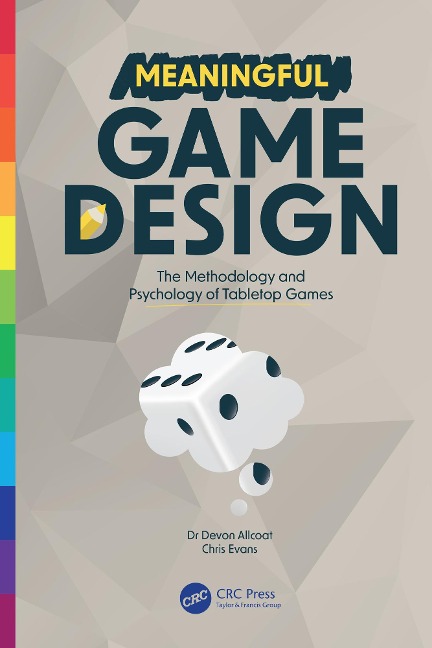
This book provides readers with the tools and methods with which to create effective tabletop games. It covers the design and development process thoroughly, guiding readers through the necessary mechanics, messages, and motivations of games that must be understood in order to build successful tabletop games, including serious educational games for teaching or training. Through a range of learning activities and methodologies, readers will develop an understanding of games and an appreciation for the creating and testing of game play whilst critically exploring the relationship between games, motivation, and learning. It includes chapters on design methodology, narrative, accessibility, playtesting, and more. This book will be of great interest to students of game design and serious game design courses. It will also appeal to designers, educators, and hobbyists interested in designing and developing their own tabletop games, educational or otherwise.
Dr Devon Allcoat completed her PhD in Psychology at the University of Warwick, in the United Kingdom. Her doctoral research explored the effects and applications of video games and virtual environments, particularly their cognitive effects and how they can be applied to education. In her current role at the University of Warwick she develops and teaches courses and modules in game design and development, whilst continuing with research projects on technology. She is an expert in game design, pedagogy, human-technology interaction, virtual reality, and mixed reality. Chris Evans is the Head of Technology Enhanced Learning at Warwick Manufacturing Group at the University of Warwick. In this role he is responsible for the strategic development, coordination and implementation of technology enhanced learning policies and initiatives. With over 20 years' experience within lecturing, teacher training, and technology enhanced learning, Chris has designed, implemented, and overseen numerous pedagogically driven game-based simulations within the tertiary learning sector. Chris also teaches game design at the University of Warwick and adopts a student centric, interactive, and highly innovative approach to teaching and learning.
Acknowledgements. About the Authors. Chapter 1 Introduction. Chapter 2 Serious Games. Chapter 3 Psychology and Pedagogy. Chapter 4 Design Methodology. Chapter 5 Accessibility. Chapter 6 Game Categories and Mechanics. Chapter 7 Narrative. Chapter 8 Deconstructing a Game. Chapter 9 Technology. Chapter 10 Visual Design. Chapter 11 Prototyping and Playtesting. Chapter 12 Taking Your Game to Market. Chapter 13 Evaluating and Writing about Your Serious Game. Chapter 14 Conclusion. References. Index.
Dieses eBook wird im PDF-Format geliefert und ist mit einem Adobe Kopierschutz (DRM) versehen. Sie können dieses eBook mit allen Geräten lesen, die das PDF-Format und den Adobe Kopierschutz (DRM) unterstützen.
Zum Beispiel mit den folgenden Geräten:
• tolino Reader
Laden Sie das eBook direkt über den Reader-Shop auf dem tolino herunter oder übertragen Sie das eBook auf Ihren tolino mit einer kostenlosen Software wie beispielsweise Adobe Digital Editions.
• Sony Reader & andere eBook Reader
Laden Sie das eBook direkt über den Reader-Shop herunter oder übertragen Sie das eBook mit der kostenlosen Software Sony READER FOR PC/Mac oder Adobe Digital Editions auf ein Standard-Lesegeräte mit epub- und Adobe DRM-Unterstützung.
• Tablets & Smartphones
Möchten Sie dieses eBook auf Ihrem Smartphone oder Tablet lesen, finden Sie hier unsere kostenlose Lese-App für iPhone/iPad und Android Smartphone/Tablets.
• PC & Mac
Lesen Sie das eBook direkt nach dem Herunterladen mit einer kostenlosen Lesesoftware, beispielsweise Adobe Digital Editions, Sony READER FOR PC/Mac oder direkt über Ihre eBook-Bibliothek in Ihrem Konto unter „Meine eBooks“ - „online lesen“.
Schalten Sie das eBook mit Ihrer persönlichen Adobe ID auf bis zu sechs Geräten gleichzeitig frei.
Bitte beachten Sie, dass die Kindle-Geräte das Format nicht unterstützen und dieses eBook somit nicht auf Kindle-Geräten lesbar ist.