Und dann auf "Zum Home-Bildschirm [+]".

Stöbern
genialokal zum Startbildschirm hinzufügen
Installieren Sie die genialokal App auf Ihrem Startbildschirm für einen schnellen Zugriff und eine komfortable Nutzung.
Installieren Sie die genialokal App auf Ihrem Startbildschirm für einen schnellen Zugriff und eine komfortable Nutzung.
Ihr gewünschter Artikel ist in 0 Buchhandlungen vorrätig - wählen Sie hier eine Buchhandlung in Ihrer Nähe aus:

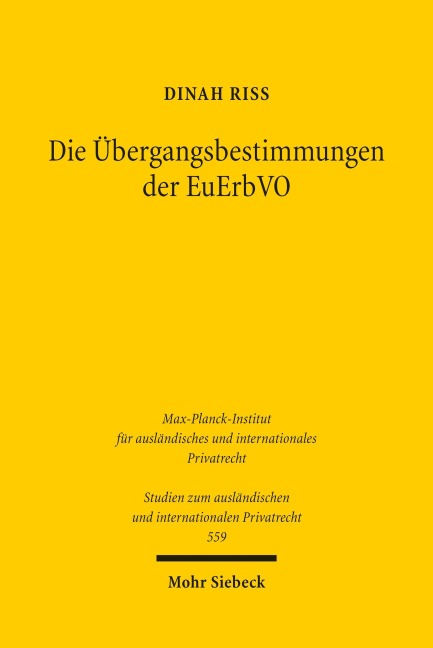
Dinah Riss examines the intertemporal conflict-of-laws provisions contained in Article 83 of the European Succession Regulation (EU Succession Regulation) from the perspective of the protection of legitimate expectations. Her analysis focuses on the tension between the state's interest in implementing the new legal regime and the protection of the legitimate expectations of those subject to the law.
The study begins by identifying the fundamental changes introduced by the EU Succession Regulation when compared with Germany's autonomous private international law of succession. The analysis of the transitional provisions is framed, on the one hand, by the rule-of-law limits that constrain legislators when enacting transitional legislation and, on the other hand, by the practical interpretative principles developed in intertemporal private international law. In this context, Dinah Riss addresses the prohibition of retroactive legislation under both European Union law and constitutional law and discusses the primacy of EU law. In interpreting Article 83 of the EU Succession Regulation, she follows the internal system of intertemporal conflict of laws as conceptualised by Burkhard Hess.
The author then analyses selected issues arising from the simultaneous applicability of the old and the new legal regimes. Particular attention is paid to the scope of the principle of favourability, with a special focus on the treatment of partial choices of law during the transitional period, the retroactive effect of individual transitional provisions, and the choice-of-law fiction contained in Article 83(4) of the EU Succession Regulation. She demonstrates that, in particular, the retroactive revival of a binding effect may result in a disproportionate interference with the testator's legitimate expectations. At the same time, the study develops concrete proposals for interpreting the Regulation in a manner that avoids violations of the prohibition of retroactivity and closes gaps in the protection of legitimate expectations.
Born 1996; studied law at the University of Cologne and Université Paris 1 Panthéon-Sorbonne; research stay at the University of Bordeaux; 2025 PhD; legal clerkship (Referendariat) at the Regional Court of Cologne.
§ 1 Einleitung
A. Einführung in die Problematik und die Fragestellung
B. Gang der Untersuchung
§ 2 Gegenüberstellung der Grundzüge des autonomen deutschen und europäischen Erbkollisionsrechts
A. Grundsatz der Nachlasseinheit im autonomen deutschen und europäischen Erbkollisionsrecht
B. Grundzüge der objektiven Anknüpfung
C. Grundzüge der subjektiven Anknüpfung
D. Zwischenergebnis
§ 3 Rechtsstaatliche Grenzen intertemporaler Gesetzgebung und Auslegungsmaximen im intertemporalen Privatrecht
A. Rechtsstaatliche Grenzen intertemporaler Gesetzgebung
B. Intertemporale Auslegungsmaximen
C. Zwischenergebnis
§ 4 Die Übergangsbestimmungen der EuErbVO im Einzelnen
A. Terminologie im europäischen intertemporalen Kollisionsrecht
B. Stichtagsregel (Art. 83 Abs. 1 EuErbVO)
C. Regelungsgehalt der intertemporalen Sonderbestimmungen (Art. 83 Abs. 2 bis Abs. 4 EuErbVO)
D. Strittige Einzelfragen der Übergangsbestimmungen
§ 5 Zusammenfassung der Ergebnisse