
Stöbern
genialokal zum Startbildschirm hinzufügen
Installieren Sie die genialokal App auf Ihrem Startbildschirm für einen schnellen Zugriff und eine komfortable Nutzung.
Installieren Sie die genialokal App auf Ihrem Startbildschirm für einen schnellen Zugriff und eine komfortable Nutzung.
Tippen Sie einfach auf Teilen:
 Und dann auf "Zum Home-Bildschirm [+]".
Ihr gewünschter Artikel ist in 0 Buchhandlungen vorrätig - wählen Sie hier eine Buchhandlung in Ihrer Nähe aus:

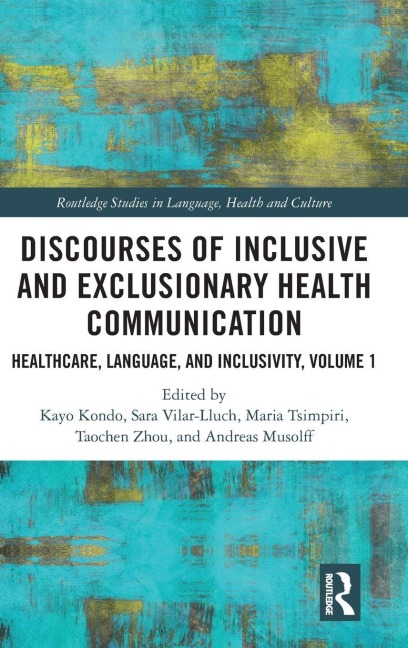
As the first of two companion volumes, this book provides a comprehensive collection of applied linguistics studies on health inclusivity, showcasing empirical research and methodological insights on different languages such as British Sign Language, Chinese, Danish, English, German, Japanese, and Spanish. The volume presents studies on health inclusivity based on first-hand patient experiences and explores the representation of health and illness across scientific, institutional, and media discourses. It features a wide range of linguistic methodologies and frameworks such as qualitative discourse studies, corpus-based discourse analysis, sociolinguistics, public involvement, narrative analysis, and metaphor analysis, as applied to a variety of contexts and communities. Integrating examples of projects and campaigns that promote inclusive healthcare, the chapters discuss potential practical implications and offer recommendations for applications to Equality, Diversity, and Inclusion (EDI). This is an essential resource for academics working in linguistics and discourse studies applied to healthcare, as well as students seeking deeper insights into how health communication, sociology, and health and social care workers can inform institutional practices and shape policy discussions, and broaden social perspectives of health inclusivity across a global scale.
Kayo Kondo is a Lecturer in Japanese Studies at the School of Modern Languages and Cultures, Durham University, UK. Her research collaborations extend across the UK and Japan, where she works closely with health and social care practitioners through research projects and academic seminars. Sara Vilar-Lluch is a Lecturer in Language and Linguistics at Cardiff University, Wales, UK. Her research interests are in discourse analysis, corpus linguistics, and Systemic Functional Linguistics, particularly as applied to health communication. Recent studies include applications to health guidance and immunization discourses. Maria Tsimpiri is a linguist with a research background in (im)politeness, cross-linguistic influence, and speech acts, and how their dynamic shift impacts global communication. Her pedagogical affiliation is with the University of East Anglia, UK. She is the founder and director of Logos UK. Taochen Zhou is Chinese Language Teaching and Learning Officer at the Confucius Institute at the University of Sheffield with a PhD in Applied Linguistics. Her research interests and publications focus on metaphor analysis, functional grammar, language acquisition, and language and aging. Andreas Musolff is Professor Emeritus of Intercultural Communication at the University of East Anglia, Norwich, UK. He has published widely on Political Discourse and Figurative Language.
List of Figures List of Tables List of Contributors Introduction: health (in)equality and communication Part I: Inclusive and respectful representations of health and illness in media discourses 1. Autism discourse in Japanese newspapers: An analysis of Yomiuri and Mainichi 2. "You try to educate and you try to educate, but then you just hit a wall." Healthcare and conspiracy narratives around COVID-19 3. Language of Mental Health: A Corpus-assisted Discourse Analysis of Mental Health in the Newspapers and Public Forums in Malaysia 4. Exploring ADHD stereotypes in the British press over time: from disruptive boys to contested diagnosis 5. 'They should get themselves a loving husband': Gender Stereotypes and Biases in Official and Public Health Narratives Across languages Part II: The power of narratives: respecting individual stories 6. Giving voice to deaf patients in Wales: Promoting more positive healthcare experiences through first-person narratives 7. Metaphorical language in signalling psychopathological experiences: a case study of interviews with trauma victims 8. What do people with communication difficulties want from their clinicians? 9. Voices from the Margins: The Value of a Blog for People with Communication Difficulties 10. The right to narrative freedom: a practice of inclusion 11. Making sense of breast cancer and migration: An Interpretive Phenomenological Analysis Index