Und dann auf "Zum Home-Bildschirm [+]".

Stöbern
genialokal zum Startbildschirm hinzufügen
Installieren Sie die genialokal App auf Ihrem Startbildschirm für einen schnellen Zugriff und eine komfortable Nutzung.
Installieren Sie die genialokal App auf Ihrem Startbildschirm für einen schnellen Zugriff und eine komfortable Nutzung.
Ihr gewünschter Artikel ist in 0 Buchhandlungen vorrätig - wählen Sie hier eine Buchhandlung in Ihrer Nähe aus:

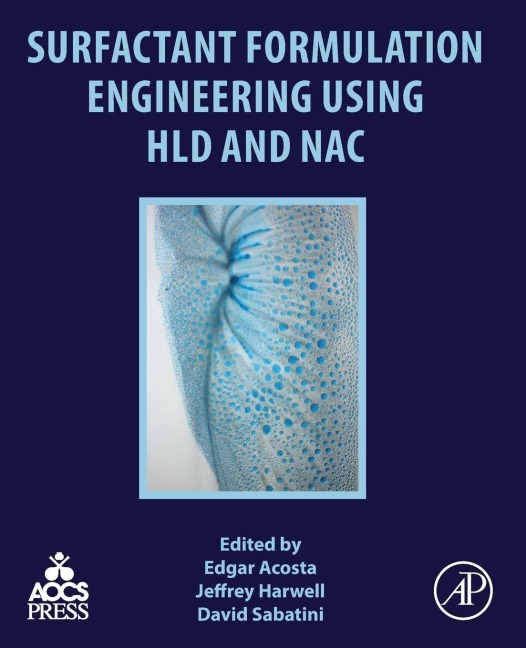
Surfactants are molecules that contain groups that are water-loving (hydrophilic) and oil-loving (lipophilic). The central question in formulations is often which of the two portions dominate the behavior of the surfactant. For many years that question was answered in terms of the surfactant structure only. However, the modern view is that the hydrophilic-lipophilic nature of the surfactant is the result of surfactant structure and formulation conditions (nature of the oil, temperature, aqueous phase composition) as captured by a semi-empirical equation called the hydrophilic-lipophilic difference (HLD). The HLD is a dimensionless number that indicate the approach to the point where the surfactant inverts its solubility from being water-soluble (negative HLD) to oil-soluble (positive HLD). The HLD alone is a good indicator of how the formulation could behave but it does not produce any formulation property that can be used to predict product performance. The net-average curvature (NAC) are a set of equations that take the value of HLD to predict the properties of the formulation, such as oil (and/or water) solubilization capacity, interfacial tension, phase diagrams, contact angle and others. Surfactant Formulation Engineering using HLD and NAC will not only introduce the reader to HLD-NAC but also to the practical use of these concepts in numerous applications ranging from application in the petroleum industry, to environmental remediation, to food, cosmetic and pharmaceutical applications, and even nanotechnology. The last part of the book will look at the molecular origins of the empirical terms in HLD via the Integrated Free Energy Model (IFEM).
1. Surfactant hydrophilicity-lipophilicity and its assessment 2. Effect of lipophilic and hydrophilic additives on the hydrophilic-lipophilic difference (HLD) 3. Design Aspects and Practices of Surfactant Formulations Used in Chemical EOR and Surfactant-Enhanced Aquifer Remediation 4. HLD-guided surfactant design for enhanced oil recovery applications 5. Detergency System Design: From Hydrophile-Lipophile Balance (HLB) to Hydrophilic-Lipophilic Deviation (HLD) 6. HLD-guided design of vegetable oil extraction technology 7. Formulation of microemulsion-based biofuels via the HLD framework 8. Catastrophic Inversion of Epoxy Emulsions 9. Using HLD as a Framework for Solutions Without your Parameters 10. High-throughput HLD-guided formulation design for latex and agrochemical formulations 11. High Throughput HLD Surfactant Characterization and Formulation 12. Net-Average Curvature (NAC) fundamentals and applications 13. A Formulator’s Guide to HLD-NAC 14. Basic HLD and NAC Applied to Household Cleaner Formulation - Advantages and Limitations 15. Engineering cold water detergents with the HLD-NAC 16. Engineering separation processes with the HLD-NAC 17. Engineering nanoscale materials with the HLD-NAC 18. Microemulsion Flash Calculations using an HLD-NAC Based Equation of State 19. Molecular thermodynamic basis: the Integrated Free Energy Model (IFEM)