
Stöbern
genialokal zum Startbildschirm hinzufügen
Installieren Sie die genialokal App auf Ihrem Startbildschirm für einen schnellen Zugriff und eine komfortable Nutzung.
Installieren Sie die genialokal App auf Ihrem Startbildschirm für einen schnellen Zugriff und eine komfortable Nutzung.
Tippen Sie einfach auf Teilen:
 Und dann auf "Zum Home-Bildschirm [+]".
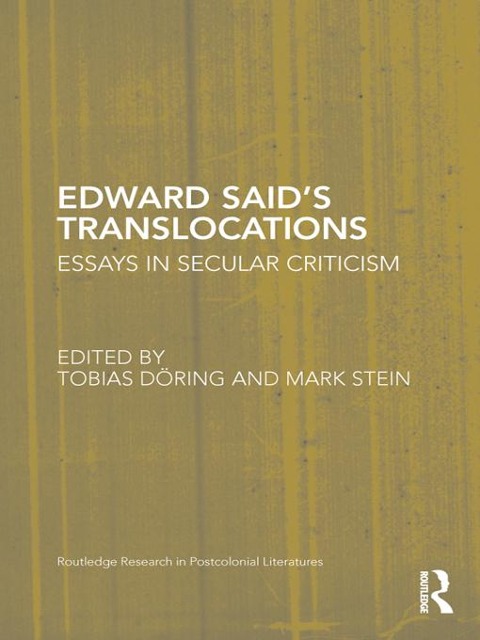
Working with processes of translocation enabled Edward Said to point out interdependence and complementarity across geographical borders and disciplinary boundaries while recognizing cultural difference and the distinct historical experiences of colonizer and colonized. This book brings into focus Said's politics of reading, from his literary criticism in English to his political columns in Arabic. The international contributors-from Britain, Egypt, France, Germany, India, Switzerland, and the United States-investigate his intellectual legacies without necessarily identifying themselves with the critical positions these involve. Instead of treating his work as a unitary theoretical system, the various arguments explored offer a critical assessment of those situations in which his writing has entered into a productive relationship with other theoretical positions and interlocutors. The collection considers location, which has always been a central category in and for Said's writing; readings, which designates the acts by which, according to Said, the world comes to be constituted; and legacies, which pertains to the many fields across the boundaries of established academic disciplines that have taken up Said's challenges. The critical positions visited in this book include critical and cultural theory, postcolonialism, literary studies, theatre and performance studies, and visual and music studies.
Tobias Döring is Chair of English Literature at the LMU Munich, where he specializes in Postcolonial and Early Modern Studies. His books include Caribbean-English Passages (Routledge, 2002), A History of Postcolonial Literature in 12 1/2 Books (WVT, 2007) and Postcolonial Literatures in English: An Introduction (Klett, 2008). Mark Stein is Chair of English, Postcolonial and Media Studies at WWU Münster and President of the Association for the Study of the New Literatures in English (ASNEL). His research interests include anglophone cultural production from around the globe; transmigration and Diaspora studies; and critical and cultural theory.
Introduction: Edward Said's Translocations Part I. 1. Edward Said: Opponent of Postcolonial Theory Robert J.C. Young 2. Religion and Dissent in Said's Secular Criticism Gauri Viswanathan 3. The Archaeology of Said: Father Foucault, Dieu Derrida, and Other (Af)Filiations Chantal Zabus 4. A Glorious Achievement: Edward Said and the Last Jewish Intellectual Bryan CheyettePart II. 5. Re-Reading Said in Arabic: (Other)worldly Counterpoints Markus Schmitz 6. Edward Said and the Practice of Comparative Literature Ferial J. Ghazoul 7. Out of Place or Caught in the Middle: Edward Said's Thinking Between Humanism and Poststructuralism Rainer Emig 8. Overlapping Territories-- 'Exilic' Readings: Edward Said and the Emergence of Critical Empire Analysis in American Literary Scholarship Gesa MackenthunPart III. 9. Orientalism, Opera, and the Public Sphere Christopher Balme 10. The Art of Counterpoint: Music as Site and Tool in Postcolonial Readings Alexander Honold 11. Picturing Palestine: Edward Said and the Fiction of Photography Tobias Döring
Dieses eBook wird im PDF-Format geliefert und ist mit einem Adobe Kopierschutz (DRM) versehen. Sie können dieses eBook mit allen Geräten lesen, die das PDF-Format und den Adobe Kopierschutz (DRM) unterstützen.
Zum Beispiel mit den folgenden Geräten:
• tolino Reader
Laden Sie das eBook direkt über den Reader-Shop auf dem tolino herunter oder übertragen Sie das eBook auf Ihren tolino mit einer kostenlosen Software wie beispielsweise Adobe Digital Editions.
• Sony Reader & andere eBook Reader
Laden Sie das eBook direkt über den Reader-Shop herunter oder übertragen Sie das eBook mit der kostenlosen Software Sony READER FOR PC/Mac oder Adobe Digital Editions auf ein Standard-Lesegeräte mit epub- und Adobe DRM-Unterstützung.
• Tablets & Smartphones
Möchten Sie dieses eBook auf Ihrem Smartphone oder Tablet lesen, finden Sie hier unsere kostenlose Lese-App für iPhone/iPad und Android Smartphone/Tablets.
• PC & Mac
Lesen Sie das eBook direkt nach dem Herunterladen mit einer kostenlosen Lesesoftware, beispielsweise Adobe Digital Editions, Sony READER FOR PC/Mac oder direkt über Ihre eBook-Bibliothek in Ihrem Konto unter „Meine eBooks“ - „online lesen“.
Schalten Sie das eBook mit Ihrer persönlichen Adobe ID auf bis zu sechs Geräten gleichzeitig frei.
Bitte beachten Sie, dass die Kindle-Geräte das Format nicht unterstützen und dieses eBook somit nicht auf Kindle-Geräten lesbar ist.