
Stöbern
genialokal zum Startbildschirm hinzufügen
Installieren Sie die genialokal App auf Ihrem Startbildschirm für einen schnellen Zugriff und eine komfortable Nutzung.
Installieren Sie die genialokal App auf Ihrem Startbildschirm für einen schnellen Zugriff und eine komfortable Nutzung.
Tippen Sie einfach auf Teilen:
 Und dann auf "Zum Home-Bildschirm [+]".
Ihr gewünschter Artikel ist in 0 Buchhandlungen vorrätig - wählen Sie hier eine Buchhandlung in Ihrer Nähe aus:

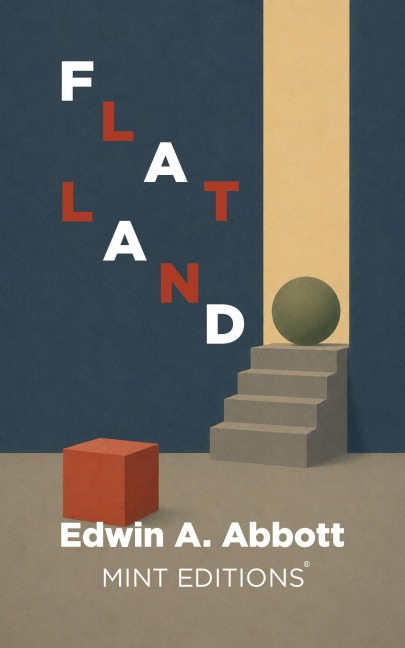
An evergreen science fiction classic, Edwin A. Abbott’s Flatland presents an alternate vision of society rendered completely in two dimensions. In the titular Flatland, women are line segments and men are polygons with various side lengths and angles. Even in such a simple world, social hierarchies and inequality persist. Social status is determined by a man’s regularity of shape and their number of sides. Women, as line segments, are considered dangerous because they can disappear from view and wound others with their end points. In addition to its social critique, Flatland has also been widely praised by scientists like Carl Sagan and Stephen Hawking as a useful thought experiment for conceptualizing life in higher and lower dimensions. Since our inception in 2020, Mint Editions has kept sustainability and innovation at the forefront of our mission. Each and every Mint Edition title gets a fresh, professionally typeset manuscript and a dazzling new cover, all while maintaining the integrity of the original book. With thousands of titles in our collection, we aim to spotlight diverse public domain works to help them find modern audiences. Mint Editions celebrates a breadth of literary works, curated from both canonical and overlooked classics from writers around the globe.
Edwin Abbott Abbott (1838-1926) was an author, schoolmaster, Anglican priest, and theologian. Born in London, he excelled at both the City of London School and St. John’s College, taking the highest honors in classics, mathematics, and theology. After retiring as the headmaster of the City of London School (a position he earned at the age of 26) in 1889, he dedicated his life to literary and theological pursuits. Beyond expounding on his open-minded approach to theology, he also wrote a Shakespearean Grammar that is still considered to be a central piece of English philology. He is best remembered for his 1884 novella Flatland: A Romance of Many Dimensions, an evergreen piece of proto-Science Fiction that still inspires authors and readers to this day.
Part I: This World 13 I. Of the Nature of Flatland 15 II. Of the Climate and Houses in Flatland 17 III. Concerning the Inhabitants of Flatland 20 IV. Concerning the Women 24 V. Of our Methods of Recognizing one another 30 VI. Of Recognition by Sight 35 VII. Concerning Irregular Figures 41 VIII. Of the Ancient Practice of Painting 45 IX. Of the Universal Colour Bill 48 X. Of the Suppression of the Chromatic Sedition 52 XI. Concerning our Priests 57 XII. Of the Doctrine of our Priests 60 Part II: Other Worlds 65 XIII. How I had a Vision of Lineland 67 XIV. How I vainly tried to explain the nature of Flatland 72 XV. Concerning a Stranger from Spaceland 78 XVI. How the Stranger vainly endeavoured to reveal to me in words the mysteries of Spaceland 82 XVII. How the Sphere, having in vain tried words, resorted to deeds 90 XVIII. How I came to Spaceland, and what I saw there 93 XIX. How, though the Sphere shewed me other mysteries of Spaceland, I still desired more; and what came of it 99 XX. How the Sphere encouraged me in a Vision 107 XXI. How I tried to teach the Theory of Three Dimensions to my Grandson, and with what success 110 XXII. How I then tried to diffuse the Theory of Three Dimensions by other means, and of the result 113