
Stöbern
genialokal zum Startbildschirm hinzufügen
Installieren Sie die genialokal App auf Ihrem Startbildschirm für einen schnellen Zugriff und eine komfortable Nutzung.
Installieren Sie die genialokal App auf Ihrem Startbildschirm für einen schnellen Zugriff und eine komfortable Nutzung.
Tippen Sie einfach auf Teilen:
 Und dann auf "Zum Home-Bildschirm [+]".

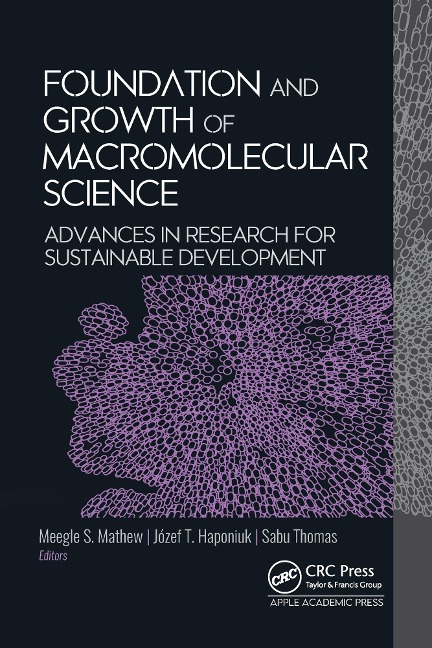
This new volume explores the foundation of macromolecular science along with the field's current challenges and solutions to challenges. The book discusses many new applications that have emerged recently based on different polymers and their composites, inlcuding some on the application of polymer composite in electromagnetic interference (EMI) shielding, sensing, and wound healing. This book discusses innovations in the synthesis and characterization of many different classes of polymers and provides in-depth explanations of the behavior of polymers in solutions and in bulk. It considers the synthesis, characterization properties, and applications of many polymer composites and nanomaterials. The diverse topics cover zein-based composites, nanocellulose extracted as a potential filler for polymers, polymers to strengthen concrete, polymer/metal nanocomposite magnetic materials, synthetic polymers in aquatic environments, pharmaceutical 3D-printing, alginate-based wound healing dressings, and more. Many chapters in the volume place emphasis on sustainable development and green eco-friendly approaches. This volume will help researchers to understand the significance of macromolecular science and research advances for sustainable development for the benefit of humanity. It emphasizes the many roles of macromolecular science in the important fields of science, such as chemistry, physics, engineering, biology, pharmaceutical science, and more.
Meegle S. Mathew, PhD, is an Assistant Professor in the Postgraduate and Research Department of Chemistry at Mar Anthanasius College, Kothamangalam, India. Dr. Mathew worked as a postdoctoral fellow for three years at the School of Energy Materials, Mahatma Gandhi University, Kottayam. She has published research articles, been granted an Indian patent, edited two books, and published several book chapters. She works in a multidisciplinary area that combines nanoscience with biomedicine and energy conversion systems. Her research interest areas are nano-biophotonics, optical imaging, the development of biosensors and biomedical devices using fluorescent nanoparticles, polymer nanocomposites for biomedical applications, photocatalysis, and photoreduction. Józef T. Haponiuk, PhD, has been the Head of the Polymers Technology Department at the Faculty of Chemistry of Gdansk University of Technology, Poland, since 2006. He is the author or co-author of over 300 original scientific papers, includingg 90 published in periodicals. He is also editor and coauthor of publications from Apple Academic Press and the Royal Society of Chemistry, and creator of 11 granted patents and 25 patent applications. A valued academic teacher in the field of polymer chemistry and engineering, he has been a supervisor for over 12 PdD theses. Sabu Thomas, PhD, is the Chairman of Trivandrum Engineering Science and Technology Resesarch Park, Kerala, India. He is also the former Vice Chancellor at Mahatma Gandhi University, Kottayam, as well as Director of the School of Energy Materials; and Founder, Director and Professor at the International and Inter University Center for Nanoscience and Nanotechnology, Kottayam. A prolific author and editor, Prof. Thomas has received international acclaim for his work, including having been conferred with an Honoris Causa DSc from the University of South Brittany, France, and the University of Lorraine, France; and being named a Foreign Fellow of the European Academy of Sciences (EurASc).
1. Introduction - Foundation and Growth of Macromolecular Science: Advances in Research for Sustainable Development 2. Synthesis and Characterization of Chitosan-Starch and Glutaric Acid Films 3. Bio-Based Polymer Science: From Past to Future in a Biodegradability and Eco-Friendly Context 4. Zein-Based Composites: Synthesis, Characterization Properties, and Applications 5. Nanocellulose Extracted from Nutshells as a Potential Filler for Polymers: A Green Approach 6. Synthesis and Characterization of Polymer/Metal Nanocomposite Magnetic Materials 7. Polymeric Materials to Improve Durability and Sustainability of Cement Concrete: A Brief Overview 8. Protein-Polyelectrolyte Complexes: Structure and Properties 9. Introduction to DNA Nanomechanics: Theory and Simulations 10. The Ultrasonic-Assisted Synthesis of Locust Gum/PEG- Silver Nanoparticles and Its Mathematical Modeling of Rheological Parameters 11. Macromolecular-Enzymes-Triggered Electrochemical Biosensing 12. Supramolecular Gel-Based Materials for Sensing Environmentally Sensitive Molecules 13. Dielectric and AC Conductivity Studies of Ag: CdZnTe-PVA Films 14. Electric Circuit Modeling of Impedance Spectroscopic Characteristics of GFRP Nanocomposites with Hybrid Carbon Nanofillers 15. The Role of Synthetic Polymers in the Aquatic Environment and Their Implications in Danio Rerio as a Model Organism 16. Alginate-Based Wound-Healing Dressings 17. Pharmaceutical 3D-Printing: Insights into Polymeric Armamentarium and Saga of Product Fabrication