Und dann auf "Zum Home-Bildschirm [+]".

Stöbern
genialokal zum Startbildschirm hinzufügen
Installieren Sie die genialokal App auf Ihrem Startbildschirm für einen schnellen Zugriff und eine komfortable Nutzung.
Installieren Sie die genialokal App auf Ihrem Startbildschirm für einen schnellen Zugriff und eine komfortable Nutzung.
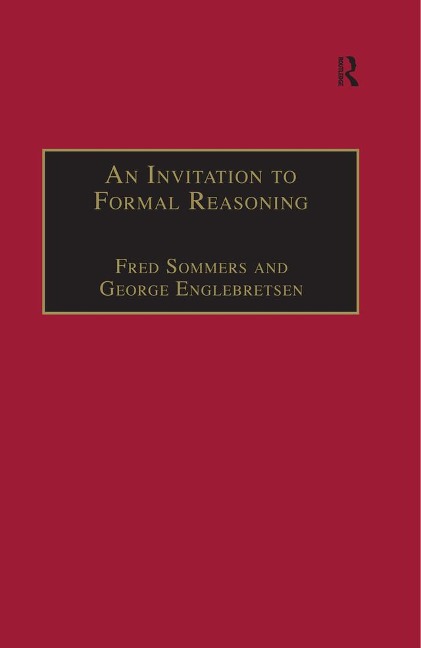
An Invitation to Formal Reasoning introduces the discipline of formal logic by means of a powerful new system formulated by Fred Sommers. This system, term logic, is different in a number of ways from the standard system employed in modern logic; most striking is its greater simplicity and naturalness. Based on a radically different theory of logical syntax than the one Frege used when initiating modern mathematical logic in the 19th Century, term logic borrows insights from Aristotle's syllogistic, Scholastic logicians, Leibniz, and the 19th century British algebraists. Term logic takes its syntax directly from natural language, construing statements as combinations of pairs of terms, where complex terms are taken to have the same syntax as statements. Whereas standard logic requires extensive 'translation' from natural language to symbolic language, term logic requires only 'transcription' into the symbolic language. Its naturalness is the result of its ability to stay close to the forms of sentences usually found in every day discourse. Written by the founders of the term logic approach, An Invitation to Formal Reasoning is a unique introduction and exploration of this new system, offering numerous exercises and examples throughout the text. Summarising the standard system of mathematical logic to set term logic in context, and showing how the two systems compare, this book presents an alternative approach to standard modern logic for those studying formal logic, philosophy of language or computer theory. Fred Sommers is Professor Emeritus, Brandeis University, USA; George Englebretsen is Professor of Philosophy, Bishop's University, Canada.
Fred Sommers, George Englebretsen
Contents: Reasoning: Introduction; The form of an argument; A word about the form of statements; The form of singular statements; Terms and statements; Symbolizing compound statements; A word about validity; How material expressions are meaningful; Terms; Some terms are 'vacuous'; Statement meaning; Truth and correspondence to facts; Propositions; 'States of affairs'; The facts and the facts; What statements denote; Summary and discussion on the meaning of statements; Picturing Propositions: State diagrams; Representing singular propositions; Entailments; Negative entailments; States and states; Positive and negative 'valence'; The limitations of state diagrams; The statement use of sentences; Truth relations; Logical syntax.
Dieses eBook wird im PDF-Format geliefert und ist mit einem Adobe Kopierschutz (DRM) versehen. Sie können dieses eBook mit allen Geräten lesen, die das PDF-Format und den Adobe Kopierschutz (DRM) unterstützen.
Zum Beispiel mit den folgenden Geräten:
• tolino Reader
Laden Sie das eBook direkt über den Reader-Shop auf dem tolino herunter oder übertragen Sie das eBook auf Ihren tolino mit einer kostenlosen Software wie beispielsweise Adobe Digital Editions.
• Sony Reader & andere eBook Reader
Laden Sie das eBook direkt über den Reader-Shop herunter oder übertragen Sie das eBook mit der kostenlosen Software Sony READER FOR PC/Mac oder Adobe Digital Editions auf ein Standard-Lesegeräte mit epub- und Adobe DRM-Unterstützung.
• Tablets & Smartphones
Möchten Sie dieses eBook auf Ihrem Smartphone oder Tablet lesen, finden Sie hier unsere kostenlose Lese-App für iPhone/iPad und Android Smartphone/Tablets.
• PC & Mac
Lesen Sie das eBook direkt nach dem Herunterladen mit einer kostenlosen Lesesoftware, beispielsweise Adobe Digital Editions, Sony READER FOR PC/Mac oder direkt über Ihre eBook-Bibliothek in Ihrem Konto unter „Meine eBooks“ - „online lesen“.
Schalten Sie das eBook mit Ihrer persönlichen Adobe ID auf bis zu sechs Geräten gleichzeitig frei.
Bitte beachten Sie, dass die Kindle-Geräte das Format nicht unterstützen und dieses eBook somit nicht auf Kindle-Geräten lesbar ist.