
Stöbern
genialokal zum Startbildschirm hinzufügen
Installieren Sie die genialokal App auf Ihrem Startbildschirm für einen schnellen Zugriff und eine komfortable Nutzung.
Installieren Sie die genialokal App auf Ihrem Startbildschirm für einen schnellen Zugriff und eine komfortable Nutzung.
Tippen Sie einfach auf Teilen:
 Und dann auf "Zum Home-Bildschirm [+]".
Ihr gewünschter Artikel ist in 0 Buchhandlungen vorrätig - wählen Sie hier eine Buchhandlung in Ihrer Nähe aus:

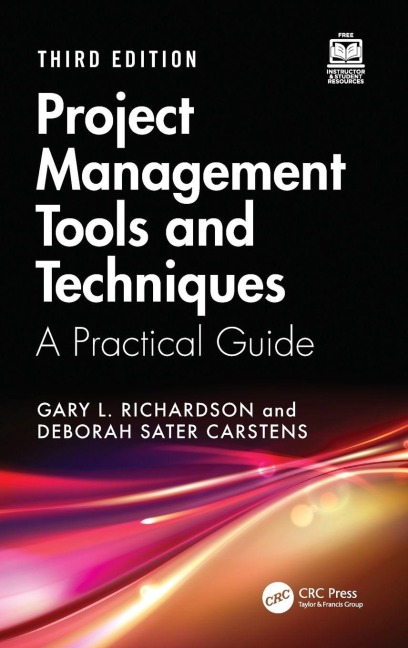
This new edition fills a void in the realm of project management tools and techniques. By integrating screenshots featuring the most up-to-date MS Project software into the content, students are equipped with essential skills needed to excel in project management.
Gary L. Richardson, PhD, earned a BS in mechanical engineering at Louisiana Tech, an AFIT post-graduate program in meteorology at the University of Texas, an MS in engineering management at the University of Alaska, and a PhD in business administration at the University of North Texas. Before his retirement, Dr. Richardson was a Project Management Institute (PMI) Houston Endowed Professor at the University of Houston in the College of Technology's graduate project management program in Texas, USA. His distinguished career spanned military service as a U.S. Air Force officer, academic positions at multiple universities, author of thirteen professional texts and numerous articles on general project management and information technology, and extensive industry experience, including roles as Managing Director of IT at a Texaco/Aramco joint venture and at Service Corporation International. Dr. Richardson held professional certifications as a Professional Engineer (PE), PMP, and Certification in Earned Value Management (EVM), taught project management internationally across five countries, and was recognized as a finalist for Outstanding IT Executive in the South Texas Region in 1991. Deborah Sater Carstens, PhD, PMP, is a Professor of Aviation Human Factors and Graduate Program Chair at the Florida Institute of Technology (Florida Tech), College of Aeronautics in Florida, USA. She is the Director of the Human Factors: Aeronautics, Safety, Sociability, Interfaces, Stress, and Training (HF ASSIST) Lab and the Site Director for the Federal Aviation Administration (FAA) Partnership to Enhance General Aviation Safety, Accessibility, and Sustainability (PEGASAS) Center of Excellence. From 1992 to 2003, Dr Carstens was a civil servant for the National Aeronautics and Space Administration (NASA) at the Kennedy Space Center (KSC), researching and managing Space Shuttle program studies, and she returned during a fall 2024 sabbatical for MARS-related human factors research. Throughout her career, Dr. Carstens has been principal investigator or team member on funded research for numerous organizations, including NASA, the Small Business Administration (SBA), Florida Department of Education (DOE), Department of Health and Human Services (DHHS), Defense Advanced Research Projects Agency (DARPA), and Oak Ridge Associated Universities (ORAU), focusing on project management and human factors. She earned a PhD in industrial engineering and a BS in business administration at the University of Central Florida, plus an MBA at Florida Tech, has authored over 90 peer-reviewed publications, including four project management books, and has advised several award-winning teams in the Airport Cooperative Research Program (ACRP) Transportation Research Board (TRB) National Competition since 2018.
Section I: Background. 1. Introduction to Project Management and Its Tools. 2. Role of the Project Manager. 3. Project Management Environment. 4. Gaining Support for a Project. Section II: Planning Processes. 5. Scope Management. 6. Quickstart Example. 7. Developing the Project Schedule. 8. Developing the Project Budget. 9. Creating a Viable Project Plan. Section III: Execution Processes. 10. Communication and Team Management. 11. Project Financial Analyses. 12. Project Performance Metrics. 13. Project Performance Tracking. 14. Earned Value Management. 15. Resource Leveling. Section IV: Support Processes. 16. Risk Management. 17. Project Control Concepts. 18. Project Model Reality Notes. Section V: Advanced Techniques. 19. Project Iterative Concepts. 20. Project Simulation. 21. Critical Chain Model. 22. Variable Time Status Model. 23. Hybrid Conceptual Model. 24. Concluding Remarks.