Und dann auf "Zum Home-Bildschirm [+]".

Stöbern
genialokal zum Startbildschirm hinzufügen
Installieren Sie die genialokal App auf Ihrem Startbildschirm für einen schnellen Zugriff und eine komfortable Nutzung.
Installieren Sie die genialokal App auf Ihrem Startbildschirm für einen schnellen Zugriff und eine komfortable Nutzung.
Ihr gewünschter Artikel ist in 0 Buchhandlungen vorrätig - wählen Sie hier eine Buchhandlung in Ihrer Nähe aus:


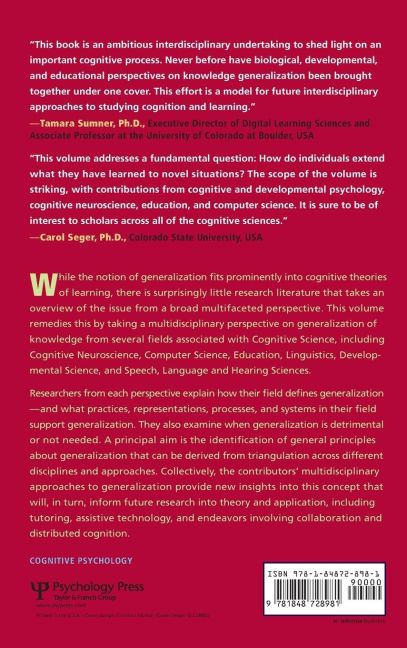
This volume takes a multi-disciplinary perspective on generalization of knowledge from several fields associated with Cognitive Science, including Cognitive Neuroscience, Computer Science, Education, Linguistics, Developmental Science, and Speech, Language and Hearing Sciences. The aim is to derive general principles from triangulation across different disciplines and approaches.
Marie T. Banich, Donna Caccamise
Preface. Part 1. Cognitive Neuroscience Approaches to Generalization. N.C. Huff, K. LaBar, Generalization and Specialization of Conditioned Learning. R.W. McGugin, J. Tanaka, Transfer and Interference in Perceptual Expertise: When Expertise Helps and When it Hurts. R. Poldrack, V. Carr, K. Foerde, Flexibility and Generalization in Memory Systems. Part 2. Developmental Perspectives on Generalization. L. Gerken, F.K. Balcomb, Three Observations About Infant Generalization and Their Implications for Generalization Mechanisms. A.V. Fisher, Mechanisms of Induction Early in Development. J. Lany, R.L. Gomez, Prior Experience Shapes Abstraction and Generalization in Language Acquisition. Part 3. Representations that Support Generalization. T.L. Griffiths, Bayesian Models as Tools for Exploring Inductive Biases. M. Huenerfauth, Representing American Sign Language Classifier Predicates Using Spatially Parameterized Planning Templates. K. Levering, K.J. Kurtz, Generalization in Higher-order Cognition: Categorization and Analogy as Bridges to Stored Knowledge. Part 4. Educational, Training Approaches to Generalization. A.C. Graesser, D. Lin, S. D'Mello, Computer Learning Environments with Agents that Support Deep Comprehension and Collaborative Learning. R. Hall, K. Wieckert, K. Wright, How Does Cognition Get Distributed? Case Studies of Making Concepts General in Technical and Scientific Work. C.K. Thompson, Generalization in Language Learning: the Role of Structural Complexity. Part 5. Technological Approaches to Generalization. J. McGrenere, A. Bunt, L. Findlater, K. Moffatt, Generalization in Human-Computer Interaction Research. K.R. Butcher, S. de la Chica, Supporting Student Learning with Adaptive Technology: Personalized Conceptual Assessment and Remediation. S.P. Carmien, G. Fischer, Beyond Human-Computer Interaction: Meta-Design in Support of Human Problem-Domain Interaction. M.T. Banich, D.J. Caccamise, In Summary. Index.