
Stöbern
genialokal zum Startbildschirm hinzufügen
Installieren Sie die genialokal App auf Ihrem Startbildschirm für einen schnellen Zugriff und eine komfortable Nutzung.
Installieren Sie die genialokal App auf Ihrem Startbildschirm für einen schnellen Zugriff und eine komfortable Nutzung.
Tippen Sie einfach auf Teilen:
 Und dann auf "Zum Home-Bildschirm [+]".
Ihr gewünschter Artikel ist in 0 Buchhandlungen vorrätig - wählen Sie hier eine Buchhandlung in Ihrer Nähe aus:

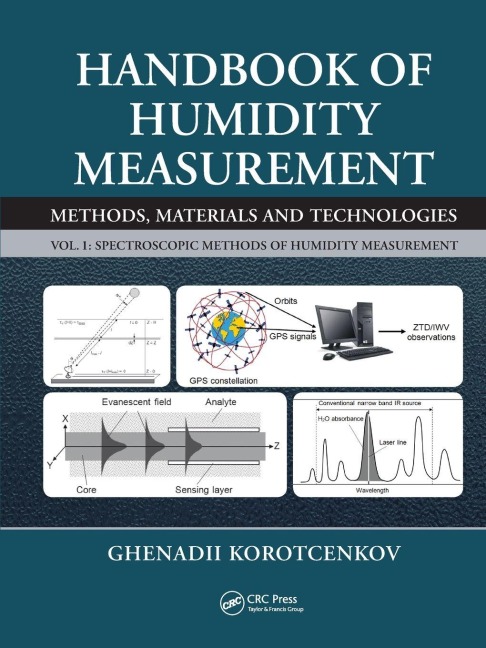
This volume comprehensively covers humidity measurement devices based on optical principles of measurement and optical and fiber-optics. This volume describes the reasons for controlling the humidity, features of water and water vapors, and units used for humidity measurement.
Ghenadii Korotcenkov received his PhD in Physics and Technology of Semiconductor Materials and Devices in 1976, and his Habilitate Degree (Dr.Sci.) in Physics and Mathematics of Semiconductors and Dielectrics in 1990. For many years, he was a leader of the Gas Sensor Group, and manager of various national and international scientific and engineering projects carried out in the Laboratory of Micro- and Optoelectronics, Technical University of Moldova. Currently, Dr. Korotcenkov is a research Professor at the Gwangju Institute of Science and Technology, Republic of Korea. His research has included significant work on Schottky barriers, MOS structures, native oxides, and photo receivers on the base of III-Vs compounds. He continues with research in various aspects of materials sciences and surface science, with a particular focus on nanostructured metal oxides and solid state gas sensor design. Dr. Korotcenkov is the author or editor of eleven books and special issues, eleven invited review papers, seventeen book chapters, and more than 190 peer-reviewed articles. His research activities have been honored with the Award of the Supreme Council of Science and Advanced Technology of the Republic of Moldova (2004) and The Prize of the Presidents of the Ukrainian, Belarus and Moldovan Academies of Sciences (2003), among many others.
PART 1: Introduction In Humidity Measurements. Water, water vapors and humidity.Why do we need to control humidity? Part 2: Humidity Monitoring using Absorption of Electromagnetic Radiation. Optical hygrometers. IR optical hygrometers. Atmosphere monitoring using methods of absorption of electromagnetic radiation. Atmosphere monitoring using methods of microwave absorption. GPS monitoring of atmospheric water vapor.Atmosphere monitoring using methods of absorption of electromagnetic radiation. LIDAR systems for atmosphere monitoring. Upper tropospheric and stratospheric water vapour control. Part 3: Optical and Fiber-Optic Humidity Sensors. Introduction in humidity measurement by optical and fiber-optic sensors. Optical and Fiber-Optic Humidity Sensors: General consideration. Absorption or colorimetric-based optical humidity sensors. Moisture indicators (3-1-2-1). Refractometry-based optical humidity sensors. Luminescence (fluorescence)-based humidity sensors. Interferometric humidity sensors. Microfiber-based humidity sensors. Humidity sensors based on special fibers. Surface Plasmon resonance-based humidity sensors. Lossy mode resonance based humidity sensors. Ellipsometry-based humidity sensors. Design and fabrication of optical and fiber-optic humidity sensors. Integrated humidity sensors. Outlook: State of the art and future prospects of optical and fiber-optic sensors.