Und dann auf "Zum Home-Bildschirm [+]".

Stöbern
genialokal zum Startbildschirm hinzufügen
Installieren Sie die genialokal App auf Ihrem Startbildschirm für einen schnellen Zugriff und eine komfortable Nutzung.
Installieren Sie die genialokal App auf Ihrem Startbildschirm für einen schnellen Zugriff und eine komfortable Nutzung.
Ihr gewünschter Artikel ist in 0 Buchhandlungen vorrätig - wählen Sie hier eine Buchhandlung in Ihrer Nähe aus:

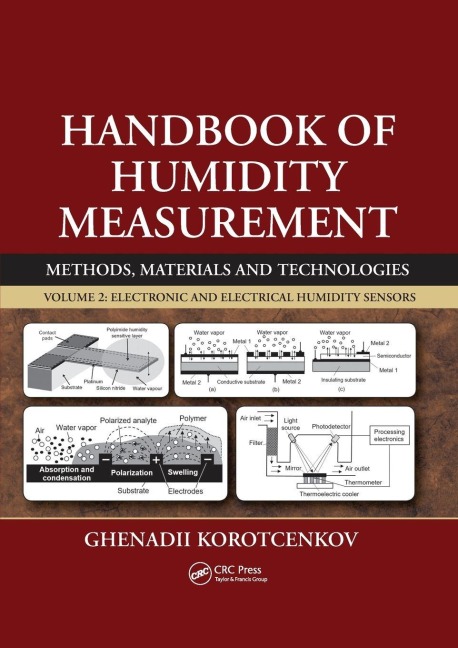
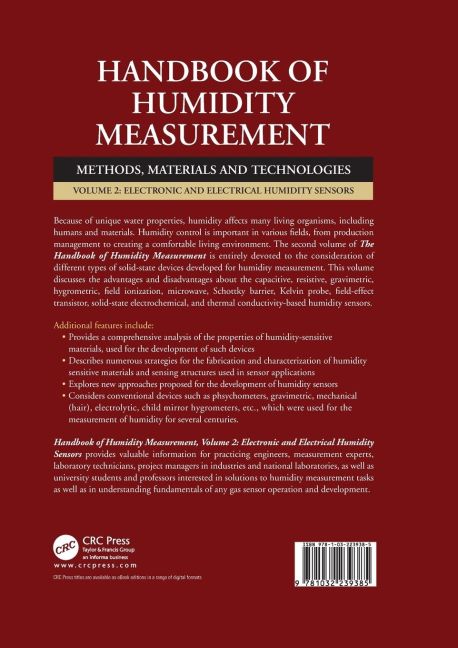
Because of unique water properties, humidity affects many living organisms, including humans and materials. Humidity control is important in various fields, from production management to creating a comfortable living environment. The second volume of The Handbook of Humidity Measurement is entirely devoted to the consideration of different types of solid-state devices developed for humidity measurement. This volume discusses the advantages and disadvantages about the capacitive, resistive, gravimetric, hygrometric, field ionization, microwave, Schottky barrier, Kelvin probe, field-effect transistor, solid-state electrochemical, and thermal conductivity-based humidity sensors. Additional features include: Provides a comprehensive analysis of the properties of humidity-sensitive materials, used for the development of such devices.
Describes numerous strategies for the fabrication and characterization of humidity sensitive materials and sensing structures used in sensor applications.
Explores new approaches proposed for the development of humidity sensors.
Considers conventional devices such as phsychometers, gravimetric, mechanical (hair), electrolytic, child mirror hygrometers, etc., which were used for the measurement of humidity for several centuries.
Handbook of Humidity Measurement, Volume 2: Electronic and Electrical Humidity Sensors provides valuable information for practicing engineers, measurement experts, laboratory technicians, project managers in industries and national laboratories, as well as university students and professors interested in solutions to humidity measurement tasks as well as in understanding fundamentals of any gas sensor operation and development.
Ghenadii Korotcenkov received his PhD in Physics and Technology of Semiconductor Materials and Devices in 1976, and his Habilitate Degree (Dr.Sci.) in Physics and Mathematics of Semiconductors and Dielectrics in 1990. For many years, he was a leader of the Gas Sensor Group, and manager of various national and international scientific and engineering projects carried out in the Laboratory of Micro- and Optoelectronics, Technical University of Moldova. Currently, Dr. Korotcenkov is a research Professor at the Gwangju Institute of Science and Technology, Republic of Korea. His research has included significant work on Schottky barriers, MOS structures, native oxides, and photo receivers on the base of III-Vs compounds. He continues with research in various aspects of materials sciences and surface science, with a particular focus on nanostructured metal oxides and solid state gas sensor design. Dr. Korotcenkov is the author or editor of eleven books and special issues, eleven invited review papers, seventeen book chapters, and more than 190 peer-reviewed articles. His research activities have been honored with the Award of the Supreme Council of Science and Advanced Technology of the Republic of Moldova (2004) and The Prize of the Presidents of the Ukrainian, Belarus and Moldovan Academies of Sciences (2003), among many others.
Introduction in Humidity Sensors. Introduction in electronic and electrical humidity sensors. Conventional Methods and Brief History of Humidity Measurements. Gravimetric method of humidity measurement. Mechanical (hair) hygrometer. Psychrometer. Chilled mirror hygrometer or mirror-based dew-point sensors. Heated salt-solution method for humidity measurement. Electrolytic or coulometric hygrometers. Humidity measurement based on Karl Fischer titration. Other conventional methods of humidity measurement. Electronic and Electrical Humidity Sensors and Basic Principles of their Operation. -apacitance-based humidity sensors. Resistive humidity sensors. Gravimetric humidity sensors. Cantilever- and membrane-based humidity sensors. Thermal conductivity-based hygrometers. Field ionization humidity sensors. Humidity sensors based on thin film and field-effect transistors. Hetero-junction-based humidity sensors. Kelvin probe as a humidity sensor. Solid state electrochemical humidity sensors. New Trends and Outlook. Microwave-based humidity sensors. Integrated humidity sensors. Humidity sensors on flexible substrate. Non-traditional approaches to humidity measurement. Summary and outlook.