Und dann auf "Zum Home-Bildschirm [+]".

Stöbern
genialokal zum Startbildschirm hinzufügen
Installieren Sie die genialokal App auf Ihrem Startbildschirm für einen schnellen Zugriff und eine komfortable Nutzung.
Installieren Sie die genialokal App auf Ihrem Startbildschirm für einen schnellen Zugriff und eine komfortable Nutzung.
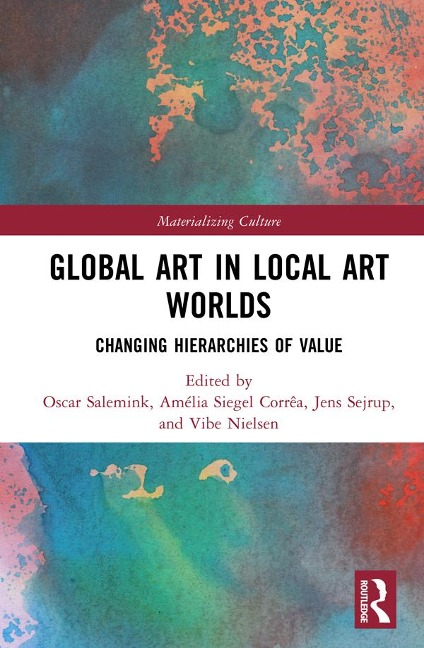
This book explores the attribution and local negotiation of cultural valuations of artistic and art-institutional practices around the world, and considers the diverse ways in which these value attributions intersect with claims of universality and cosmopolitanism. Taking Michael Herzfeld's notion of the "global hierarchy of value" as point of departure, the volume brings together six empirical studies of the collection, circulation, classification and exhibition of objects in present-day Brazil, China, India, Japan, South Africa and Indigenous Australia in light of Europe's loss of global hegemony. Including reflections by a number of senior scholars, the chapters demonstrate that the question of valuation lies at the heart of artistic and art-institutional practices writ large - including museum practices, museum architecture, galleries, auction houses, art fairs and biennales.
Oscar Salemink is Professor of Anthropology at the University of Copenhagen, Denmark. Amélia Siegel Corrêa is an independent curator, researcher and a Lecturer in Art History at the Pontificia Universidade Catolica do Parana, Brazil. Jens Sejrup is Assistant Professor of Japanese Studies at the University of Copenhagen, Denmark with a joint appointment in the Departments of Anthropology and Cross-cultural and Regional Studies. Vibe Nielsen is affiliated as postdoctoral researcher at the Pitt Rivers Museum, University of Oxford, UK, where she is a Junior Research Fellow at Linacre College.
Introduction: Global Art in Local Art Worlds and the Global Hierarchy of Value-Oscar Salemink; Reflection 1: Going Beyond, notes on cultural valuations and spatial difference-Hou Hanru; Part 1: Tropicalism and canonization; 1 Inhotim, an international tropical museum: Distinction and the canonization of Brazilian Avant-Gardes-Amélia Siegel Corrêa; Reflection 2: The tropics as convention and consecration; Lilia Moritz Schwarcz; Reflection 3: Is there a Global Cannon? Reflections on World Art History-Nora A. Taylor; Part 2: recognition and ambivalence; 2 Ambivalent Art at the Tip of a Continent: the Zeitz MOCAA and its Quest for Global Recognition-Vibe Nielsen; Reflection 4: Recognition-Michael Rowlands; Reflection 5: Ambivalence and the racial politics of value-Deborah Posel; Part 3: Global circulation of ideas and universality; 3 A local universal modernity: World-Heritagizing Le Corbusier's building for the National Museum of Western Art in Tokyo-Jens Sejrup; Reflection 6: The role of public statuary in the global circulation of ideas-Sven Saaler; Reflection 7: Provincializing the universal-Peter Pels; Part 4: Curation and authorization; 4 Curatorship and authorization in Chinese contemporary art institutions-Oscar Salemink; Reflection 8: Curation-Pi Li; Reflection 9: Authorization-Parul Dave Mukherji; Part 5: Validation and circuits of valuation; 5 From Mumbai to London: Co-constituting value in art from India via local and global circuits of valuation-Olga Kanzaki Sooudi; Reflection 10: Validation and the global hierarchy of value: moving in a rugged landscape-João Rickli; Reflection 11: A mandala of value: A granular approach to art valuation across geopolitical fragments-Manuela Ciotti; Part 6: Indigenous art and Indigenous cultural capital; 6: Re-collecting, Re-classifying, Re-ordering: Indigenous Art and the Contemporary Australian Art Field-Tony Bennett; Reflection 12: Indigenous protagonism and its impact on the Brazilian art system-Ilana Seltzer Goldstein; Reflection 13: Indigenous Art: Decolonization through the Looking Glass-Ruth B. Phillips; Afterword: Agency and Hierarchy in the Creation of Aesthetic Value-Michael Herzfeld
Dieses eBook wird im PDF-Format geliefert und ist mit einem Adobe Kopierschutz (DRM) versehen. Sie können dieses eBook mit allen Geräten lesen, die das PDF-Format und den Adobe Kopierschutz (DRM) unterstützen.
Zum Beispiel mit den folgenden Geräten:
• tolino Reader
Laden Sie das eBook direkt über den Reader-Shop auf dem tolino herunter oder übertragen Sie das eBook auf Ihren tolino mit einer kostenlosen Software wie beispielsweise Adobe Digital Editions.
• Sony Reader & andere eBook Reader
Laden Sie das eBook direkt über den Reader-Shop herunter oder übertragen Sie das eBook mit der kostenlosen Software Sony READER FOR PC/Mac oder Adobe Digital Editions auf ein Standard-Lesegeräte mit epub- und Adobe DRM-Unterstützung.
• Tablets & Smartphones
Möchten Sie dieses eBook auf Ihrem Smartphone oder Tablet lesen, finden Sie hier unsere kostenlose Lese-App für iPhone/iPad und Android Smartphone/Tablets.
• PC & Mac
Lesen Sie das eBook direkt nach dem Herunterladen mit einer kostenlosen Lesesoftware, beispielsweise Adobe Digital Editions, Sony READER FOR PC/Mac oder direkt über Ihre eBook-Bibliothek in Ihrem Konto unter „Meine eBooks“ - „online lesen“.
Schalten Sie das eBook mit Ihrer persönlichen Adobe ID auf bis zu sechs Geräten gleichzeitig frei.
Bitte beachten Sie, dass die Kindle-Geräte das Format nicht unterstützen und dieses eBook somit nicht auf Kindle-Geräten lesbar ist.