Und dann auf "Zum Home-Bildschirm [+]".

Stöbern
genialokal zum Startbildschirm hinzufügen
Installieren Sie die genialokal App auf Ihrem Startbildschirm für einen schnellen Zugriff und eine komfortable Nutzung.
Installieren Sie die genialokal App auf Ihrem Startbildschirm für einen schnellen Zugriff und eine komfortable Nutzung.
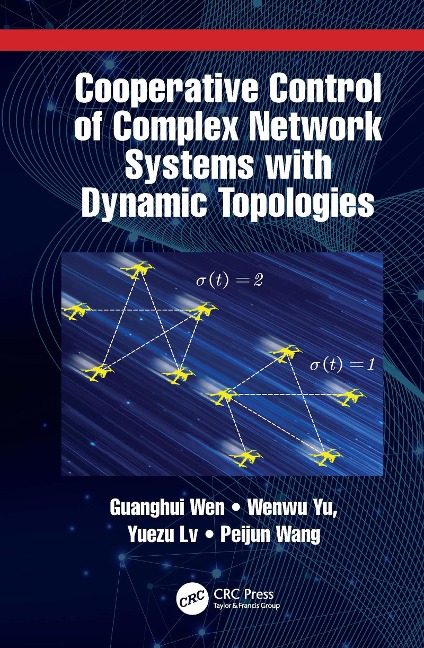
Far from being separate entities, many social and engineering systems can be considered as complex network systems (CNSs) associated with closely linked interactions with neighbouring entities such as the Internet and power grids. Roughly speaking, a CNS refers to a networking system consisting of lots of interactional individuals, exhibiting fascinating collective behaviour that cannot always be anticipated from the inherent properties of the individuals themselves. As one of the most fundamental examples of cooperative behaviour, consensus within CNSs (or the synchronization of complex networks) has gained considerable attention from various fields of research, including systems science, control theory and electrical engineering. This book mainly studies consensus of CNSs with dynamics topologies - unlike most existing books that have focused on consensus control and analysis for CNSs under a fixed topology. As most practical networks have limited communication ability, switching graphs can be used to characterize real-world communication topologies, leading to a wider range of practical applications. This book provides some novel multiple Lyapunov functions (MLFs), good candidates for analysing the consensus of CNSs with directed switching topologies, while each chapter provides detailed theoretical analyses according to the stability theory of switched systems. Moreover, numerical simulations are provided to validate the theoretical results. Both professional researchers and laypeople will benefit from this book.
Guanghui Wen is a Professor with the Department of Systems Science, School of Mathematics, Southeast University, China. His current research interests include autonomous intelligent systems, complex networked systems, distributed control and optimization, resilient control, and distributed reinforcement learning. Wenwu Yu is a Professor in Southeast University, China. Also, he is the Founding Director of Laboratory of Cooperative Control of Complex Systems. His research interests include multi-agent systems, complex networks and systems, disturbance control, distributed optimization, neural networks, game theory etc. Yuezu Lv is a Lecturer with School of Mathematics, Southeast University, China. His research focuses on cyber-physical systems, distributed estimation, cooperative control, adaptive control, and artificial intelligence. Peijun Wang is an Associate Professor with the School of Mathematics and Statistics, Anhui Normal University, China. His current research interests include analysis and synthesis of complex networks and distributed fault-tolerant control.
1. Introduction 2. Preliminaries 3. Consensus of linear CNSs with directed switching topologies 4. Consensus disturbance rejection of MIMO linear CNSs with directed switching topologies 5. Consensus tracking of CNSs with first-order nonlinear dynamics and directed switching topologies 6. Consensus tracking of CNSs with higher-order dynamics and directed switching topologies 7. H-infinity consensus of CNSs with directed switching topologies 8. Distributed tracking of nonlinear CNSs with directed switching topologies: An observer-based protocol 9. Cooperative tracking of CNSs with a high-dimensional leader and directed switching topologies 10. Neuro-adaptive consensus of CNSs with uncertain dynamics 11. Resilient consensus of CNSs with input saturation and malicious attack under switching topologies
Dieses eBook wird im PDF-Format geliefert und ist mit einem Adobe Kopierschutz (DRM) versehen. Sie können dieses eBook mit allen Geräten lesen, die das PDF-Format und den Adobe Kopierschutz (DRM) unterstützen.
Zum Beispiel mit den folgenden Geräten:
• tolino Reader
Laden Sie das eBook direkt über den Reader-Shop auf dem tolino herunter oder übertragen Sie das eBook auf Ihren tolino mit einer kostenlosen Software wie beispielsweise Adobe Digital Editions.
• Sony Reader & andere eBook Reader
Laden Sie das eBook direkt über den Reader-Shop herunter oder übertragen Sie das eBook mit der kostenlosen Software Sony READER FOR PC/Mac oder Adobe Digital Editions auf ein Standard-Lesegeräte mit epub- und Adobe DRM-Unterstützung.
• Tablets & Smartphones
Möchten Sie dieses eBook auf Ihrem Smartphone oder Tablet lesen, finden Sie hier unsere kostenlose Lese-App für iPhone/iPad und Android Smartphone/Tablets.
• PC & Mac
Lesen Sie das eBook direkt nach dem Herunterladen mit einer kostenlosen Lesesoftware, beispielsweise Adobe Digital Editions, Sony READER FOR PC/Mac oder direkt über Ihre eBook-Bibliothek in Ihrem Konto unter „Meine eBooks“ - „online lesen“.
Schalten Sie das eBook mit Ihrer persönlichen Adobe ID auf bis zu sechs Geräten gleichzeitig frei.
Bitte beachten Sie, dass die Kindle-Geräte das Format nicht unterstützen und dieses eBook somit nicht auf Kindle-Geräten lesbar ist.