
Stöbern
genialokal zum Startbildschirm hinzufügen
Installieren Sie die genialokal App auf Ihrem Startbildschirm für einen schnellen Zugriff und eine komfortable Nutzung.
Installieren Sie die genialokal App auf Ihrem Startbildschirm für einen schnellen Zugriff und eine komfortable Nutzung.
Tippen Sie einfach auf Teilen:
 Und dann auf "Zum Home-Bildschirm [+]".
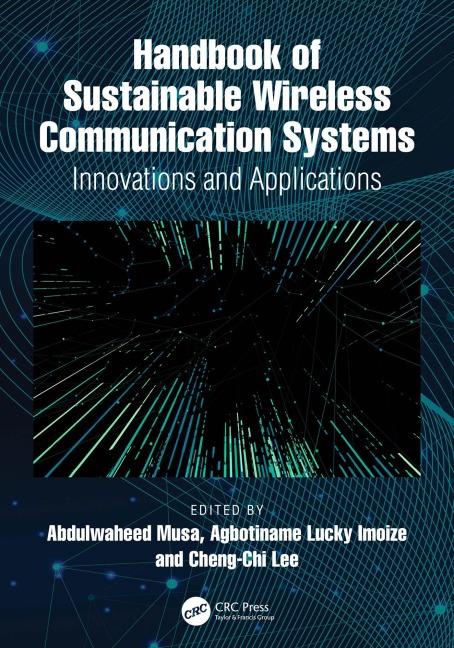
This book begins by exploring the foundations of wireless communication systems, providing a detailed overview of the principles, protocols, and technologies that underpin modern wireless networks. It then progresses to discuss emerging trends and technologies, such as fifth generation (5G) and sixth generation (6G) networks, the Internet of Things (IoT), and artificialiIntelligence (AI), and their potential contributions to green environments. Features: - Emphasizes green communications for energy-efficient wireless systems and networks, providing in-depth insights into sustainable practices in wireless technology. - Investigates strategies for efficient utilization of hardware resources such as spectrum allocation, power management, and antenna design. - Explores how advanced wireless systems can be harnessed to create eco-friendly solutions for a greener world. - Explains advanced encryption techniques, authentication protocols, and intrusion detection systems specifically tailored for safeguarding wireless communication networks operating in open channels. - Discusses the application of wireless technologies in the realm of environmental conservation and biodiversity preservation. It is primarily written for senior undergraduates, graduate students, and academic researchers in electrical engineering, electronics and communications engineering, telecommunication, wireless communication, and environmental engineering.
Abdulwaheed Musa is a senior academic in the Department of Electrical and Computer Engineering at the Kwara State University (KWASU), Malete, Nigeria. He holds a Ph.D. in engineering and has expertise in wireless communication systems, renewable energy, artificial intelligence, and emerging technologies. He was a Postdoctoral Research Fellow and a Senior Research Associate at the Institute for Intelligent Systems, University of Johannesburg, South Africa. Dr. Musa is a senior member of IEEE, ITU, and IET. Agbotiname Lucky Imoize is a Lecturer in the Department of Electrical and Electronics Engineering at the University of Lagos, Nigeria. His research interests include 6G wireless communications, wireless security systems, and artificial intelligence. He is a Fulbright fellow, the vice chair of the IEEE Communication Society Nigeria chapter, and a registered engineer with the Council for the Regulation of Engineering in Nigeria. He is a senior member of IEEE. Cheng-Chi Lee received the Ph.D. degree in Computer Science from National Chung Hsing University (NCHU), Taiwan, in 2007. He is currently a distinguished professor in the Department of Library and Information Science at Fu Jen Catholic University, Taiwan. Dr. Lee is currently an Editorial Board Member and Guest Editor for several journals. He serves as a reviewer for several journals and conferences. His current research interests include data security, cryptography, network security, mobile communications and computing, and wireless communications. Dr. Lee has published over 300 scientific articles in international journals and conferences on these fields.
Chapter 1. Principles and Innovations in Sustainable Wireless Communication Systems for Environmental Efficiency. Chapter 2. Lightweight Cryptographic Protocols for Energy-Efficient IoT Communication Systems. Chapter 3. Symmetric Encryption in Edge Computing: Balancing Security and Performance in Resource-Constrained Environments. Chapter 4. Renewable energy and RF energy harvesting solutions for green wireless networks. Chapter 5. Enhancing Energy Harvesting in Wireless Sensor Networks: Strategies, Challenges, and Future Trends. Chapter 6. Dynamic Path Optimization for Lunar Cave Exploration Rovers Using Deep Reinforcement Learning. Chapter 7. Artificial Intelligence for Sustainable Wireless Network Management: Models, Strategies, and Optimization. Chapter 8. Low-Power Wireless Systems for IoT and Edge Computing. Chapter 9. Wireless technologies for disaster management and protection. Chapter 10. Assessing Ecosystem Resilience through Passive Acoustic Monitoring: Current Challenges and Potential Applications. Chapter 11. Non-Lambertian Corner Cube Retroreflector Optical Wireless Communications for Sustainable Green 6G. Chapter 12. 6G Enabling Sustainable Wireless Connectivity in Smart Cities.