Und dann auf "Zum Home-Bildschirm [+]".

Stöbern
genialokal zum Startbildschirm hinzufügen
Installieren Sie die genialokal App auf Ihrem Startbildschirm für einen schnellen Zugriff und eine komfortable Nutzung.
Installieren Sie die genialokal App auf Ihrem Startbildschirm für einen schnellen Zugriff und eine komfortable Nutzung.

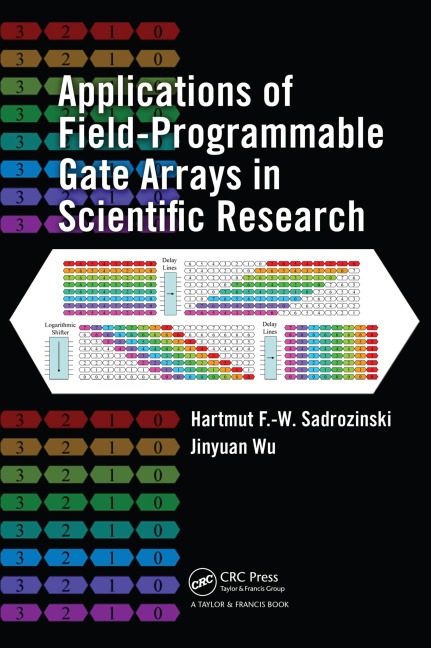
Focusing on resource awareness in field-programmable gate array (FPGA) design, Applications of Field-Programmable Gate Arrays in Scientific Research covers the principle of FPGAs and their functionality. It explores a host of applications, ranging from small one-chip laboratory systems to large-scale applications in "big science." The book first de
Hartmut F.-W. Sadrozinski is a research physicist and adjunct professor at the University of California, Santa Cruz. A senior fellow of the IEEE, Dr. Sadrozinski has been working on the application of silicon sensors and front-end electronics in elementary particle physics and astrophysics for over 30 years. He is currently involved in the use of silicon sensors to support hadron therapy. He earned his Ph.D. from the Massachusetts Institute of Technology. Jinyuan Wu is an electronics engineer in the Particle Physics Division of Fermi National Accelerator Laboratory. Dr. Wu is a frequent lecturer at international workshops and IEEE conferences. He earned his Ph.D. in experimental high energy physics from Pennsylvania State University.
Introduction. Understanding FPGA Resources. Several Principles and Methods of Resource Usage Control. Examples of an FPGA in Daily Design Jobs. The ADC + FPGA Structure. Examples of FPGA in Front-End Electronics. Examples of an FPGA in Advanced Trigger Systems. Examples of an FPGA Computation. Radiation Issues. Time-over-Threshold: The Embedded Particle-Tracking Silicon Microscope (EPTSM). Appendix. Index.