
Stöbern
genialokal zum Startbildschirm hinzufügen
Installieren Sie die genialokal App auf Ihrem Startbildschirm für einen schnellen Zugriff und eine komfortable Nutzung.
Installieren Sie die genialokal App auf Ihrem Startbildschirm für einen schnellen Zugriff und eine komfortable Nutzung.
Tippen Sie einfach auf Teilen:
 Und dann auf "Zum Home-Bildschirm [+]".
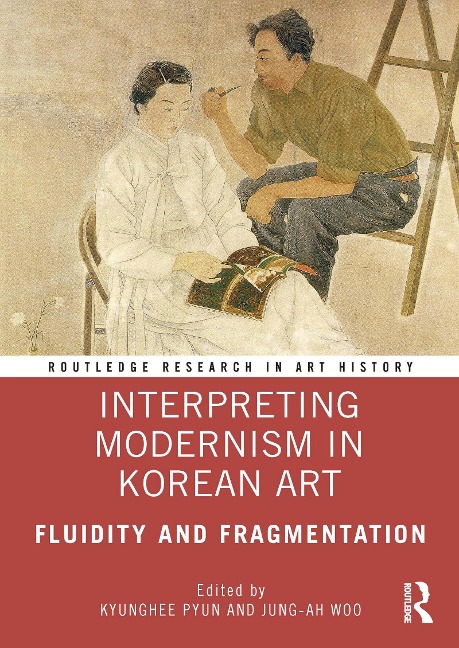
This book examines the development of national emblems, photographic portraiture, oil painting, world expositions, modern spaces for art exhibitions, university programs of visual arts, and other agencies of modern art in Korea. With few books on modern art in Korea available in English, this book is an authoritative volume on the topic and provides a comparative perspective on Asian modernism including Japan, China, and India. In turn, these essays also shed a light on Asian reception of and response to the Orientalism and exoticism popular in Europe and North America in the early twentieth century. The book will be of interest to scholars working in art history, the history of Asia, Asian studies, colonialism, nationalism, and cultural identity.
Kyunghee Pyun is Associate Professor of History of Art at the Fashion Institute of Technology, State University of New York, USA. Jung-Ah Woo is Associate Professor of Art History at the Pohang University of Science and Technology, South Korea.
Introduction; 1. Modernity, Modernism, and the Modern in Korean Art and Culture (Jung-Ah Woo and Kyunghee Pyun); Part I: Korean Modernity and Modernism; 2. Korean Art in the Historiography of Multiple Modernities (Kyunghee Pyun); 3. Modernism and Avant-Garde in Korean Art (Youngna Kim); Part II: Inventing a Modern Nation: Visual Culture at the Turn of the Century; 4. The Search for Modernity in Korean Ink-wash Painting (Mingi Kang); 5. Royal Propaganda and National Identity in Emperor Gojong's Portrait Photography (Heangga Kwon); 6. From Patriotism to Capitalism: Transformation of Korean National Symbols Under Colonial Rule (Soohyun Mok); Part III: Visualizing Colonial Modernities; 7. Modernity and Authenticity in Korean Pictorialism: From Pungsok Painting to Art Photography (Hye-ri Oh); 8. "Vernacular Modernism" in Korea: Lee Quede's Hyangtosaek and Yanagi Muneyoshi's Folk Art Movement (Yeon Shim Chung); 9. Korea, Last Retreat in Wartime for Murayama Tomoyoshi, a Modernist (Toshiharu Omuka); Part IV: Cultural Consumption and Modernism; 10. Magazine Covers and Colonial Modernity: Politics of the Korean Face (Yuri Seo); 11. Korean Modernists and the Nangnang Parlour Coffeehouse in the 1930s (Younjung Oh); 12. Cultural Network in 1930s Korea: Avant-Garde Practices and Individual Artistry (Inhye Kim); Part V: Modernism as Ideology: Revision and Appropriation; 13. Architecture as a Profession in Modern Korea (Hyunjung Cho); 14. Imitation or Necessity: A Framework for Postwar Korean Art in Contemporary Art Criticism (Chunghoon Shin); 15. Never a Failed Avant-Garde: Interdisciplinary Strategy of the Fourth Group in 1969-1970 (Sooran Choi); Epilogue; 16. Contemporaneity of Korean Contemporary Art (Jung-Ah Woo)
Dieses eBook wird im PDF-Format geliefert und ist mit einem Adobe Kopierschutz (DRM) versehen. Sie können dieses eBook mit allen Geräten lesen, die das PDF-Format und den Adobe Kopierschutz (DRM) unterstützen.
Zum Beispiel mit den folgenden Geräten:
• tolino Reader
Laden Sie das eBook direkt über den Reader-Shop auf dem tolino herunter oder übertragen Sie das eBook auf Ihren tolino mit einer kostenlosen Software wie beispielsweise Adobe Digital Editions.
• Sony Reader & andere eBook Reader
Laden Sie das eBook direkt über den Reader-Shop herunter oder übertragen Sie das eBook mit der kostenlosen Software Sony READER FOR PC/Mac oder Adobe Digital Editions auf ein Standard-Lesegeräte mit epub- und Adobe DRM-Unterstützung.
• Tablets & Smartphones
Möchten Sie dieses eBook auf Ihrem Smartphone oder Tablet lesen, finden Sie hier unsere kostenlose Lese-App für iPhone/iPad und Android Smartphone/Tablets.
• PC & Mac
Lesen Sie das eBook direkt nach dem Herunterladen mit einer kostenlosen Lesesoftware, beispielsweise Adobe Digital Editions, Sony READER FOR PC/Mac oder direkt über Ihre eBook-Bibliothek in Ihrem Konto unter „Meine eBooks“ - „online lesen“.
Schalten Sie das eBook mit Ihrer persönlichen Adobe ID auf bis zu sechs Geräten gleichzeitig frei.
Bitte beachten Sie, dass die Kindle-Geräte das Format nicht unterstützen und dieses eBook somit nicht auf Kindle-Geräten lesbar ist.