Und dann auf "Zum Home-Bildschirm [+]".

Stöbern
genialokal zum Startbildschirm hinzufügen
Installieren Sie die genialokal App auf Ihrem Startbildschirm für einen schnellen Zugriff und eine komfortable Nutzung.
Installieren Sie die genialokal App auf Ihrem Startbildschirm für einen schnellen Zugriff und eine komfortable Nutzung.
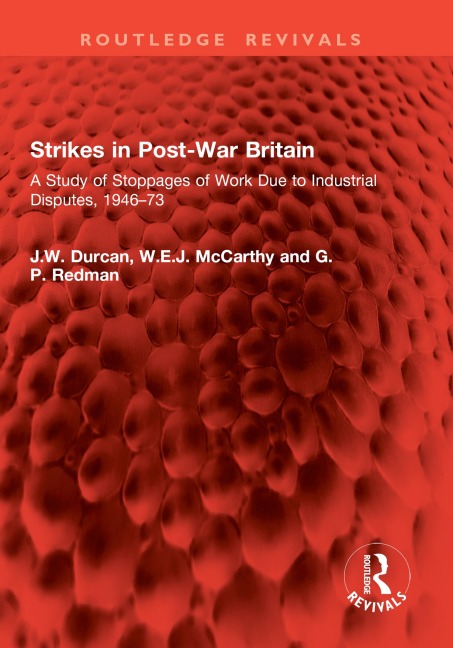
First published in 1983, Strikes in Post-War Britain provides the first systematic long-run examination of official strike statistics since the war. It is based on a wealth of new material and analysis. The overall strike pattern is first compared with the relevant data on economic activity rates-e.g. movements in prices, output, and employment. Theories linking strikes with variations in all these factors are examined in some detail. Studies of strike prone industries and occupations are analysed and tested against the background of institutional and other changes. Sections follow on the role of government, law, and the impact of incomes policy. The role of management and the influence of union militancy are also examined. A final chapter suggests the way in which these and other factors have combined to produce Britain's varied and varying propensity to strike. An attempt is made to assess the cost and consequences of strikes for management, workers, and the British economy. The result is a standard work which challenges a whole series of assumptions about strikes. Economic factors are found to be less helpful explanations than political change, or legal developments. Bargaining reform and trade union government are shown to have had a significant impact on the form and timing of certain significant changes in the volume of strike activity. Nobody who wishes to discuss seriously the causes and consequences of Britain's so-called 'strike problem' can afford to remain ignorant of the main conclusions of this book.
J.W. Durcan, at the time of the first publication, was Senior Lecturer in Industrial Relations at Oxford Polytechnic. W.E.J. McCarthy was a British Labour politician. He was one of Britain's most experienced mediators and arbitrators and served as an adviser to several Governments and public bodies. G.P. Redman, at the time of the first publication, was Lecturer in Industrial Relations at Southwest London College.
1. Objectives and sources 2. The post-war peace, 1946-52 3. The return of the strike, 1953-9 4. The shop-floor movement, 1960-8 5. The formal challenge, 1969-73 6. An overview, 1946 -73 7. Strikes and the economic environment 8. Coal mining - the traditional battleground 9. Docks - another traditional background 10. Motor vehicles - an odd case 11. Strikes and the state - the challenging role of government 12. Conclusions and explanations Appendix 1 Details of the classification of variables in the major strike series Appendix 2 Political stoppages, 1969-73
Dieses eBook wird im PDF-Format geliefert und ist mit einem Adobe Kopierschutz (DRM) versehen. Sie können dieses eBook mit allen Geräten lesen, die das PDF-Format und den Adobe Kopierschutz (DRM) unterstützen.
Zum Beispiel mit den folgenden Geräten:
• tolino Reader
Laden Sie das eBook direkt über den Reader-Shop auf dem tolino herunter oder übertragen Sie das eBook auf Ihren tolino mit einer kostenlosen Software wie beispielsweise Adobe Digital Editions.
• Sony Reader & andere eBook Reader
Laden Sie das eBook direkt über den Reader-Shop herunter oder übertragen Sie das eBook mit der kostenlosen Software Sony READER FOR PC/Mac oder Adobe Digital Editions auf ein Standard-Lesegeräte mit epub- und Adobe DRM-Unterstützung.
• Tablets & Smartphones
Möchten Sie dieses eBook auf Ihrem Smartphone oder Tablet lesen, finden Sie hier unsere kostenlose Lese-App für iPhone/iPad und Android Smartphone/Tablets.
• PC & Mac
Lesen Sie das eBook direkt nach dem Herunterladen mit einer kostenlosen Lesesoftware, beispielsweise Adobe Digital Editions, Sony READER FOR PC/Mac oder direkt über Ihre eBook-Bibliothek in Ihrem Konto unter „Meine eBooks“ - „online lesen“.
Schalten Sie das eBook mit Ihrer persönlichen Adobe ID auf bis zu sechs Geräten gleichzeitig frei.
Bitte beachten Sie, dass die Kindle-Geräte das Format nicht unterstützen und dieses eBook somit nicht auf Kindle-Geräten lesbar ist.