
Stöbern
genialokal zum Startbildschirm hinzufügen
Installieren Sie die genialokal App auf Ihrem Startbildschirm für einen schnellen Zugriff und eine komfortable Nutzung.
Installieren Sie die genialokal App auf Ihrem Startbildschirm für einen schnellen Zugriff und eine komfortable Nutzung.
Tippen Sie einfach auf Teilen:
 Und dann auf "Zum Home-Bildschirm [+]".

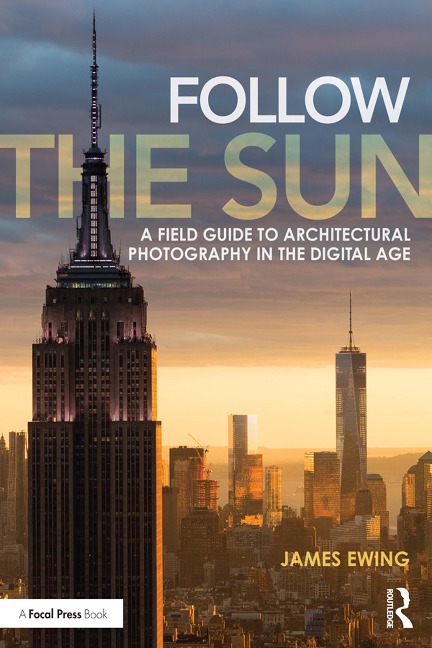

Follow the Sun will guide you through all aspects of architectural photography, from the genre's rich history to the exciting new approaches brought by the advent of the digital age. It explains how to use the powerful tools of digital photography while employing many of the skills and traditions of the established genre. Written to be accessible to professionals, amateurs, and students alike, this book will be useful for photographers exploring architecture as fine artists, on editorial assignments, or on commercial shoots. Key features include: . Example photographs and diagrams . Historical background of architectural photography . Advice on essential equipment . How to plan a shoot to your advantage . How to use tilt-shift lenses for architecture . Editing workflow and strategies . Interviews with architectural photographers Peter Aaron, Magda Biernat, Ty Cole, and Elizabeth Felicella.
James Ewing is an award-winning photographer of architecture, landscapes, and interiors. His work has been featured in publications such as Architect, Architectural Record, Metropolis, Architectural Digest, Wallpaper, Icon, Azure, Surface, l'Architecture d'Aujourd'hui, A+U, and The New York Times, among others. James is the recipient of the 2010 and 2014 American Photographic Artists (APA) top prize for Architectural Photography. He has taught photography at CUNY Kingsborough Community College, Oakland Community College, and Indiana University School of Fine Arts. He lives in Brooklyn, New York.
PART 1: Background Chapter 1: What is Architectural Photography? 1.1 Who needs architectural images and why? 1.2 Various approaches and styles create subjective visions. 1.3 The photographer's role as both promoter and critic of the built environment. Chapter 2: A Brief History 2.1 Influence of Linear Perspective 2.2 The Continuous Evolution of Photographic Tools 2.3 A Timeline of Architectural Photography 2.4 Illustration in Both Analog and Digital Images PART 2: Planning and Preparation Chapter 3: The Assignment 3.1 Defining an Assignment 3.2 Self-Assigned Work 3.3 Commissioned Work 3.4 Assignment and Voice Chapter 4: Know The Site 4.1 Access and Permissions 4.2 Mapping the Site 4.3 Working Shot List 4.4 Site Visit and Revised Shot List 4.5 Scheduling Chapter 5: Follow the Sun 5.1 Rhythms of Earth and Sun 5.2 Qualities of Light 5.3 Light for Architecture 5.4 Sun Tracking Software 5.5 Chronological Shot List Chapter 6: The Tools of The Trade 6.1 Camera Support 6.2 Lens 6.3 Camera Body 6.4 Camera Case 6.5 Computers and Storage 6.6 Accessories 6.7 Grip kit 6.8 Lighting PART 3: The Shoot Chapter 7: Workflow Onsite 7.1 Shooting Checklist 7.2 Photo Assistant 7.3 Keeping Images Safe 7.4 Shooting Tethered Chapter 8: Composition 8.1 Formal Elements 8.2 Fundamental Variables 8.3 Cultural Components 8.4 Building a Shot Chapter 9: Perspective and the Tilt-Shift Lens 9.1 Linear Perspective 9.2 Tilt-Shift Lens and Perspective 9.3 Using a Tilt-Shift Lens for Architecture 9.4 Optimizing Sharpness 9.5 Using a Tilt to Extend Focus 9.6 Breaking the z Axis Chapter 10: Translating Interior Space 10.1 Identify Goals 10.2 Consider Light and Timing 10.3 Select Camera Position, Lens, and Frame 10.4 Style the Room, Move and Edit Objects 10.5 Adjust Existing Light 10.6 Test, Revise, and Take Final Shot PART 4: The Final Image Chapter 11: Post Production Workflow 11.1 Download to Delivery 11.2 Hardware for Post-Production 11.3 Software for Post-Production 11.4 Archiving 11.5 Editing, the Selection Process 11.6 Basic Raw Processing Chapter 12: Advanced Retouching 12.1 Working with a Professional Retoucher 12.2 How much is too much? Choosing a look 12.3 Lightroom Local Adjustments; Gradients and Brushes 12.4 Compositing with Masked Adjustment Layers 12.5 Lens Corrections 12.6 Spotting and Sharpening Chapter 13: Presentation 13.1 Editing a Portfolio 13.2 Portfolio Website 13.3 Print Portfolio PART 5: Work in Action Chapter 14: Voices From the Field 14.1 Peter Aaron 14.2 Magda Biernat 14.3 Ty Cole 14.4 Elizabeth Felicella