
Stöbern
genialokal zum Startbildschirm hinzufügen
Installieren Sie die genialokal App auf Ihrem Startbildschirm für einen schnellen Zugriff und eine komfortable Nutzung.
Installieren Sie die genialokal App auf Ihrem Startbildschirm für einen schnellen Zugriff und eine komfortable Nutzung.
Tippen Sie einfach auf Teilen:
 Und dann auf "Zum Home-Bildschirm [+]".

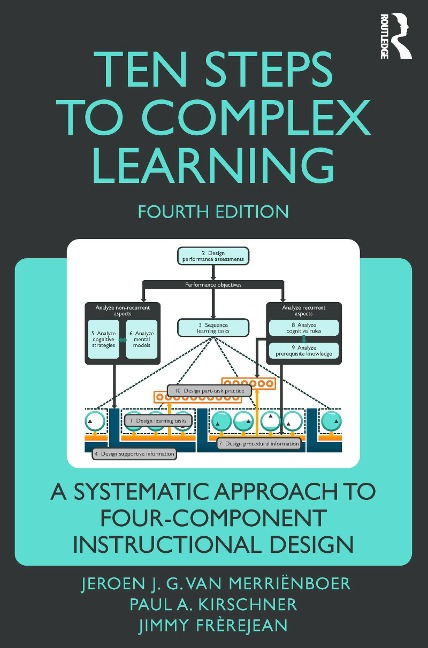
Ten Steps to Complex Learning presents a path from an educational problem to a solution in a way that students, design practitioners, and researchers can understand and easily use. Students in the fields of instructional design and the learning sciences can use this book to broaden their knowledge of the design of training programs for complex learning. Practitioners can use this book as a reference guide to support their design of courses, curricula, or environments for complex learning. Driven by the acclaimed Four-Component Instructional Design (4C/ID) model, this fourth edition of Ten Steps to Complex Learning is fully revised with the latest research, featuring over 50 new references. The entire book has been updated for clarity, incorporating new colorful graphics and diagrams, and the guiding example used throughout the book is replaced with a training blueprint for the complex skill of "producing video content." The closing chapter explores the future development of the Ten Steps, discussing changes in teacher roles and the influence of artificial intelligence.
Jeroen J. G. van Merriënboer (1959-2023) was Emeritus Professor of Learning and Instruction at Maastricht University, The Netherlands. Before retiring, he was Research Director of the Graduate School of Health Professions Education (SHE) at Maastricht University. He also held honorary positions at the University of Bergen, Norway, and the Open University of the Netherlands. He has published over 450 journal articles and book chapters in the areas of learning and instruction and medical education. Paul A. Kirschner (1951) is Emeritus Professor of Educational Psychology at the Open University of the Netherlands as well as Honorary Doctor (Doctor Honoris Causa) at the University of Oulu, Finland, and Guest Professor at Thomas More University of Applied Sciences, Belgium. He owns his own educational consultancy company kirschner-ED and has published more than 400 journal articles, books, and book chapters in the areas of educational psychology, learning, and instruction. Jimmy Frèrejean (1986) is Assistant Professor at the Faculty of Health, Medicine and Life Sciences at Maastricht University, The Netherlands. Alongside his teaching and research on instructional design at the School of Health Professions Education, Jimmy actively contributes to the Maastricht University Medical Center and Academy as an educational consultant. He specializes in simulation-based education, coordinates a national lifelong learning program for healthcare professionals, and is part of the TRISIM expert group on training, research, and innovation in simulation-based education in healthcare.
1. A New Approach to Instruction 2. Four Blueprint Components 3. Ten Steps 4. Step 1: Design Learning Tasks 5. Step 2: Design Performance Assessments 6. Step 3: Sequence Learning Tasks 7. Step 4: Design Supportive Information 8. Step 5: Analyze Cognitive Strategies 9. Step 6: Analyze Mental Models 10. Step 7: Design Procedural Information 11. Step 8: Analyze Cognitive Rules 12. Step 9: Analyze Prerequisite Knowledge 13. Step 10: Design Part-Task Practice 14. Domain-General Skills 15. Programs of Assessment 16. Closing Remarks Appendices