
Stöbern
genialokal zum Startbildschirm hinzufügen
Installieren Sie die genialokal App auf Ihrem Startbildschirm für einen schnellen Zugriff und eine komfortable Nutzung.
Installieren Sie die genialokal App auf Ihrem Startbildschirm für einen schnellen Zugriff und eine komfortable Nutzung.
Tippen Sie einfach auf Teilen:
 Und dann auf "Zum Home-Bildschirm [+]".
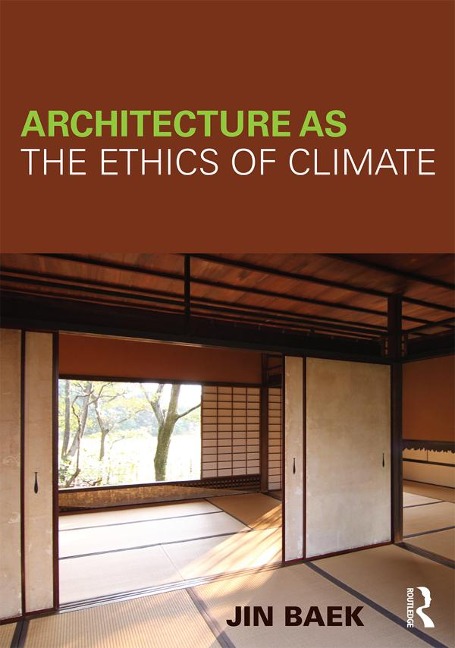
At a time when climate and ethics have become so important to architectural debate, this book proposes an entirely new way for architects to engage with these core issues. Drawing on Tetsuro Watsuji's (1889-1960) philosophy, the book illuminates climate not as a collection of objective natural phenomena, but as a concrete form of bond in which "who we are"-the subjective human experience-is indivisibly intertwined with the natural phenomena. The book further elucidates the inter-personal nature of climatic experiences, criticizing a view that sees atmospheric effects of climate under the guise of personal experientialism and reinforcing the linkage between climate and ethos as the appropriateness of a setting for human affairs. This ethical premise of climate stretches the horizon of sustainability as pertaining not only to man's solitary relationship with natural phenomena-a predominant trend in contemporary discourse of sustainability-but also to man's relationship with man. Overcoming climatic determinism-regional determinism, too-and expanding the ethics of the inter-personal to the level where the whole and particulars are joined through the dialectics of the mutually-negating opposites, Jin Baek develops a new thesis engaging with the very urgent issues inherent in sustainable architecture. Crucially, the book explores examples that join climate and the dynamics of the inter-personal, including: - Japanese vernacular residential architecture - the white residential architecture of Richard Neutra - contemporary architectural works and urban artifacts by Tadao Ando and Aldo Rossi Beautifully illustrated, this book is an important contribution to the discourse which surrounds architecture, climate and ethics and encourages the reader to think more broadly about how to respond to the current challenges facing the profession.
Jin Baek teaches theory and history at the Department of Architecture and Architectural Engineering of Seoul National University. His research focuses on environmental ethics, cross-cultural issues that exist between East Asia and the West in both architecture and urbanism, and the cultural significance of urban regeneration.
Introduction 1. Tetsuro Watsuji's Notion of Fudo and Its Cultural Significance 1.1 Beyond Heidegger's Dasein 1.2 What is Fudo? 1.3 Ex-sistere and Reflection 1.4 Beyond Regional Determinism 1.5 Ethics of the Inter-personal 1.6 Inter-Fudos and the Subject transcending the Insularity of a Fudo 2. "Self-less Openness" and Fudo: Renewed Sustainable Significance of Japanese Vernacular Architecture 2.1 Criticism of the Traditional Japanese House 2.2 Corridor and Individualism 2.3 The Wall, Fan and the Wind Conduit 2.4 "Self-less Openness" of Japanese Vernacular Housing 2.5 Modernity and the Duality between the Inside and Outside 2.6 Joint Measure and the Spatiality of Japanese Vernacular Housing 2.7 From Collectivity to Privacy 2.8 Contemporary Fudo-sensitive House 3. The Ecology of "We" and Ambient Warmth: Richard Neutra's Ecological Architecture 3.1 Beyond Psychoanalysis and Positivism 3.2 Coordinated Balance of Different Forces 3.3 Anchorage and the Coordination of Forces 3.4 Illumination 3.5 Warmth and the Inter-personal in Japanese Tradition 3.6 Facing and the Ecology of "We" 3.7 Ecos and the Inter-personal 4. Dialectics between the Regional and the Trans-Regional 4.1 Fudo and Beyond Critical Regionalism 4.2 Criticism of Regionalism 4.3 Fudo and the Resuscitation of the Corporeal Efficacy of a Code 4.4 Fudo and the Dialectics of Opposites 4.5 Dialectics of Opposites and Human Praxis 4.6 Beyond Regional Confines 4.7 The Regional and the Trans-Regional 4.8 Type and Differences Conclusion Index
Dieses eBook wird im PDF-Format geliefert und ist mit einem Adobe Kopierschutz (DRM) versehen. Sie können dieses eBook mit allen Geräten lesen, die das PDF-Format und den Adobe Kopierschutz (DRM) unterstützen.
Zum Beispiel mit den folgenden Geräten:
• tolino Reader
Laden Sie das eBook direkt über den Reader-Shop auf dem tolino herunter oder übertragen Sie das eBook auf Ihren tolino mit einer kostenlosen Software wie beispielsweise Adobe Digital Editions.
• Sony Reader & andere eBook Reader
Laden Sie das eBook direkt über den Reader-Shop herunter oder übertragen Sie das eBook mit der kostenlosen Software Sony READER FOR PC/Mac oder Adobe Digital Editions auf ein Standard-Lesegeräte mit epub- und Adobe DRM-Unterstützung.
• Tablets & Smartphones
Möchten Sie dieses eBook auf Ihrem Smartphone oder Tablet lesen, finden Sie hier unsere kostenlose Lese-App für iPhone/iPad und Android Smartphone/Tablets.
• PC & Mac
Lesen Sie das eBook direkt nach dem Herunterladen mit einer kostenlosen Lesesoftware, beispielsweise Adobe Digital Editions, Sony READER FOR PC/Mac oder direkt über Ihre eBook-Bibliothek in Ihrem Konto unter „Meine eBooks“ - „online lesen“.
Schalten Sie das eBook mit Ihrer persönlichen Adobe ID auf bis zu sechs Geräten gleichzeitig frei.
Bitte beachten Sie, dass die Kindle-Geräte das Format nicht unterstützen und dieses eBook somit nicht auf Kindle-Geräten lesbar ist.