
Stöbern
genialokal zum Startbildschirm hinzufügen
Installieren Sie die genialokal App auf Ihrem Startbildschirm für einen schnellen Zugriff und eine komfortable Nutzung.
Installieren Sie die genialokal App auf Ihrem Startbildschirm für einen schnellen Zugriff und eine komfortable Nutzung.
Tippen Sie einfach auf Teilen:
 Und dann auf "Zum Home-Bildschirm [+]".
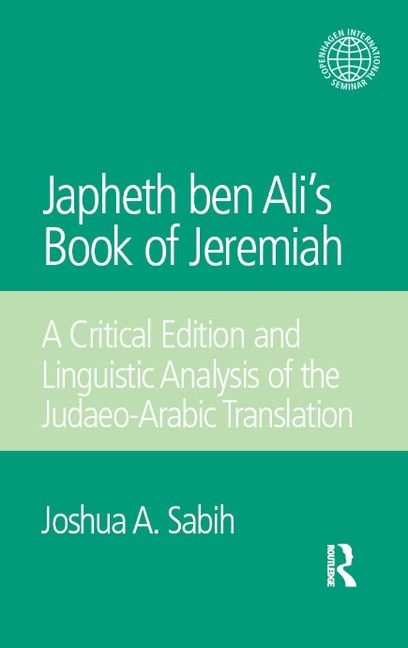
This volume deals with three themes: medieval Judaism, Arabic and Hebrew sociolinguistics, and Arabic Bible translation. Within Medieval Judaism, the Karaite Jews became a prosperous community under the banners of Islam. One of the most salient signs of the Karaite community's strength and internal cohesion was the extensive scientific contribution that it made to the fields of Biblical studies, Hebrew philology and philosophy. This book presents for the first time a critical edition of one of the works of the leading Karaite scholars in biblical exegeses and translation, Japheth ben Ali's Judaeo-Arabic translation of the "Book of Jeremiah", drawing on five medieval manuscripts. As the majority of Karaite works, including Bible manuscripts, are in Judaeo-Arabic, relatively few of them have been published. A number of the Karaite Bible manuscripts were written in Arabic script, resulting in their being neglected by scholars, despite the significance of these manuscripts to the history of medieval Judaism and Bible textual Studies. The author of this volume focuses on some of the most important issues in the field of sociolinguistics, namely language-contact, diglossia and the status of both Arabic and Hebrew in the medieval Jewish literary system. Equally important is the issue of the script-in-use (Hebrew or Arabic), which was a major subject of debate among the Rabbinates and the Karaites. Indeed, the language and the script used in these manuscripts will help us re-evaluate the established theories about the language-situation and literary systems in medieval Islamic and Jewish societies. The value of translating the Hebrew Bible into Arabic was unparalleled in medieval inter-religious scholarship. For Muslim scholars it was their only access to the Jewish Bible. The contribution of the Karaites to this field is enormous, and this work offers us a unique window into the Karaite theory of Biblical hermeneutics.
Joshua A. Sabih is a Moroccan-Danish scholar. He is lecturer in Jewish, Islamic Studies and Semitic Philology at the Carsten Niebuhr Department of Middle Eastern Studies, TORS Institute, University of Copenhagen.
Part I IntroductionChapter I: Middle ArabicChapter II: Judaeo-ArabicChapter III: The Linguistic Status and Cultural Function of the Medieval Judaeo-Arabic LanguageChapter IV: The Function of Scripts in Medieval Arabic ScriptolectConclusionPart IIThe Critical Edition and Linguistic AnalysisDescription of the manuscriptsDescription of the Hebrew Text in Arabic scriptThe Edited TextTranslationOrthography and PhoneticsMorpho-syntaxDiscursive Analysis
Dieses eBook wird im PDF-Format geliefert und ist mit einem Adobe Kopierschutz (DRM) versehen. Sie können dieses eBook mit allen Geräten lesen, die das PDF-Format und den Adobe Kopierschutz (DRM) unterstützen.
Zum Beispiel mit den folgenden Geräten:
• tolino Reader
Laden Sie das eBook direkt über den Reader-Shop auf dem tolino herunter oder übertragen Sie das eBook auf Ihren tolino mit einer kostenlosen Software wie beispielsweise Adobe Digital Editions.
• Sony Reader & andere eBook Reader
Laden Sie das eBook direkt über den Reader-Shop herunter oder übertragen Sie das eBook mit der kostenlosen Software Sony READER FOR PC/Mac oder Adobe Digital Editions auf ein Standard-Lesegeräte mit epub- und Adobe DRM-Unterstützung.
• Tablets & Smartphones
Möchten Sie dieses eBook auf Ihrem Smartphone oder Tablet lesen, finden Sie hier unsere kostenlose Lese-App für iPhone/iPad und Android Smartphone/Tablets.
• PC & Mac
Lesen Sie das eBook direkt nach dem Herunterladen mit einer kostenlosen Lesesoftware, beispielsweise Adobe Digital Editions, Sony READER FOR PC/Mac oder direkt über Ihre eBook-Bibliothek in Ihrem Konto unter „Meine eBooks“ - „online lesen“.
Schalten Sie das eBook mit Ihrer persönlichen Adobe ID auf bis zu sechs Geräten gleichzeitig frei.
Bitte beachten Sie, dass die Kindle-Geräte das Format nicht unterstützen und dieses eBook somit nicht auf Kindle-Geräten lesbar ist.