
Stöbern
genialokal zum Startbildschirm hinzufügen
Installieren Sie die genialokal App auf Ihrem Startbildschirm für einen schnellen Zugriff und eine komfortable Nutzung.
Installieren Sie die genialokal App auf Ihrem Startbildschirm für einen schnellen Zugriff und eine komfortable Nutzung.
Tippen Sie einfach auf Teilen:
 Und dann auf "Zum Home-Bildschirm [+]".

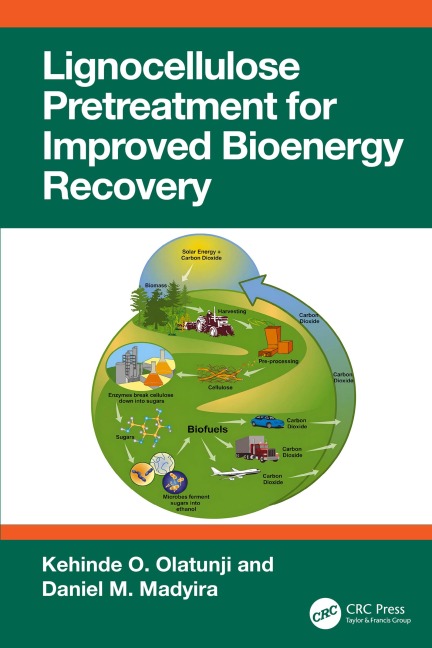
Lignocellulosic biomass is a promising feedstock for second-generation bioenergy due to its low value and abundance. Different types of lignocellulosic biomass require specific pretreatment methods to enhance biorefinery processes. This book provides state-of-the-art information on recent developments in available pretreatment methods. It offers an overview of structural analysis of pretreated lignocellulosic biomass using various techniques, including optimization and prediction of bioenergy production with the help of statistical and artificial intelligence models. Features: - Focuses on lignocellulosic biomass pretreatment for bioenergy production - Discusses environmental and social impacts, as well as economic approaches, of different pretreatment methods - Covers the economic realities and environmental implications of each pretreatment technique - Evaluates the performance of individual pretreatment techniques on biogas and methane yields - Includes applications of statistical, artificial intelligence, and kinetic models This book is intended for graduate students and researchers in bioprocessing, bioresource management, bioeconomy, and sustainability.
Kehinde O. Olatunji received his PhD in mechanical engineering from the University of Johannesburg, South Africa, in 2023 and a Master of Technology in Agricultural Engineering from Ladoke Akintola University of Technology, Ogbomoso, Nigeria, in 2019. He is a postdoctoral research fellow at the University of Johannesburg, South Africa, and a research coordinator at Process Energy and Environmental Technology Station (PEETS), University of Johannesburg, South Africa. His research interests are waste-to-energy, biorefinery, waste management, and the application of artificial intelligence to energy recovery from organic wastes. He has authored and co-authored several peer-reviewed articles in reputable international journals and has presented at various academic/renewable energy/waste management conferences. He is currently co-supervising master's students researching energy recovery from biomass and working on applying the findings with PEETS. Kehinde is a corporate member of the Nigerian Institution of Agricultural Engineers (NIAE), Nigerian Society of Engineers (NSE), and a Registered Engineer with the Council for Regulation of Engineering Practices in Nigeria (COREN). He holds an academic excellence award as PhD student in the Faculty of Engineering and the Built Environment of the University of Johannesburg in 2022. Daniel M. Madyira is a registered professional engineer and currently an associate professor of mechanical engineering in the Department of Mechanical Engineering Science in the Department of Mechanical Engineering and the Built Environment, at the University of Johannesburg. He has taught a wide range of core mechanical engineering courses, including machine design, fluid dynamics, thermodynamics, strength of materials, and biomass processing. He is a highly experienced mechanical engineer and academic with over 30 years of experience in both academia and industry. He is passionate about engineering design with special expertise in machine component stress analysis and thermal systems analysis. He has developed several mechanical designs addressing a range of contemporary societal problems, including biomass briquetting and solar crop drying, as well as advanced mechanical systems such as rotating bending fatigue testing machines. His research interests range from high-speed machining of titanium and fatigue of titanium and composites to natural composites, biomass briquetting, and biomass combustion modelling, as well as the fracture behaviour of materials produced using modern manufacturing techniques such as additive manufacturing. Additionally, he focuses on post-weld heat treatment of steels using weld beads. He is also involved in several industry-related activities, addressing specific problems within the industry. This makes his academic work relevant to industry and fruitful to his students. He has edited two conference proceedings, published two chapters of book, several journal papers, and more than 150 refereed conference papers. He has registered one patent and graduated seven PhD students as supervisor and co-supervisor, as well as 34 MSc and MPhil students. and MTech. students and supervised more than 20 international MSc interns. He is currently supervising and co-supervising 10 PhD students and more than 20 master's students.
PART I: Biomass, biorefinery, and bioenergy 1. Biomass 2. Biorefinery of biomass and bioenergy PART II: Lignocellulose biomass pretreatment 3. Biological pretreatment 4. Chemical pretreatment 5. Mechanical/physical pretreatments 6. Thermal pretreatments 7. Nanoparticles additive and combined pretreatment 8. Techno-economic analysis of pretreatment methods PART III: Structural analysis and biomethane modeling approaches 9. Structural analysis of pretreated lignocellulose biomass 10. Merits and limitations of lignocellulose pretreatment 11. Modeling of bioenergy yield of pretreated lignocellulose feedstocks