
Stöbern
genialokal zum Startbildschirm hinzufügen
Installieren Sie die genialokal App auf Ihrem Startbildschirm für einen schnellen Zugriff und eine komfortable Nutzung.
Installieren Sie die genialokal App auf Ihrem Startbildschirm für einen schnellen Zugriff und eine komfortable Nutzung.
Tippen Sie einfach auf Teilen:
 Und dann auf "Zum Home-Bildschirm [+]".

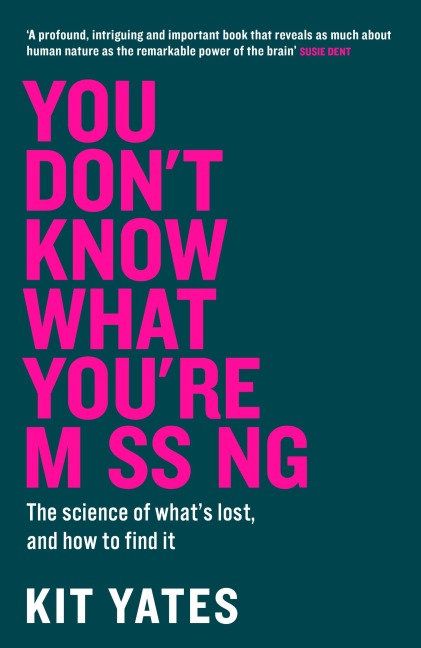

'A profound, intriguing, and important book that reveals as much about human nature as the remarkable power of the brain. Every insight comes to life through real-world examples of the potential and the pitfalls of the hidden patterns all around us. I loved it.' Susie Dent 'I was amazed, reading this, how much we overlook the gaps around us... Made me look around my own life and wonder "What have I missed?"' Jeremy Vine 'A wide-ranging and engaging guide not only to our blind spots, but to our blind spots about our blind spots. Delightful!' Tim Harford, author of How To Make The World Add Up 'An enjoyable look at 'missingness' and how it affects the way we experience the world' The Arts Desk We all like to think we're making decisions based on reality, but in fact, we're almost always working from incomplete information. And when 'you don't know what you don't know', it can be impossible to navigate successfully. In You Don't Know What You're Missing mathematician Kit Yates explores the blind spots, gaps in our knowledge and how we make sense of the world given we usually have an unfinished picture. From avoiding common traps and pitfalls to filling in the gaps without guessing, it shows us how to turn our misses into hits.
Kit Yates is a Senior Lecturer in the Department of Mathematical Sciences and co-director of the Centre for Mathematical Biology at the University of Bath. He completed his PhD in mathematics at the University of Oxford in 2011. His research demonstrates that mathematics can be used to describe all sorts of real-world phenomena: from embryo formation to locust swarming and from sleeping sickness to egg-shell patterning. He is particularly interested in the role that randomness plays in biology. His research into mathematical biology has been covered by the BBC, the Guardian, the Telegraph, the Daily Mail, RTE, Scientific American and Reuters amongst others.
Alongside his academic position, Kit is also an author and science communicator. The Maths of Life and Death is his first book.