
Stöbern
genialokal zum Startbildschirm hinzufügen
Installieren Sie die genialokal App auf Ihrem Startbildschirm für einen schnellen Zugriff und eine komfortable Nutzung.
Installieren Sie die genialokal App auf Ihrem Startbildschirm für einen schnellen Zugriff und eine komfortable Nutzung.
Tippen Sie einfach auf Teilen:
 Und dann auf "Zum Home-Bildschirm [+]".
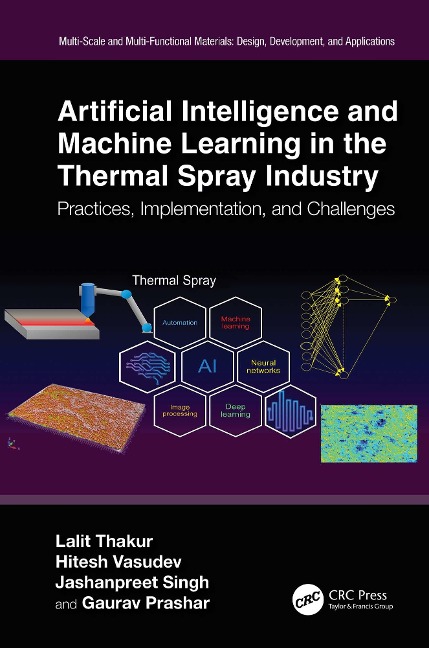
This book details the emerging area of the induction of expert systems in thermal spray technology, replacing traditional parametric optimization methods like numerical modeling and simulation. It promotes, enlightens, and hastens the digital transformation of the surface engineering industry by discussing the contribution of expert systems like Machine Learning (ML) and Artificial Intelligence (AI) toward achieving durable Thermal Spray (TS) coatings. Artificial Intelligence and Machine Learning in the Thermal Spray Industry: Practices, Implementation, and Challenges highlights how AI and ML techniques are used in the TS industry. It sheds light on AI's versatility, revealing its applicability in solving problems related to conventional simulation and numeric modeling techniques. This book combines automated technologies with expert machines to show several advantages, including decreased error and greater accuracy in judgment, and prediction, enhanced efficiency, reduced time consumption, and lower costs. Specific barriers preventing AI's successful implementation in the TS industry are also discussed. This book also looks at how training and validating more models with microstructural features of deposited coating will be the center point to grooming this technology in the future. Lastly, this book thoroughly analyzes the digital technologies available for modeling and achieving high-performance coatings, including giving AI-related models like Artificial Neural Networks (ANN) and Convolutional Neural Networks (CNN) more attention. This reference book is directed toward professors, students, practitioners, and researchers of higher education institutions working in the fields that deal with the application of AI and ML technology.
Dr. Lalit Thakur is currently working as an Assistant Professor in the Department of Mechanical Engineering at the National Institute of Technology (NIT) in Kurukshetra, India. He has obtained his M.Tech. (Welding Engineering) and Ph.D. degrees from the Indian Institute of Technology (I.I.T.) Roorkee, India. For the last 13 years, he is continuously exploring new possibilities in Welding Engineering and Thermal Spray Technology. He has guided many Ph.D. and Master candidates in the area of Welding and Thermal Spraying. He has authored more than 80 research publications in various international journals, books, and conferences of repute. Prof. (Dr.) Hitesh Vasudev is working as a full-time Professor in the School of Mechanical Engineering and Division of Research and Development at Lovely Professional University, Jalandhar, India. He has received Ph.D. in Mechanical Engineering from Guru Nanak Dev Engineering College, India. His area of research is surface engineering, bimodal coatings, and additive manufacturing. He has more than 10 years of teaching and research experience. He has authored more than 100 research papers, and 3 books, and has organized International conferences. Dr. Jashanpreet Singh is currently working at the University Centre of Research and Development, Chandigarh University as an Assistant Professor. He obtained his Ph.D. degree from the Thapar Institute of Engineering and Technology, Patiala in 2019. He has authored more than 55 research publications in various international journals (SCI/Scopus), books, and conferences of repute. He has a teaching experience of more than three years and industrial experience of more than two years. His area of research is tribology-solid particle erosion, thermal spray coatings, CFD simulation, artificial intelligence, machine learning and regression tools, process optimization, composites, and materials characterization. Dr. Gaurav Prashar is an Associate Professor and Head of the Department of Mechanical Engineering, at Rayat Bahra Institute of Engineering and Nano-Technology, Hoshiarpur- India. His area of research is surface engineering and additive manufacturing. He has more than 15 years of teaching and research experience. He has authored more than 20 research papers (SCI/Scopus). The research outcomes have been published in reputed journals (SCI/Scopus) such as the Journal of Cleaner Production, Surface and Coatings Technology, Journal of Thermal Spray Technology, Engineering Failure Analysis, Surface Topography: Metrology and Properties.
1. Artificial Intelligence in Thermal Spray Industry: Introduction and Benefits. 2. Unsupervised and Supervised Machine Learning Techniques in Wear Prediction. 3. Artificial Intelligence-Based Image Processing Techniques for Assessment of Patterns and Mechanisms in Thermal Spray. 4. Artificial Intelligence and Automation in Sustainable Development. 5. Role of Machine Learning Techniques in Coating Process Monitoring, Controlling, and Optimization. 6. Challenges of Using Artificial Intelligence in Thermal Spray Industry: Implementation, Optimization, and Control. 7. Neural Network Model for Wear Prediction of Coatings: Case Study. 8. Implementation of Regression Modes for Wear Analysis of Coating: Case Study.
Dieses eBook wird im PDF-Format geliefert und ist mit einem Adobe Kopierschutz (DRM) versehen. Sie können dieses eBook mit allen Geräten lesen, die das PDF-Format und den Adobe Kopierschutz (DRM) unterstützen.
Zum Beispiel mit den folgenden Geräten:
• tolino Reader
Laden Sie das eBook direkt über den Reader-Shop auf dem tolino herunter oder übertragen Sie das eBook auf Ihren tolino mit einer kostenlosen Software wie beispielsweise Adobe Digital Editions.
• Sony Reader & andere eBook Reader
Laden Sie das eBook direkt über den Reader-Shop herunter oder übertragen Sie das eBook mit der kostenlosen Software Sony READER FOR PC/Mac oder Adobe Digital Editions auf ein Standard-Lesegeräte mit epub- und Adobe DRM-Unterstützung.
• Tablets & Smartphones
Möchten Sie dieses eBook auf Ihrem Smartphone oder Tablet lesen, finden Sie hier unsere kostenlose Lese-App für iPhone/iPad und Android Smartphone/Tablets.
• PC & Mac
Lesen Sie das eBook direkt nach dem Herunterladen mit einer kostenlosen Lesesoftware, beispielsweise Adobe Digital Editions, Sony READER FOR PC/Mac oder direkt über Ihre eBook-Bibliothek in Ihrem Konto unter „Meine eBooks“ - „online lesen“.
Schalten Sie das eBook mit Ihrer persönlichen Adobe ID auf bis zu sechs Geräten gleichzeitig frei.
Bitte beachten Sie, dass die Kindle-Geräte das Format nicht unterstützen und dieses eBook somit nicht auf Kindle-Geräten lesbar ist.