
Stöbern
genialokal zum Startbildschirm hinzufügen
Installieren Sie die genialokal App auf Ihrem Startbildschirm für einen schnellen Zugriff und eine komfortable Nutzung.
Installieren Sie die genialokal App auf Ihrem Startbildschirm für einen schnellen Zugriff und eine komfortable Nutzung.
Tippen Sie einfach auf Teilen:
 Und dann auf "Zum Home-Bildschirm [+]".

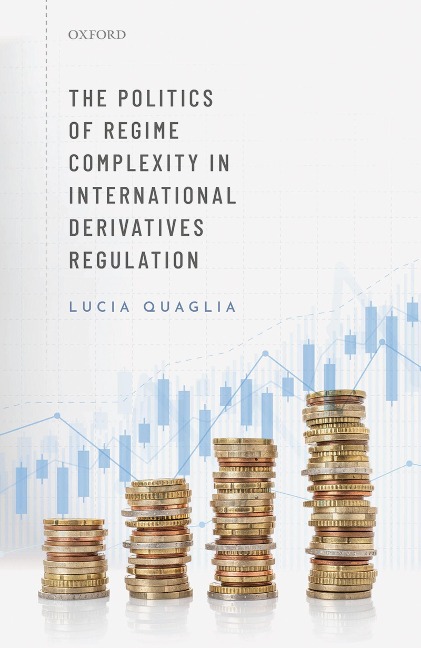
This book provides the first comprehensive account of post-crisis international regulation of derivatives by bringing together the international relations literature on regime complexity and the international political economy literature on financial regulation.
It addresses three questions: What factors drove international standard-setting on derivatives post-crisis? Why did international regime complexity emerge? And how was it managed and with what outcomes? This research innovatively combines a state-centric, a transgovernmental, and business-led explanations. It examines all the main sets of standards (or elemental regimes) concerning various aspects of derivatives markets, namely: trading, clearing, and reporting of derivatives; resilience, recovery and resolution of central counterparties; capital requirements for bank exposures to central counterparties and derivatives; margins for derivatives non-centrally cleared. It is argued that regime complexity in derivatives ensued from the multi-dimensionality and the interlinkages of the problems to tackle, especially given the fact that it was a new policy area without a focal international standard-setter. Despite these challenges, international cooperation resulted in relatively precise, stringent, and consistent rules, even though there was variation across standards. The main jurisdictions played an important role in managing regime complexity, but their effectiveness was constrained by limited domestic coordination. Networks of regulators gathered in international standard-setting bodies deployed a variety of formal and informal coordination tools to deal with regime complexity. The financial industry, at times, lobbied for less precise and stringent rules and engaged in 'venue shopping', whereas, other times, it contributed to the quest for regulatory consistency.
Lucia Quaglia is Professor of Political Science at the University of Bologna. Her publications include The UK and Multi-level Financial Regulation (with Scott James, OUP, 2020), The Political Economy of Banking Union (with David Howarth, OUP, 2016), and The European Union and Global Financial Regulation (OUP, 2014).
- 1: Introduction - 2: State of the Art and Research Design - 3: Context and Empirical Patterns - 4: International Standards for Derivatives Trading and Clearing - 5: International Standards for Reporting Derivatives Trades - 6: International Standards for CCPs - 7: International Standards for Bank Capital Exposures to CCPs and Derivatives - 8: International Margin Standards for Non-Centrally Cleared Derivatives