
Stöbern
genialokal zum Startbildschirm hinzufügen
Installieren Sie die genialokal App auf Ihrem Startbildschirm für einen schnellen Zugriff und eine komfortable Nutzung.
Installieren Sie die genialokal App auf Ihrem Startbildschirm für einen schnellen Zugriff und eine komfortable Nutzung.
Tippen Sie einfach auf Teilen:
 Und dann auf "Zum Home-Bildschirm [+]".
Ihr gewünschter Artikel ist in 0 Buchhandlungen vorrätig - wählen Sie hier eine Buchhandlung in Ihrer Nähe aus:

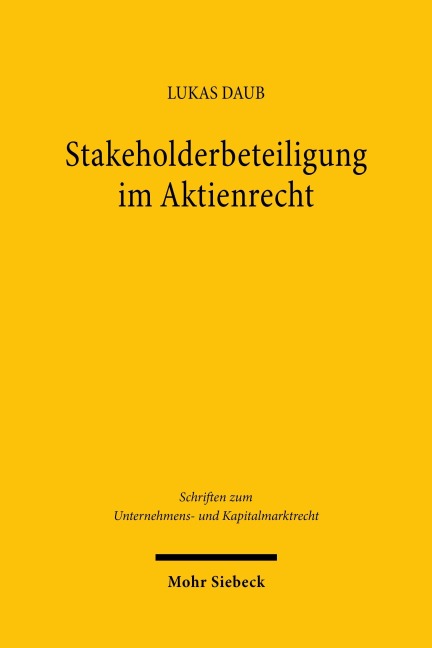
The question of whether and how sustainability and public-interest objectives can be achieved through the regulation of corporate governance lends a new dimension to the academic debate on corporate governance. One aspect of the current discussion lies in the increasing calls for management concepts that take into account the interests of all a company's stakeholders - not only those of its shareholders.
This reorientation of the corporate governance concept is not limited to discussion forums and position papers. With the Corporate Sustainability Due Diligence Directive (CSDDD), adopted by the European legislator in implementation of the European Green Deal , the reality for many companies is already changing. For the first time, beyond employee co-determination, the CSDDD introduces a statutory obligation to involve stakeholders.
In light of this development, German stock corporations and their (legal) advisors face the question of how stakeholder involvement can be implemented in practice. This raises legal issues due to the binding framework governing stock corporations. How much room does the mandatory allocation of competences under the German Stock Corporation Act leave for stakeholder involvement? Do other statutory requirements impose limits on such participation?
The study contributes to clarifying the legal issues associated with stakeholder involvement. It first examines the stakeholder concept and its significance within the current framework of German stock corporation law. It then considers the practical implementation of stakeholder participation in German stock corporations. Building on this, it seeks to answer the legal questions arising from the involvement of stakeholders in internal corporate decision-making processes.
Born 1996; studied law at Bucerius Law School (Hamburg) and the University of Sydney; First State Examination in Law in 2020; research assistant at the Chair of Private Law II at Bucerius Law School as well as at the Chair of Civil Law, Commercial and Corporate Law at the University of Düsseldorf; PhD (Düsseldorf) in 2026; legal clerkship (Rechtsreferendariat) at the Regional Court of Essen.
Einführung
A. Untersuchungsanlass
B. Gang der Untersuchung und Methodik
1. Kapitel: Grundlagen
A. Der Stakeholder-Ansatz - Konzept und Historie
B. Umsetzung des Stakeholder-Ansatzes im geltenden Aktienrecht
C. Fortgang der Untersuchung
2. Kapitel: Stakeholderbeteiligung in der Praxis
A. Einführung
B. Methode
C. Stichprobe
D. Resultate der qualitativen Inhaltsanalyse
E. Einwand: Stakeholder-Gremien und externe Berater
3. Kapitel: Stakeholderbeteiligung im (Aktien-)Recht
A. Einführung
B. Einführende Beispiele
C. Rechtsformübergreifende Überlegungen - Dritteinflüsse und Verbandssouveränität
D. Aktienrecht
Abschließende Betrachtung
A. Der Stakeholder-Gedanke und seine Rezeption im deutschsprachigen Diskurs
B. Stakeholderbeteiligung in der unternehmerischen Praxis
C. Stakeholderbeteiligung im (Aktien-)Recht