
Stöbern
genialokal zum Startbildschirm hinzufügen
Installieren Sie die genialokal App auf Ihrem Startbildschirm für einen schnellen Zugriff und eine komfortable Nutzung.
Installieren Sie die genialokal App auf Ihrem Startbildschirm für einen schnellen Zugriff und eine komfortable Nutzung.
Tippen Sie einfach auf Teilen:
 Und dann auf "Zum Home-Bildschirm [+]".
Ihr gewünschter Artikel ist in 0 Buchhandlungen vorrätig - wählen Sie hier eine Buchhandlung in Ihrer Nähe aus:

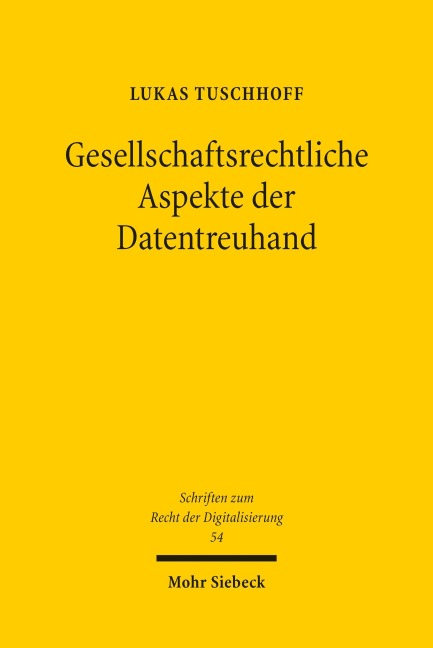
Lukas Tuschhoff examines the design of data trustees at the intersection of data economy law and corporate law. Data trustees are regarded as an institutional response to trust deficits, power asymmetries, and coordination problems in data-driven markets. They are intended to address inefficiencies such as data silos, principal-agent conflicts, network effects, and concentrated market structures. EU data economy law, in particular the Data Governance Act, sets out requirements for data intermediation services but does not prescribe their organizational structure, leaving this to national corporate law. The study starts from the premise that data-related power and conflicts of interest require institutional structures. Data trusteeship is therefore understood as a matter of organizational law. The analysis focuses on how data power can be translated into corporate governance, control, and accountability structures. In addition to the choice of legal form, the design of articles of association and contracts, as well as group law aspects, are central. The author develops a typology of data trustee models-such as intra-company, data altruistic, and arrangements between companies or between companies and consumers-and assigns them differentiated corporate law solutions. Particular attention is given to foundation-based limited liability companies, dual-foundation models, and corporate group structures. The study thus opens up a previously underexplored interface between European data economy law and national corporate law.
Born 1997; studied law at Heidelberg University; First State Examination in 2021; doctoral studies at the University of Marburg; doctorate in 2026; Second State Examination in 2026 (Higher Regional Court of Hamm); attorney in Frankfurt.
Einleitung und Problemaufriss
I. Einführung
II. Problemaufriss
III. Gang der Untersuchung
A. Grundlagen
I. Technisch-ökonomische Grundzüge der Digital- und Datenwirtschaft
II. Daten als Gegenstand des Privatrechts
III. Treuhand nach herkömmlichem Verständnis
IV. Kompatibilität des Treuhandbegriffs mit Daten
V. Datentreuhänder in der Digitalstrategie der Europäischen Kommission
VI. Die Datentreuhand als Lösungsbaustein
VII. Bedeutung der gesellschaftsrechtlichen Gestaltung
VIII. Systematisierung der Modelle
B. Die Datentreuhand für einzelne Unternehmen
I. Grundlagen
II. Rechtliche Anforderungen an die Rechtsform
III. Die Rechtsformen im Einzelnen
C. Die Datentreuhand zwischen Unternehmen
I. Grundlagen
II. Rechtsrahmen für die Rechtsform
III. Die Rechtsformen im Einzelnen
D. Die Datentreuhand für Verbraucher
I. Grundlagen
II. Rechtsrahmen für die Rechtsform
III. Die Rechtsformen im Einzelnen
Fazit
I. Grundlegendes
II. Datentreuhand für einzelne Unternehmen
III. Datentreuhand zwischen Unternehmen
IV. Datentreuhand für Verbraucher