
Stöbern
genialokal zum Startbildschirm hinzufügen
Installieren Sie die genialokal App auf Ihrem Startbildschirm für einen schnellen Zugriff und eine komfortable Nutzung.
Installieren Sie die genialokal App auf Ihrem Startbildschirm für einen schnellen Zugriff und eine komfortable Nutzung.
Tippen Sie einfach auf Teilen:
 Und dann auf "Zum Home-Bildschirm [+]".

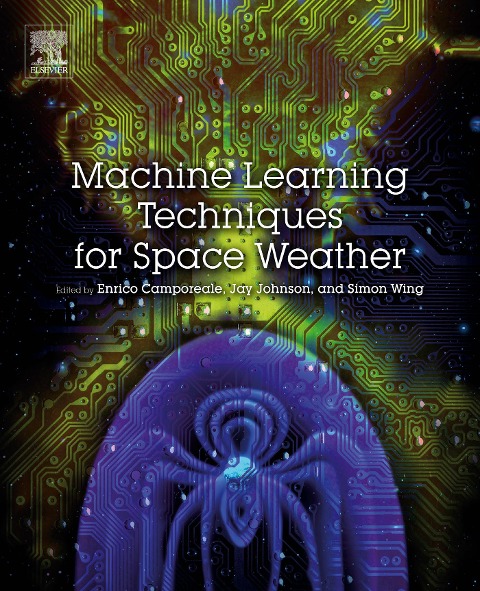
Machine Learning Techniques for Space Weather provides a thorough and accessible presentation of machine learning techniques that can be employed by space weather professionals. Additionally, it presents an overview of real-world applications in space science to the machine learning community, offering a bridge between the fields. As this volume demonstrates, real advances in space weather can be gained using nontraditional approaches that take into account nonlinear and complex dynamics, including information theory, nonlinear auto-regression models, neural networks and clustering algorithms. Offering practical techniques for translating the huge amount of information hidden in data into useful knowledge that allows for better prediction, this book is a unique and important resource for space physicists, space weather professionals and computer scientists in related fields.
- Collects many representative non-traditional approaches to space weather into a single volume
- Covers, in an accessible way, the mathematical background that is not often explained in detail for space scientists
- Includes free software in the form of simple MATLAB® scripts that allow for replication of results in the book, also familiarizing readers with algorithms
Space Weather1. Societal and Economic Importance of Space Weather2. Data Availability and Forecast Products for Space Weather Machine Learning3. Information Theory4. Regression5. Classification Applications6. Geo-effectiveness of Solar Wind Parameter: An Information Theory Approach7. Emergence of Dynamical Complexity in the Earth's Magnetosphere8. Applications of NARMAX in Space Weather9. Many Hours Ahead Prediction of Geomagnetic Storms with Gaussian Processes10. Prediction of Mev Electron Fluxes with Autoregressive Models11. Forecast of Solar Wind Parameters Using Kalman Filter12. Artificial Neural Networks for Determining Magnetospheric Conditions13. Reconstruction of Plasma Electron Density from Satellite Measurements via Artifical Neural Networks14. Classification of Magnetospheric Particle Distributions via NN15. Automated Solar Flare Prediction16. Coronal Holes Detection using Supervised Classification17. CME Classification via k-means Clustering Algorithm