
Stöbern
genialokal zum Startbildschirm hinzufügen
Installieren Sie die genialokal App auf Ihrem Startbildschirm für einen schnellen Zugriff und eine komfortable Nutzung.
Installieren Sie die genialokal App auf Ihrem Startbildschirm für einen schnellen Zugriff und eine komfortable Nutzung.
Tippen Sie einfach auf Teilen:
 Und dann auf "Zum Home-Bildschirm [+]".
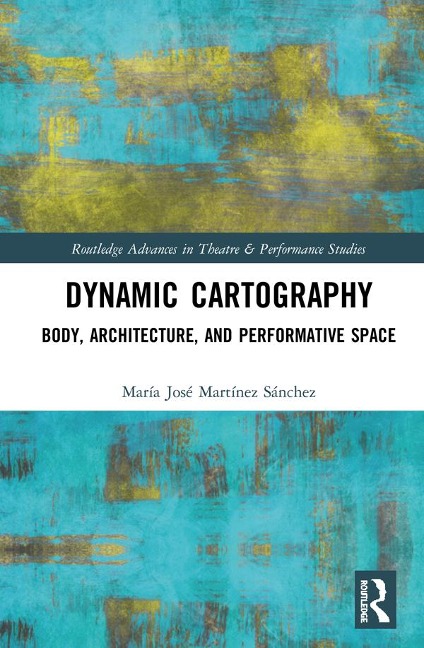
Dynamic Cartography analyses the works of Rudolf Laban, Lawrence Halprin, Anne Bogart, Adolphe Appia, Cedric Price, Joan Littlewood, and Hélio Oiticica. They are practitioners who have worked on different areas of enquiry from the existing relations between body and space through movement, events, or actions but whose work has never been presented from this perspective or in this context. The work and methodologies set up by these practitioners enable us to develop a practice-based exploration. Some of the experiments in the book - Micro-actions I and II - explore the presence of the body in the space. In Kinetography I and II, Laban's dance notation system - kinetography - is used to create these dynamic cartographies. Kinetography III proposes the analysis of an urban public space through the transcription of the body movement contained on it. The series Dynamic Cartographies I, II, and III analyses movement in geometrically controlled spaces through the Viewpoints techniques by Anne Bogart. Finally, Wooosh! and Trellick Tales present two projects in which performance is applied in order to analyse and understand urban and architectural space.
María José Martínez Sánchez is a lecturer the Birmingham School of Architecture and Design (BCU), UK, and a researcher at the Centre for Interdisciplinary Performing Arts at the Royal Birmingham Conservatoire, UK. Her work has been published in international journals and presented at the Dance Biennale of Venice, the Biennale of Architecture in Venice, the Spanish National Theatre (CDN), and the Prague Quadrennial of Scenography.
Contents List of illustrations Acknowledgements Introduction Chapter 1: Body and the surrounding space: scoring body movement Introduction: spatial body rituals The representation of movement Rudolf Laban: Kinetography as a spatial scoring system Scores: the representation of processes Scoring: mapping spatial processes Experiments Kinetography I: movement notation for one body Kinetography II: movement scores on stage Kinetography III: movement scores in complex environments From surrounding space to geometry Chapter 2: Body and Geometry: Contemporary Rituals Introduction: performativity and ritual Body, space, and geometry The Laboratory of Movement Study - L.E.M. (Le Laboratoire d'Estude du Mouvement) Viewpoints: a spatial composition tool Experiments Dynamic Cartography I, II, and III From geometry to the scenic space Chapter 3: Body and Scenic Space: Ritual Spaces Introduction: the origins of space Reflections on space The Work of Living Art: radical proposals for the mise- en- scène of Wagnerian drama The body in the theatrical space: the Greek theatre Atmospheres Experiments Micro-actions in Greece Strings, Old Vinegar Factory (2015, Limassol, Cyprus) From scenic space to architectural programme Chapter 4: Body and Architecture: Spatial Dramaturgies Introduction: the architectural script Once upon a time, a laboratory of fun Event and situation The art of action Performative architecture Breaking the architectural fourth wall Experiments Wooosh! (Winchester, 2016) From programme to landscape Chapter 5: Body and Landscape: Performativity and Social Space Introduction: urban anthropophagy The representation of landscape Corpografias (corpographies) and corpocidade (corpocity) The body as a means of artistic expression Environmental art and Thirdspace ExperimentTrellick Tales: the Thirdspace of Trellick Tower From landscape to the surrounding space Conclusions: towards the creation of a dynamic cartography - an interdisciplinary methodology
Dieses eBook wird im PDF-Format geliefert und ist mit einem Adobe Kopierschutz (DRM) versehen. Sie können dieses eBook mit allen Geräten lesen, die das PDF-Format und den Adobe Kopierschutz (DRM) unterstützen.
Zum Beispiel mit den folgenden Geräten:
• tolino Reader
Laden Sie das eBook direkt über den Reader-Shop auf dem tolino herunter oder übertragen Sie das eBook auf Ihren tolino mit einer kostenlosen Software wie beispielsweise Adobe Digital Editions.
• Sony Reader & andere eBook Reader
Laden Sie das eBook direkt über den Reader-Shop herunter oder übertragen Sie das eBook mit der kostenlosen Software Sony READER FOR PC/Mac oder Adobe Digital Editions auf ein Standard-Lesegeräte mit epub- und Adobe DRM-Unterstützung.
• Tablets & Smartphones
Möchten Sie dieses eBook auf Ihrem Smartphone oder Tablet lesen, finden Sie hier unsere kostenlose Lese-App für iPhone/iPad und Android Smartphone/Tablets.
• PC & Mac
Lesen Sie das eBook direkt nach dem Herunterladen mit einer kostenlosen Lesesoftware, beispielsweise Adobe Digital Editions, Sony READER FOR PC/Mac oder direkt über Ihre eBook-Bibliothek in Ihrem Konto unter „Meine eBooks“ - „online lesen“.
Schalten Sie das eBook mit Ihrer persönlichen Adobe ID auf bis zu sechs Geräten gleichzeitig frei.
Bitte beachten Sie, dass die Kindle-Geräte das Format nicht unterstützen und dieses eBook somit nicht auf Kindle-Geräten lesbar ist.