
Stöbern
genialokal zum Startbildschirm hinzufügen
Installieren Sie die genialokal App auf Ihrem Startbildschirm für einen schnellen Zugriff und eine komfortable Nutzung.
Installieren Sie die genialokal App auf Ihrem Startbildschirm für einen schnellen Zugriff und eine komfortable Nutzung.
Tippen Sie einfach auf Teilen:
 Und dann auf "Zum Home-Bildschirm [+]".
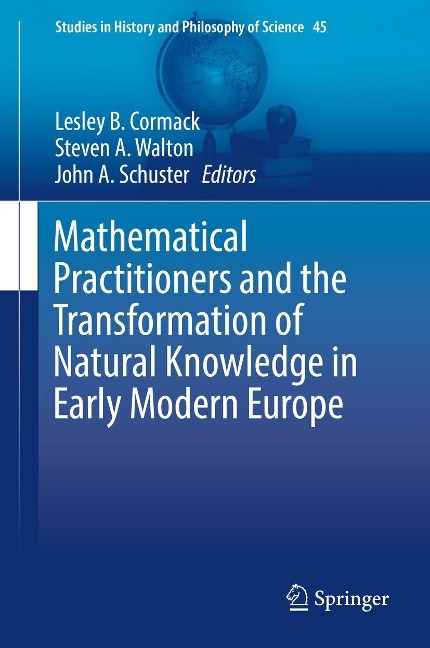
This book argues that we can only understand transformations of nature studies in the Scientific Revolution if we take seriously the interaction between practitioners (those who know by doing) and scholars (those who know by thinking). These are not in opposition, however. Theory and practice are end points on a continuum, with some participants interested only in the practical, others only in the theoretical, and most in the murky intellectual and material world in between. It is this borderland where influence, appropriation, and collaboration have the potential to lead to new methods, new subjects of enquiry, and new social structures of natural philosophy and science. The case for connection between theory and practice can be most persuasively drawn in the area of mathematics, which is the focus of this book. Practical mathematics was a growing field in early modern Europe and these essays are organised into three parts which contribute to the debate about the role ofmathematical practice in the Scientific Revolution. First, they demonstrate the variability of the identity of practical mathematicians, and of the practices involved in their activities in early modern Europe. Second, readers are invited to consider what practical mathematics looked like and that although practical mathematical knowledge was transmitted and circulated in a wide variety of ways, participants were able to recognize them all as practical mathematics. Third, the authors show how differences and nuances in practical mathematics typically depended on the different contexts in which it was practiced: social, cultural, political, and economic particularities matter. Historians of science, especially those interested in the Scientific Revolution period and the history of mathematics will find this book and its ground-breaking approach of particular interest.
Lesley B. Cormack is a historian of science and now Dean of Arts at the University of Alberta. She is the author of Charting an Empire: Geography at the English Universities 1580-1620 (Chicago, 1997), A History of Science in Society: From Philosophy to Utility with Andrew Ede (Broadview Press,2004, 3rd Edition University of Toronto Press, 2017) and editor of Making Contact: Maps, Identity, and Travel (University of Alberta Press, 2003) and A History of Science in Society: A Reader (Broadview Press, 2007). She is now completing a book on the development and use of the Molyneux Globes in sixteenth century England. Steven A. Walton teaches history of science and technology, European history, and military history at Michigan Technological University, where is also actively involved with the graduate program in Industrial Archaeology. His primary scholarly writing is on the intersections between science, technology and the military, particularly in the early modern and antebellum American world. He has just published the travel diaries of Thomas Kelah Wharton, a nineteenth-century architect and artist, an article on U.S. Civil War artillery, and is working on a book on Transitions in Defense, on changed in fortification practice and rationale in sixteenth-century England. He has edited works on Fifty Years of Medieval Technology & Social Change (Ashgate, 2017); Wind & Water in the Middle Ages: Fluid Technologies from Antiquity to the Renaissance (ACMRS, 2006); and Instrumental in War: Science, Research, and Instruments Between Knowledge and the World (Brill, 2005). John A. Schuster is Honorary Research Fellow in the Unit for History and Philosophy of Science and Sydney Centre for the Foundations of Science, University of Sydney; and Honorary Fellow, Campion College, Sydney, the only private liberal arts college in Australia. He previously taught at Princeton, Leeds, Cambridge and the University of New South Wales. He is a Fellow of the Australian Academy of the Humanities. He has published on the historiography of the Scientific Revolution; the nature and dynamics of the field of early modern natural philosophy; Descartes' natural philosophical and mathematical career; the problem of the origin of experimental sciences in the 17th and 18th centuries; and the political and rhetorical roles of scientific method. Recent publications include Descartes-agonistes: Physico-Mathematics, Method and Corpuscular-Mechanism-1618-33 (Springer, 2013) and 'Cartesian Physics' in The Oxford Handbook of the History of Physics (2013): 56-95
Introduction: Practical Mathematics, Practical Mathematicians, and the Case for Transforming the Study of Nature.- Part 1: Framing The Argument: Theories Of Connection.- Handwork and Brainwork: Beyond the Zilsel Thesis (Lesley B. Cormack).- Consuming and Appropriating Practical Mathematics and the Mixed Mathematical Fields, Or Being "Influenced" by Them: The Case of the Young Descartes (John Schuster).- Part 2: What Did Practical Mathematics Look Like?.- Mathematics for Sale: Mathematical Practitioners, Instrument-makers, and Communities of Scholars in Sixteenth-Century London (Lesley B. Cormack).- Technologies of Pow(d)er: Military Mathematical Practitioners' Strategies and Self-Presentation (Steven A. Walton).- Machines as Mathematical Instruments (Alex G. Keller).- Part 3: What was the Relationship Between Practical Mathematics and Natural Philosophy?.- The Making of Practical Optics: Mathematical Practitioners' Appropriation of Optical Knowledge Between Theory and Practice (Sven Dupré).- Hero of Alexandria and Renaissance Mechanics (Roy Laird).- Duytsche Mathematique and the Building of a New Society: Pursuits of Mathematics in the Seventeenth-Century Dutch Republic (Fokko Jan Dijksterhuis).