
Stöbern
genialokal zum Startbildschirm hinzufügen
Installieren Sie die genialokal App auf Ihrem Startbildschirm für einen schnellen Zugriff und eine komfortable Nutzung.
Installieren Sie die genialokal App auf Ihrem Startbildschirm für einen schnellen Zugriff und eine komfortable Nutzung.
Tippen Sie einfach auf Teilen:
 Und dann auf "Zum Home-Bildschirm [+]".

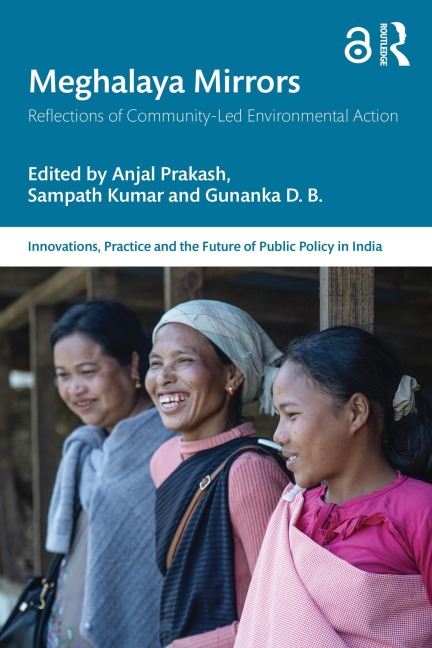
Meghalaya Mirrors offers an insightful exploration of innovative, community-led initiatives that are shaping environmental conservation, biodiversity preservation, and socio-economic development in Meghalaya, India. Between the state's rich natural heritage and pressing environmental challenges such as deforestation, mining, and climate change, this book emphasizes the vital role of communities in protecting their resources and promoting sustainable development. Through case studies, grassroots perspectives, and examples of indigenous knowledge systems, the book showcases the resilience and creativity of local communities. Part of the Innovations, Practice and the Future of Public Policy in India series, this open access volume will be an essential resource for policymakers, researchers, development practitioners, and stakeholders committed to understanding and advancing community-driven environmental action in ecologically sensitive regions. It will also be of interest to researchers working on climate change, climate action, social sciences, environmental science, geography and South Asia studies.
Anjal Prakash is Professor - Public Policy at Flame University, Pune, India. Earlier he was the Clinical Associate Professor (Research) and Research Director at the Bharti Institute of Public Policy, ISB. With over 25 years of experience in water, climate, and policy research across South Asia, he has served as Coordinating Lead Author for the IPCC's Special Report on Oceans and Cryosphere and contributed to the IPCC AR6. He specialises in urban resilience, gender, and social inclusion, and has authored numerous publications, including a number of edited books. Sampath Kumar, IAS, serves as Development Commissioner and Principal Secretary, Government of Meghalaya. With 26 years of public administration experience, he pioneered the State Capability Enhancement Project (SCEP), promoting adaptive governance, convergence, and data-driven decisionmaking. Under his leadership, Meghalaya achieved a significant reduction in acute malnutrition and institutionalised its Early Childhood Development Mission. A Harvard Kennedy School alumnus, he continues to champion systemic governance reforms rooted in community participation and iterative learning. Gunanka D. B., an Indian Forest Service officer, is the Additional Secretary to the Government of Meghalaya. With over 16 years spanning corporate IT and public administration, he works across institutional reform, natural resource management, and data-driven governance. He has led major externally aided projects financed by the World Bank, JICA, KfW, and ADB, strengthened geospatial systems, and advanced community-led conservation models. His work blends systems thinking with grounded implementation, contributing to applied research and policy innovation in ecologically sensitive regions. Currently, he is on study leave to pursue an MPA-DP at SIPA, Columbia University, through the Fulbright-Nehru Scholarship and Columbia Dean's Distinguished Scholarship.
List of Figures xii List of Tables xiv List of Contributors xvi Preface xxv Acknowledgements xxvii List of Abbreviations xxx1 Editorial: Meghalaya Mirrors - A Blueprint for Community-Led Environmental Resilience 1 Anjal Prakash, Sampath Kumar, and Gunanka D. B. PART ICommunity Engagement: Empowering Local Institutions for Environmental Change 19 2 Ecological Transitions and Environmental Change in the North-Eastern Hills 21 B. Padmapriya 3 Building a Cadre of Community Professionals 41 Dokatchi K. Marak and Nangteibor Shabong 4 Community Nurseries for Forest Restoration 59 Bratati Purkayastha and Van Shanborlang Buhphang 5 Community Seed Saving for Food Security 82 Junie P. Lyngdoh, Reccica D. Lyngkhoi, M Wanlambok Sanglyne, and Thomas Iangjuh 6 Preserving Cultural and Natural Heritage: Towards a Sustainable Future: Jingkieng Jri/Lyu Chrai Cultural Landscape, an Exemplar of Community-Led Conservation and Heritage Stewardship 98 Tilaris Marwein, Goldenstar Thongni, and Catherine Derica Kyndiah 7 Supporting Grassroot Innovations 112 Veveane Sayo, Delanmi Massar, and Gordon Steven Pde PART II Innovative Solutions: Harnessing Technology for Climate Resilience 131 8 Sloping Agriculture Land Technology 133 John Kearney Wanniang 9 Neutralisation of Acid Mine Drainage Contaminated Water 147 Effie Gwyneth L. Kharjana, Wansah Pyrbot, Justin Pathaw, Raynold Marwein, Bandarihun Kharlor, Fidellia Sun and Cheryl Bernice Pohrmen 10 Community Led Hydrological Spring Mapping and Springshed Management in Meghalaya 161 Gaurav Singh and Jillianda Kharjana 11 Seed Ball Initiatives for Biodiversity Conservation 180 Subhash Ashutosh, Tremie M. Sangma, and Rikmenlang Khongsng 12 Integrating Technology for Natural Resource Management 191 Raymond Wahlang and Fettleman Dohling PART III Green Financing: Innovations in Funding Climate Action 213 13 Conservation of Forests and Payment for Ecosystem Services 215 James T. Kharkongor and Lavinia Mary Dkhar 14 Forest Management Plan for Sustainable Forestry 230 Lavinia Mary Dkhar, Jyswill Lyngdoh Nongpiur, Rajaul Karim and H. Liansuanmung 15 Reclamation of Mining-Affected Land Using Aromatic Grass 253 Hygina Siangbood, Paka I Yo Suja, Baniaraplang Syiemiong, Rikermeka Kharsahnoh, Diadema Nongrum, Markshield Warjri, Mourdome B Marak and Rishotskhem Kharkongor 16 Agroforestry-Carbon Project in Meghalaya 268 Lavinia Mary Dkhar 17 Leveraging Bamboo Resource 277 Nangteibor Shabong and Lavinia Mary Dkhar PART IV Governance and Policy 289 18 The Policy and Governance Impact of the MBDA: A Case Study 291 Wankit K. Swer 19 Bridging Skill Gaps in Meghalaya through the Apprenticeship Training Programme 304 T. Niang Suan Ching and Sucielia Mylliemngap 20 Conclusion: Policy Convergence and the Blueprint for Regenerative Governance in Meghalaya 328 Anjal Prakash, Sampath Kumar, and Gunanka D. B. Index 339 -